


Governing, a nearly 40-year-old publication focused on informing state and local policymakers, published an article blaming climate change for causing more extreme heat and detailing ways for city governments to combat heat. [some emphasis, links added]
The recommendations for mitigating people’s heat exposure and limiting harm are pretty good, but its unjustified foray into false climate attribution distracts from the valuable portion of the story.
Climate change is not causing more days of extreme heat, but expanded urban development and the associated urban heat island (UHI) effect are raising nighttime temperatures, and in some instances, causing problems for the elderly, the homeless, and vulnerable populations with preexisting health conditions.
In the Governing article, “A Toolkit for Surviving Extreme Heat,” author Carl Smith writes, “[d]angerous heat is coming to more parts of the country than ever.”
“Extreme heat … kills more Americans than any other weather event — more than floods, hurricanes, and tornadoes combined,” Smith continues. “Very hot days are a fact of life in states all over the country, but there have been more and more of them in recent years.”
Almost every sentence Smith wrote in his opening paragraphs is wrong.
Real-world data recorded by various U.S. government agencies show that extreme heat has not become more frequent or intense in recent years (See graph below). As Climate at a Glance: U.S. Heatwaves points out:
- Data indicate heatwaves have been much less frequent and severe than in the 1930s.
- The all-time high temperature records set in most states occurred in the first half of the twentieth century.
- The most accurate nationwide temperature station network, implemented in 2005, shows no sustained increase in daily high temperatures in the United States since at least 2005.
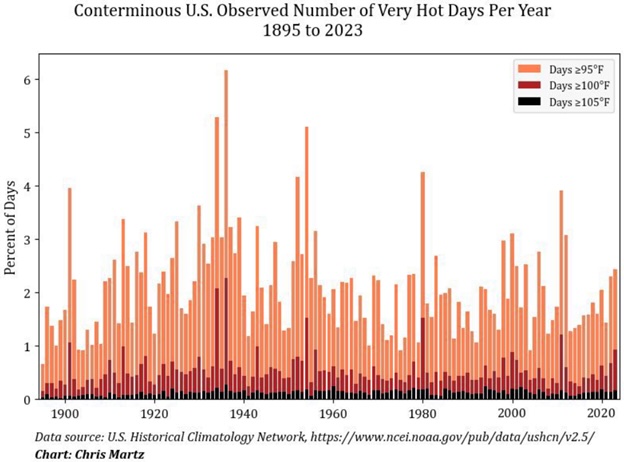
U.S. average temperatures have increased slightly, driven by higher nighttime average temperatures stemming from the UHI effect in growing cities and suburbs. The number of extremely hot days is not increasing, nor are temperatures on extremely hot days rising.
Smith’s assertion that “[e]xtreme heat … kills more Americans than any other weather event — more than floods, hurricanes, and tornadoes combined,” is partially right, but essentially wrong.
While high temperatures do account for more premature deaths each year than floods, hurricanes, and tornadoes combined, heat deaths remain far lower than the number of lives lost in the United States and around the world each year to extreme cold.
Research proves that cold weather kills more people each year – 10 to 17 times more, depending on the study – than hot temperatures (see chart below).
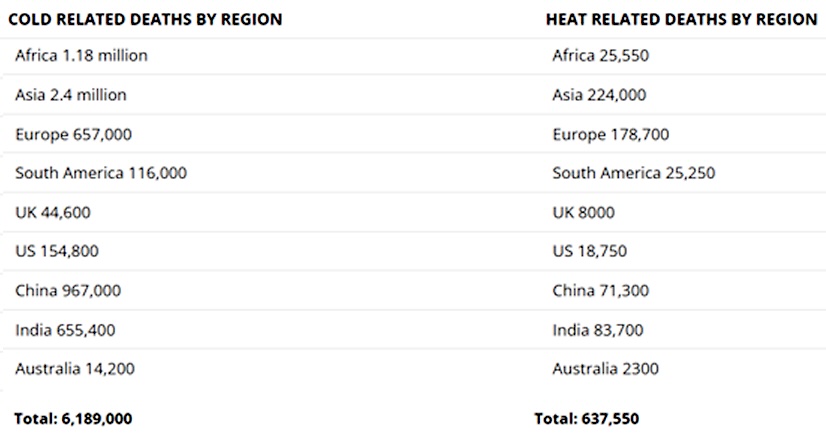
In short, since temperatures are not becoming more extreme, climate change can’t be blamed for “[d]angerous heat … coming to more parts of the country than ever.”
Despite the fundamental failings of attributing extreme heat and heat-related deaths to climate change, the article does have some redeeming virtues: primarily the recommendations it offers based on the advice of the Federation of American Scientists (FAS).
The FAS recommends, for example, requiring air conditioning on school buses and requiring cooling actions if indoor temperature thresholds are crossed, requiring childcare facilities, and I would add nursing homes and rehabilitation facilities, with indoor-temperature standards and working air conditioning licensed.
The FAS also recommends cities operate cooling centers, perform wellness checks, and ensure critical infrastructure such as water, energy, and transportation facilities are operational during extreme heat events.
Opening suitable public facilities during periods of extreme heat to hydrate the homeless, the elderly, the destitute, and those with particular sensitivities to heat stress due to preexisting medical conditions can mitigate some of the harm to people exposed to extreme heat daily.

Some cities are working to find more housing for the homeless, which, if the new housing facilities are air-conditioned, would go a long way to reducing heat-related deaths.
The point is that extreme heat is and always has been a fact of life, and does and always will cause premature deaths; climate change hasn’t altered that fact at all.
But ways exist now to minimize daily exposure to extreme heat and mitigate it, with air conditioning and the public availability of hydration being the most prominent.
The latter is the message that Governing should have limited itself to. Had it done so, readers would not have had to wade through a false climate narrative before reaching the story’s “recommendations” part, making the latter more credible and the story more likely to be read in its entirety by busy people.
Read more at Climate Realism







You keep repeating this lie about heart attacks which many other commenters have explained. Either you have never seen them or you ignore the posts. Or you don’t understand what they have said. But we are used to your posts that are full of lies.
Your knowledge of physiology is apparently as good as your knowledge of UHI and so much more related to weather and climate.