
The Boston Globe claims in “Climate change fueled the extreme heat in Europe. New England is next” (subsequently retitled, “What two continents’ heat waves tell us about the climate crisis”) that today’s heat waves bear the unmistakable fingerprints of human-caused climate change and that New England should expect more of the same. [some emphasis, links added]
This is false.
The historical record shows that severe and deadly heat waves have always occurred long before modern greenhouse gas emissions became a political issue, and the Globe ignores both that history and the significant biases that make today’s heat waves appear more unprecedented than they really are.
The Globe leans heavily on an analysis from the World Weather Attribution group claiming Europe’s recent heat wave would have been “virtually impossible” without climate change, quoting one scientist saying, “At this point, your default assumption has to be that there was some influence.”
That statement says more about modern climate attribution than it does about the weather.
World Weather Attribution begins with climate models that assume carbon dioxide emissions are causing warming and then estimates how much warming human CO2 emissions have contributed to a particular event.
Those studies are not direct observations. They are model-based exercises built on assumptions about how the atmosphere would have behaved in an alternate world without increased greenhouse gases.
Climate Realism has debunked individual attribution “studies” and the methodology used to produce them multiple times previously. Models don’t provide data, and attribution studies are case studies in Garbage In, Garbage Out, or GIGO, a phrase developed by computer scientists to describe data manipulation through biased inputs.
The Globe never asks the more fundamental question: Have severe heat waves occurred throughout history? The answer is loudly yes. See the table below.
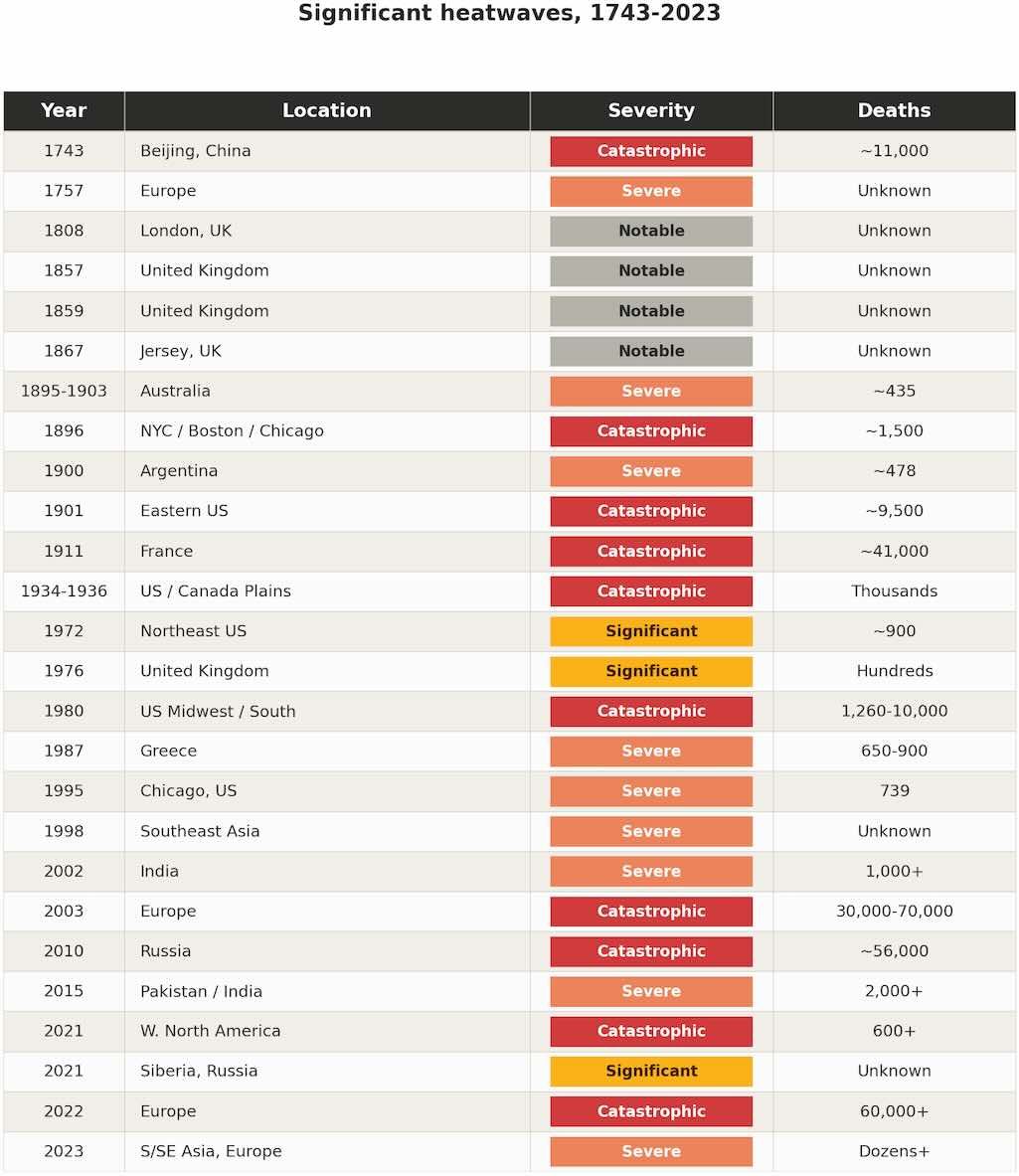
The historical summary table of significant heat waves dating back to 1743 makes one thing abundantly clear: current heat waves are not unprecedented. They aren’t record-setting in any meaningful way; rather, they are part of a long history of naturally occurring extreme weather that spans nearly three centuries.
Long before climate change became the explanation for every weather event, catastrophic heat waves repeatedly struck Europe, North America, Asia, and Australia.
The historical record includes the devastating Beijing heat wave of 1743, severe European heat waves in the eighteenth century like the one in 1857, London’s notorious heat wave of 1808, the catastrophic eastern U.S. heat wave of 1901 that killed an estimated 9,500 people, France’s deadly 1911 heat wave that claimed roughly 41,000 lives, the Dust Bowl heat wave of the 1936, and the devastating U.S. heat wave of 1980.
Each of these events occurred when the Earth’s global average temperature and carbon dioxide levels were lower.
Climate at a Glance reaches the same conclusion. Its review of U.S. heat waves shows that the United States experienced more frequent and intense heat waves during the 1930s than in recent decades. That conclusion is based on National Oceanic and Atmospheric Administration observations, not computer model projections.
The Globe also suffers from what might be called historical reporting bias.
Today, heat waves dominate news coverage because every event is instantly reported by thousands of newspapers, television stations, websites, blogs, and podcasts, as well as millions of social media users. Search engines permanently catalog every article, photograph, and video.
None of that existed a century ago, hence the bias favoring the present.
When a major heat wave struck in 1901 or 1911, coverage was limited to local newspapers, wire services, and government reports. Many events outside major cities received little documentation. Plus, countless historical heat waves simply never made the jump from paper into the modern digital record.

Comparing today’s flood of Internet coverage with sparse newspaper archives from a century ago inevitably creates the false impression that heat waves are becoming more common when, in reality, modern reporting has become dramatically more comprehensive.
The Globe correctly notes that Europe experiences more heat-related deaths than the United States. But the article largely glosses over the most important reason: lack of air conditioning. In fact, much of Europe works to suppress the use of air conditioning.
The Globe acknowledges that nearly 90 percent of Massachusetts homes have air conditioning, while only about 20 percent of European homes do. That single fact explains far more about the difference in mortality than discussions of greenhouse gases.
According to the Harvard School of Engineering and Applied Sciences, air conditioning is one of the most significant public health interventions in history, averting hundreds of thousands of premature heat-related deaths annually.
By dramatically reducing vulnerability to extreme heat, residential cooling has become a critical lifeline, especially for the elderly and vulnerable populations worldwide. There is another factor the Globe never mentions: the Urban Heat Island effect (UHI).
Climate at a Glance documents that cities routinely record significantly higher nighttime temperatures than surrounding rural areas because asphalt, concrete, brick, and buildings absorb solar energy during the day and slowly release it overnight.
These elevated city nighttime temperatures are especially dangerous because they prevent people from cooling off while they sleep, creating heat exhaustion or even worse, heat stroke.
That is exactly where most heat-related mortality occurs.
UHI also makes temperature records in major cities more common, not because ambient temperatures are hotter, but because the UHI increases temperatures when compared to the surrounding countryside. This also biases urban and regional climate trends.
Ironically, many of the cities highlighted in heat-wave reporting, including Boston, Paris, London, and New York, are among the most urbanized environments in their respective regions.
Boston itself has quite a heat-wave record. Boston’s all-time heat record is still from 1911.
The city reached 104°F on July 4, 1911, and that record has stood for 115 years. If man-made greenhouse gas warming were producing ever-more-extreme heat, one would expect the record to have fallen by now. It hasn’t.
Because Boston has nearly 150 years of instrumental temperature data, we don’t need climate models to know whether heat waves are unprecedented there. See the table for Boston heatwaves below.
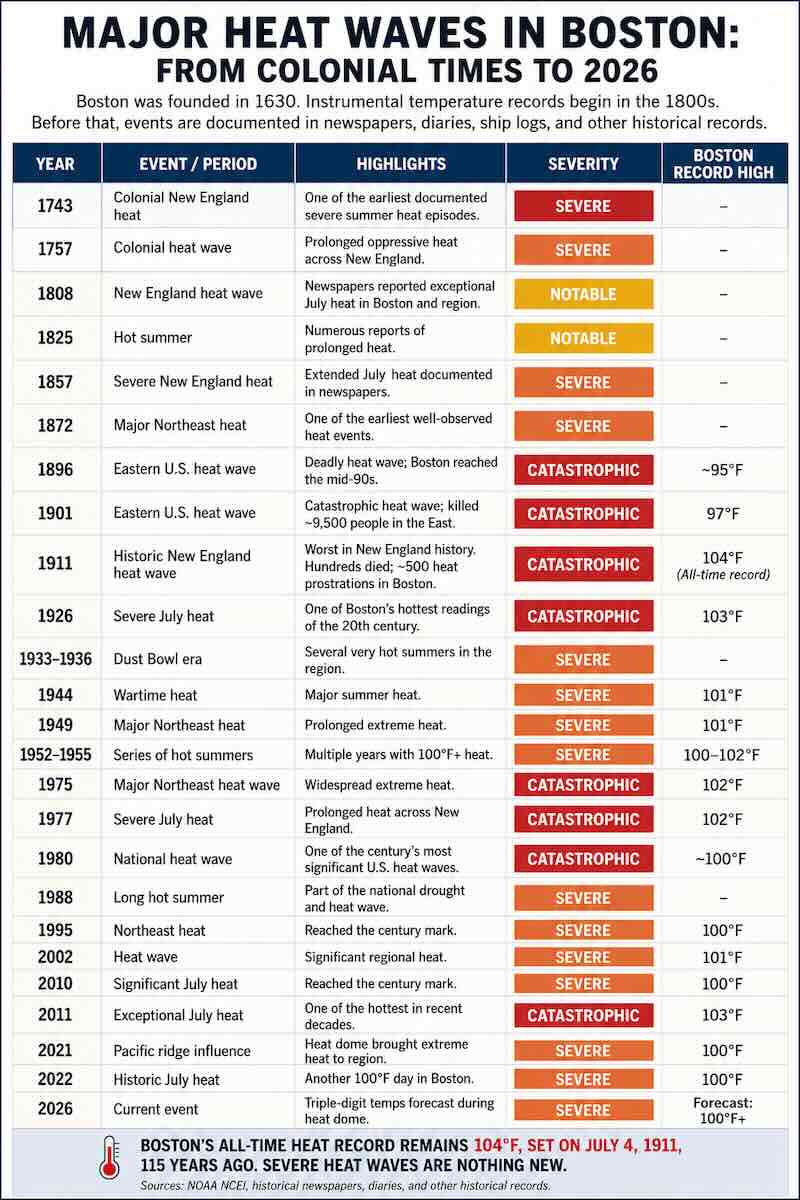
The city’s historical record shows heat waves in Boston are not unprecedented. Funny how the Globe missed reporting on that.
The Globe further suggests that this week’s New England heat wave shares the same atmospheric pattern as Europe’s because both involve persistent high-pressure systems. That’s called weather; climate is tracked over 30 years.
Heat domes, blocking highs, and persistent ridges have produced dangerous summer heat for centuries. They existed before industrialization, before SUVs, and before climate attribution studies. Their occurrence does not, by itself, demonstrate human influence.
Weather events happen because of atmospheric circulation. Climate trends emerge over many decades, yet there is no multidecadal trend of worsening or more frequent heat domes – just more alarming and frequent reporting on them.
The Globe closes by suggesting heat is now “front and center in ways that it hasn’t been before.” That is true, but it says more about today’s media and technology than today’s weather.
Never before have we had thousands of news outlets, smartphones, live weather apps, satellite imagery, social media feeds, and twenty-four-hour cable news turning every heat wave into a global event. The weather has not suddenly become more newsworthy. The media has become far more capable of amplifying it.
The Boston Globe is derelict in its duty to responsible reporting by not placing the present heat wave in a historical and meteorological context. Scary headlines about “unprecedented, climate change-driven,” heatwaves may sell papers and make for good clickbait online, but it represents false and shoddy journalism.
Read more at Climate Realism