

The contiguous United States (CONUS) has the most reliable and comprehensive long-term daily maximum and minimum temperature records, with over 1,200 stations recording these data since the late 19th century. [some emphasis, links added]
It is often reported that extremes in hot and cold temperatures – and especially heatwaves – have been increasing in both frequency and intensity in the last few decades as a consequence of rising greenhouse gas concentrations.
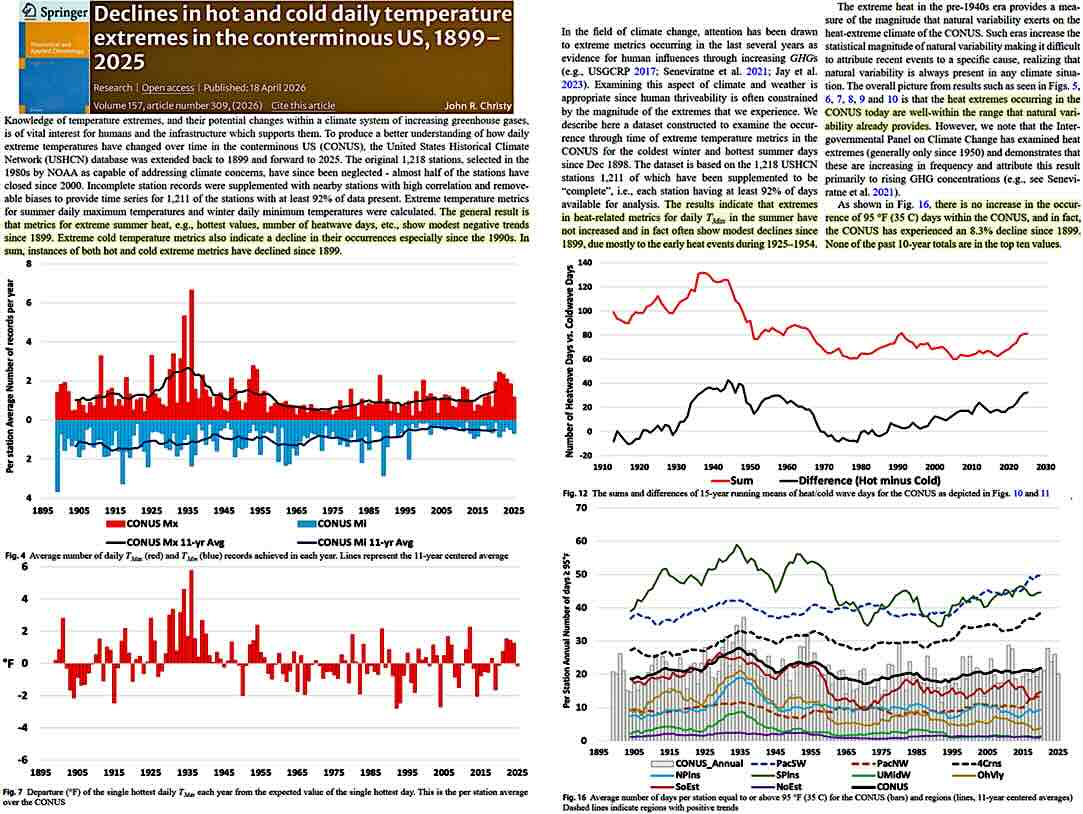
“The results indicate that extremes in heat-related metrics for daily T [Max] in the summer have not increased and in fact often show modest declines since 1899, due mostly to the early heat events during 1925-1954.” – Christy, 2026
However, reliable data from temperature stations across the CONUS indicate extreme heat, extreme cold, and heatwave duration and intensity have been declining since 1899, mostly due to the much higher extremes recorded during the 1925-1954 period.
Conveniently, most alarmist claims about accelerating maximum and minimum temperature extremes start their analysis in the 1950s or later.
In recent decades, CONUS’s extreme heat (and cold) records fall well within the range of natural variability.
“The metrics for extreme summer heat, e.g., hottest values, number of heatwave days, etc., show modest negative trends since 1899. Extreme cold temperature metrics also indicate a decline in their occurrences, especially since the 1990s. In sum, instances of both hot and cold extreme metrics have declined since 1899.” …
“[T]he heat extremes occurring in the CONUS today are well within the range that natural variability already provides.” …
“[T]here is no increase in the occurrence of 95°F (35°C) days within the CONUS, and in fact, the CONUS has experienced an 8.3% decline since 1899. None of the past 10-year totals [2015-2025] are in the top ten values.”
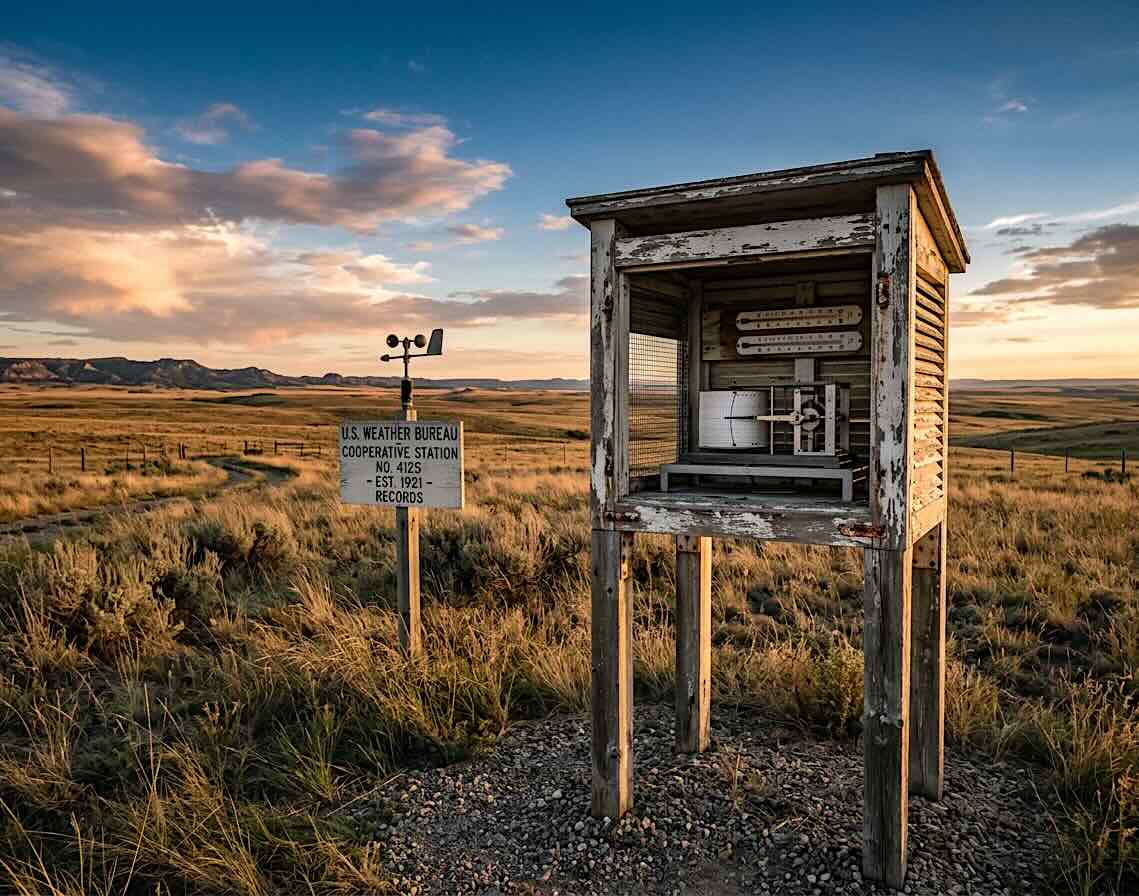
Top image: Cross-section of a weathered Stevenson Screen measuring station. Generated by AI.
Read more at No Tricks Zone





During the mid‑1930s, especially in the summer of 1936,
17 of the 48 contiguous U.S. states experienced
heat waves that tied or broke all‑time state heat records
… but the US 48 states are only 1.6% of earth’s surface
heat waves in a minority of states for a few years
are just weather — climate requires
a 30 to 50 year trend of weather
In the contiguous United States,
the 1930s remains the decade
with the highest average daily
maximum temperatures (Tmax).
While recent decades (such as 2011–2020)
have been the warmest on record
for average temperatures (which includes
both daytime highs and nighttime lows),
this overall warming is driven largely
by a rapid increase in nighttime
minimum temperatures (Tmin).
one variable of climate is average temperature
CO2 emissions mainly affect minimum temperatures
and that’s why minimum temperatures
have been rising for the past 50 years
average temperature:
2010–2019 – Warmest decade on record, with multiple U.S. states breaking all-time annual temperature records
2000–2009 – Second warmest, with persistent heat waves and record-breaking summer months.
1990–1999 – Third warmest, including the 1998–2002 El Niño–Southern Oscillation (ENSO) period.
1980–1989 – Fourth warmest, with strong La Niña–El Niño transitions.
1970–1979 – Fifth warmest, marked by the 1976–1977 La Niña and 1979–1983 El Niño.
1960–1969 – Sixth warmest, with notable heat in the 1960s.
1950–1959 – Seventh warmest, including the 1957–1958 La Niña.
1940–1949 – Eighth warmest, with several states setting new annual highs.
1930–1939 – Ninth warmest, including the Dust Bowl heat extremes.
1920–1929 – Tenth warmest, with multiple record-breaking years.
Richard, I congratulate you on admitting your data is heavily dependent on night time temperatures. Many who write about this topic would try to hide that. However, using night time temperatures is cherry picking the data because it better supports the warming narrative. This issue is about warming, remember the term global warming. What counts are the highest temperatures, not the highest of the lowest that night time temperatures gives us.