

The CO2-induced “polar amplification” narrative peddled by climate alarmists has just taken another hit. [some emphasis, links added]
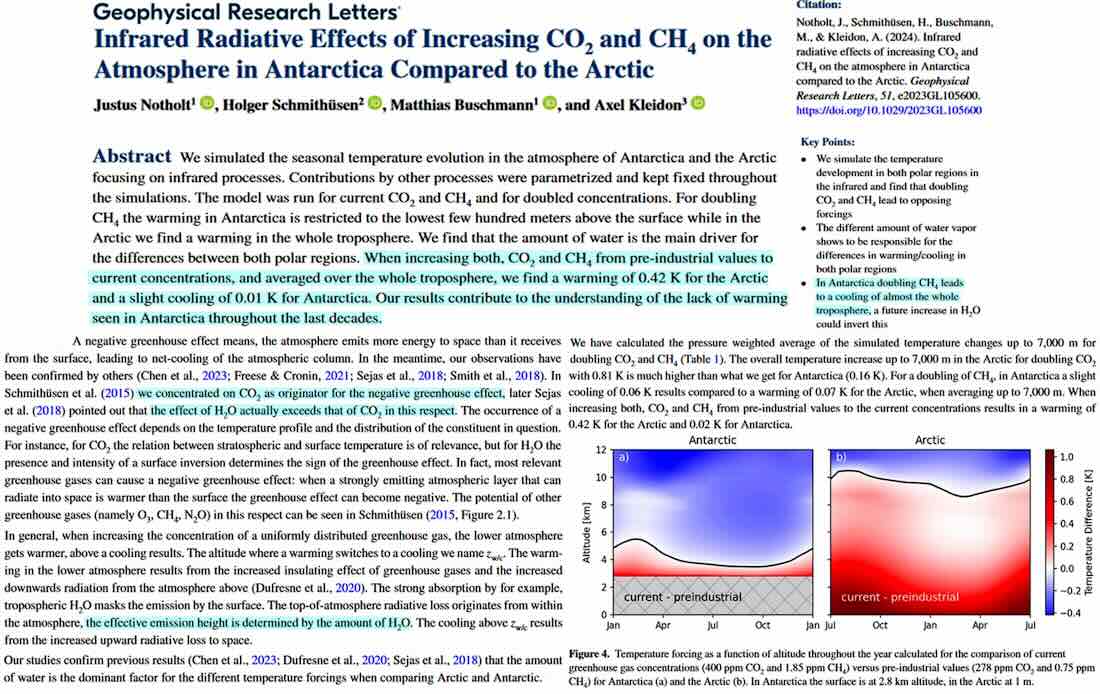
It has been shown previously that increasing CO2 by more than 120 ppm (from 278 to 400 ppm) cools the Antarctic climate (Notholt et al., 2024).
These scientists found that there has been a slight (-0.01°C) net cooling effect of CO2 in Antarctica since 1750.
Now, a new study suggests Arctic CO2 cooling may occur as increasing concentrations of greenhouse gases CO2 and CH4 radiatively cool the Arctic, too.
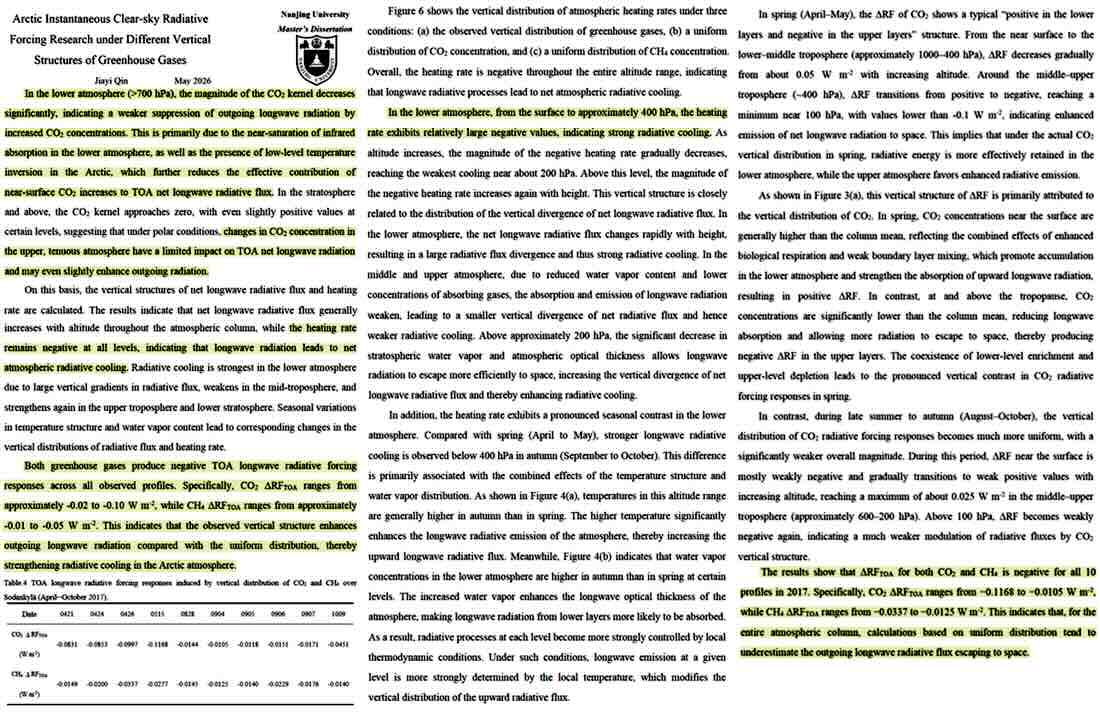
Rising concentrations of greenhouse gases – presumed to be derived from anthropogenic emissions – induce Arctic cooling “primarily due to the near-saturation of infrared absorption [CO2 and CH4] in the lower atmosphere”.
“In the lower atmosphere (>700 hPa), the magnitude of the CO2 kernel decreases significantly, indicating a weaker suppression of outgoing longwave radiation by increased CO2 concentrations. …
“In the lower atmosphere, from the surface to approximately 400 hPa, the heating rate [derived from increasing CO2] exhibits relatively large negative values, indicating strong radiative cooling. …
“…the heating rate remains negative at all levels, indicating the longwave radiation leads to net atmospheric radiative cooling. …
“…the observed vertical structure enhances outgoing longwave radiation compared with the uniform distribution, thereby strengthening radiative cooling in the Arctic atmosphere.”
If increasing CO2 leads to radiative cooling in the Antarctic and Arctic, then CO2 cannot be a driver of polar ice sheet, glacier, or sea ice melt.
Read more at No Tricks Zone








CO2 has only three IR absorption bands, equivalent to blackbody radiation of objects at -80, 400, and 800 deg C. The only one applicable on Earth is the first, at -80 deg C. As everything on Earth is warmer than this, IR from CO2 cannot be absorbed by anything, as those energy levels are already full.
However, it also means that CO2 is constantly radiating -80 deg C IR, which is lost to space as nothing in the atmosphere can absorb it. This is one reason that physicists have been unable to have CO2 warm anything, but have found that it spends all of its time trying to cool the atmosphere.
In fact, CO2 is now considered the world’s best refrigerant as it is abundant, nontoxic, nonflammable, noncorrosive, stable, cheap, and easy to handle. It has been a secondary refrigerant for years in ice rinks, but is now being used as the primary coolant in new ice rinks and in Mercedes car A/C units.
And, there is no downside to CO2 as it is also plant food and greening the planet.
“where there is a temperature region”
should have said
“where there is a temperature inversion”
“If increasing CO2 leads to radiative cooling in the Antarctic and Arctic, then CO2 cannot be a driver of polar ice sheet, glacier, or sea ice melt.”
When there is a temperature region there is a negative greenhouse effect causing cooling at the surface rather than warming, This happens over most of antarctica and that’s why there has been almost no warming there in the past 50 years, There has been some melting of ice shelves and the peninsula due to heat from nearby oceans
While articles on polar warming frequently omit it, the negative greenhouse effect is a real atmospheric paradox unique to the Antarctic Plateau. It occurs due to a massive temperature inversion combined with an extreme lack of water vapor.
The negative greenhouse effect rarely affects the Arctic, as it is a localized phenomenon primarily occurring over the Antarctic Plateau. However, under highly specific, temporary conditions, a marginal negative greenhouse effect can manifest in the Arctic
The article does not mention the negative greenhouse effect which has nothing to do with polar amplification. Polar amplification is primarily driven by surface albedo feedbacks (melting ice exposing darker land/ocean that absorbs more sunlight) and poleward heat/moisture transport from the tropics.
There never was a greenhouse effect and there are no greenhouse gases. This is junk science based on a failed conjecture by Arrhenius in 1896. It has been disproven many times since.
And there is no “localized phenomenon.” CO2 always does the same thing no matter where it is.