

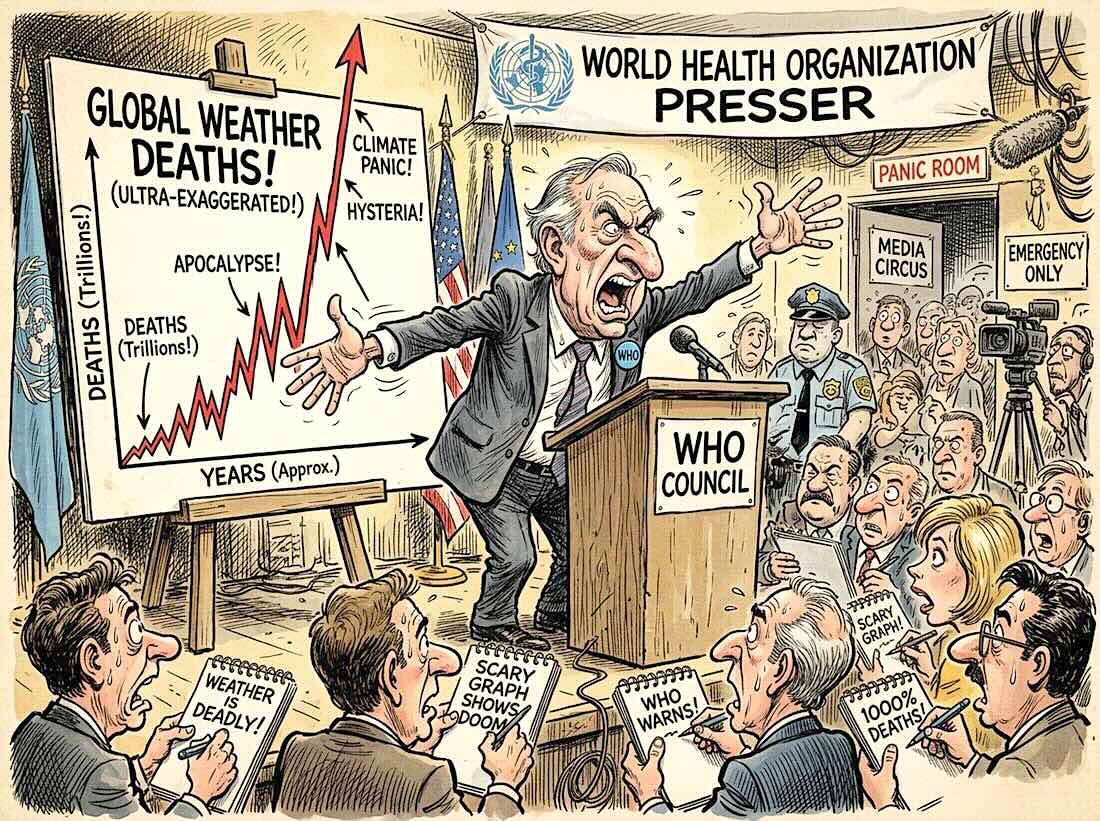
Having emerged from the COVID era with its credibility under increasing scrutiny, the World Health Organization (WHO) is now attempting to redefine climate change as a public health emergency. [some emphasis, links added]
The latest push comes from a special commission urging that climate change in Europe be treated as an international health crisis requiring urgent action.
The language is familiar. We are warned of catastrophic risks, escalating emergencies, and growing threats to human well-being.
The objective is clear: to create a sense of urgency that justifies greater political intervention and international coordination.
Yet when we step back and examine the evidence, a very different picture emerges.
The most important graph in the entire climate debate is one rarely shown by governments, environmental activists, or the media.
Data from the EM-DAT international disaster database show that deaths from extreme weather have collapsed over the last century.
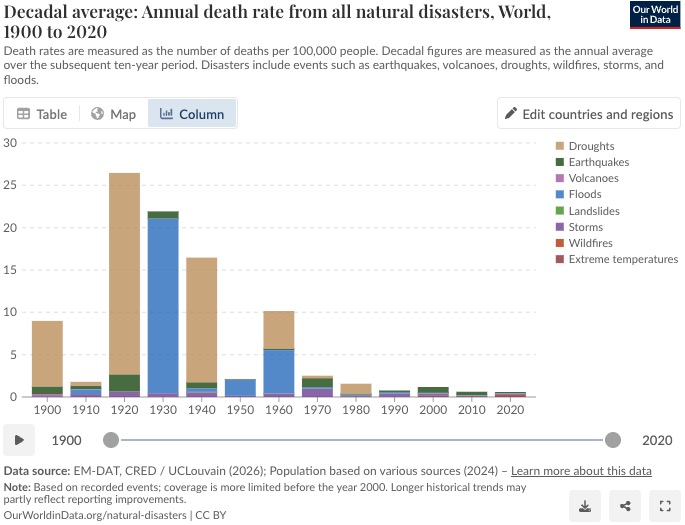
Although the global population has grown from roughly two billion to more than eight billion people, annual weather-related deaths have fallen by well over 95%. On a per-capita basis, the decline exceeds 99%.
This extraordinary achievement did not occur because hurricanes disappeared or because droughts ceased to exist. It occurred because human societies became wealthier and more resilient.
Better infrastructure, irrigation systems, weather forecasting, air conditioning, and advances in emergency response dramatically reduced vulnerability.
In other words, adaptation works.
Yet this obvious success story is largely absent from WHO climate messaging. Instead, the focus has shifted almost entirely toward heat-related mortality.
The WHO cites studies suggesting that rising temperatures are causing increasing numbers of deaths across Europe. At first glance, such claims appear persuasive. Many of the papers are published in prestigious journals and carry the names of dozens of academic contributors.
But a closer examination reveals a serious problem.
As Danish economist Bjørn Lomborg has repeatedly pointed out, many of these analyses fail to [account for Europe’s rapidly aging population properly]. Older people are naturally more vulnerable to heat stress.
If the proportion of elderly people rises, heat-related mortality can increase even if temperature patterns remain largely unchanged.
This is not a minor statistical oversight. It fundamentally changes the interpretation of the data.
If a population grows older, one would expect more heat-related deaths even without any climate influence at all.
What is even more remarkable is what is often omitted from these discussions.
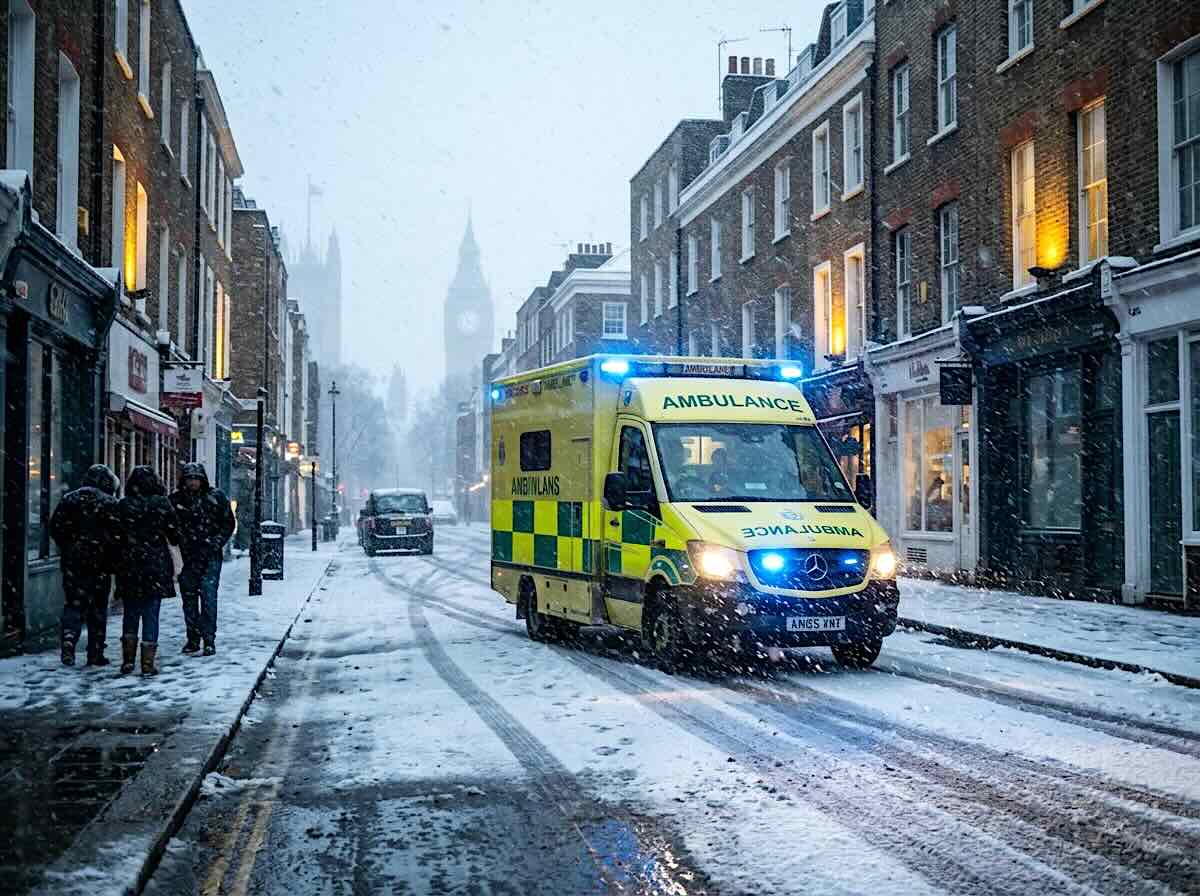
Far more people die from cold than from heat.
A major study published in The Lancet Planetary Health estimated that approximately 5.1 million deaths worldwide each year are associated with non-optimal temperatures, accounting for about 9.4% of global mortality.
Importantly, the study found that cold-related deaths outnumbered heat-related deaths by roughly nine to one.
Yet the overwhelming majority are linked to cold exposure rather than heat.
The ratio varies by region, but globally, cold-related mortality exceeds heat-related mortality by a wide margin.
This fact rarely appears in climate headlines.
The reason is obvious. It complicates a simple political narrative.
If warming reduces cold-related mortality while increasing heat-related mortality, then the question becomes far more nuanced than activists would like to admit.
The issue is no longer a straightforward tale of climate catastrophe. It becomes a question of balancing costs and benefits, adaptation, technological progress, and human resilience.
That discussion does not generate the same sense of panic.
Nor does it support demands for sweeping political control.
The growing tendency to frame climate change as a health emergency is therefore worth examining more carefully.
Public health has become one of the most powerful political tools available to governments and international organizations. During a health emergency, extraordinary measures that would otherwise be politically unacceptable can be justified.
Once climate change is redefined as a health crisis, the scope for intervention expands dramatically.
Energy policy, transportation, agriculture, urban planning, housing, and even personal lifestyle choices can all be brought under the umbrella of public health management.
This transformation is already underway.
Read rest at American Thinker



This article shows one good reason for President Trump pulling the US out of the World Health Organization.
both unusual heat and unusual cold kill a very small percentage of people
the claim that cold kills far more people than the heat is a deception
the deception is how one categorizes deaths from heart disease
the deception is the claim that people with heart disease who die in the winter months have died from the climate … while people who die from heart disease and all other months have died from the heart disease not the climax
the truth is that warmer winters from CO2 emissions might extend heart patients lives somewhat but not very much. For heart related deaths confounding factors such as obesity and the lack of exercise are far more important than a slightly warmer winter
The main problem is indoor temperatures. The year in 2017 was mild in the UK. Yet, there were a remarkable 40% rise in winter deaths, which was a rise from the normal 25,000 to 34,000 people. That same year a dual energy tax was implemented making it less affordable to heat home to optimum temperatures.
One study showed that influenza viruses spread more easily at colder temperature. One means our body maintains temperature is by constricting capillaries reducing the flow of blood to the skin and in doing so reduces heat loss. However, this capillary constriction also increases blood pressure.
Despite our body’s measures to conserve heat our core temperature falls slightly at low ambient temperatures. Our immune system is hyper sensitive to body temperature. I experienced this when I dumped a canoe while on a cold lake. A few days later I was hospitalize with pneumonia
You are deceptive by changing deaths into people with heart diseases. Total excess mortality is about 10 times higher in winter cold then in summer heat. We in the Netherlands have that experience and it is extensive documented and also quantified. Futhermore CO2 emissions have nothing to do with warmer winters and that also presenting as ‘truth’ is simply a lie. To be clear; there is a parallel between warmer weather and higher CO2 levels, but correlation does not mean causation. During the covid crisis when a huge part of the economy came to a halt and CO2 emission where at least 20% lower worldwide, it was hardly visible in the daily CO2 measurements in Hawaii; so much for the so called impact of emissions on the total CO2 levels of earth. If this really is you who is promoting all this so called science about climate change, i have something to say: it’s all propaganda, you don;t give a dime about the truth if it does not align with your personal convictions. Climate change is only a branch of pseudo science, mostly used by socialists, communists, fascists (also modern day antifascists) and a lot of people who believe in a big government as a solution to all major problems we face today; we in the Netherlands have had enough of the self appointed saviors and other doom prophets of the ruling establishment who have fucked up things way too long, but are drowning in corruption, whose main purpose is to scare people and to induce fear, so they can steal the money and goods of others under the pretence of saving the world and climate, and under the legal protection of the laws they themselves have enacted to protect themselves
I don’t remember reading comments from you previously and if not you need to get used to Greene’s distortion of facts. It is very common of him posting the nonsense you are replying to.