A USA Today story, “Was that climate change? Scientists ponder a deadly July 4 weekend,” claims that extreme heat in some parts of the country over the July 4 weekend was caused by climate change, and is part of a pattern of climate-induced July extreme weather events. [some emphasis, links added]
This is false.
For one, extreme summer heat is not at all unprecedented, and the other weather events that USA Today references are not evidence of climate change either. USA Today relies on single-event attribution studies, which are not real data.
The article begins by claiming that “early July brought historic extreme weather for the fourth year in a row, and scientists again see the ‘fingerprints’ of climate change in a deadly Fourth of July.”
The historic extremes they point to are different kinds of weather that weren’t even unprecedented, and in completely different parts of the world.
The author cites “a record-smashing heat wave” in 2023, implying this was some kind of single worldwide event, but links to an article where heat records were described as being broken in various places across the country and the world, and in different months!
Statistics say that a temperature record is broken somewhere on the planet on any given day, but it’s not evidence of a trend.
Average temperatures have risen modestly worldwide over the past century and a half, but extreme heat has not been driving those averages.
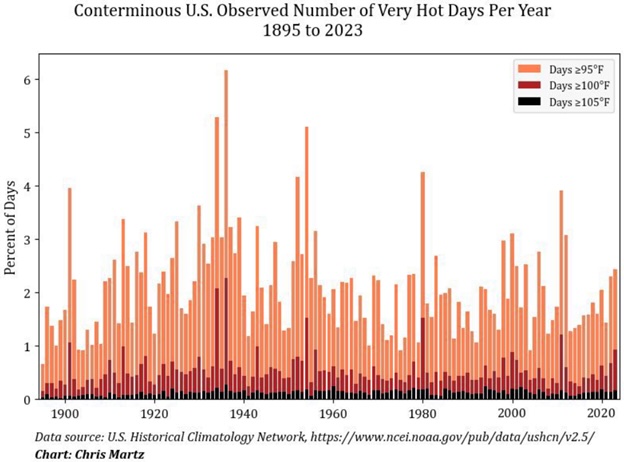
As Climate Realism has pointed out in many articles covering various heatwaves over the years, data does not show that extreme heat is becoming more common, not even in the United States, which the media often claims is seeing worsening heatwaves. (See figure below)
Even more embarrassing for USA Today, they then listed Hurricane Beryl in 2024 as further evidence of the “fourth year in a row” of “extreme weather” they want to attribute to climate change.
That isn’t even a heat wave. It isn’t even occurring in the United States, and the “history” it made was by being an early Category 5 storm; the storm it beat was by just two weeks.
This is absurd cherry-picking. Extreme weather occurs every day on the planet, and again, somewhere, SOME record is being broken, especially if the net of possible conditions is cast wide enough.
There is no long-term trend of worsening or earlier-arriving hurricanes that points toward a “fingerprint of climate change.”
Again, USA Today then points to another disconnected weather event as the evidence that 2025 was part of this supposed pattern: the deadly floods in Texas.
Again, these were not caused by climate change; there is no long-term trend of flood severity on the Guadalupe River. Expert hydrologists reported at the time that “this kind of outcome was a known risk.”
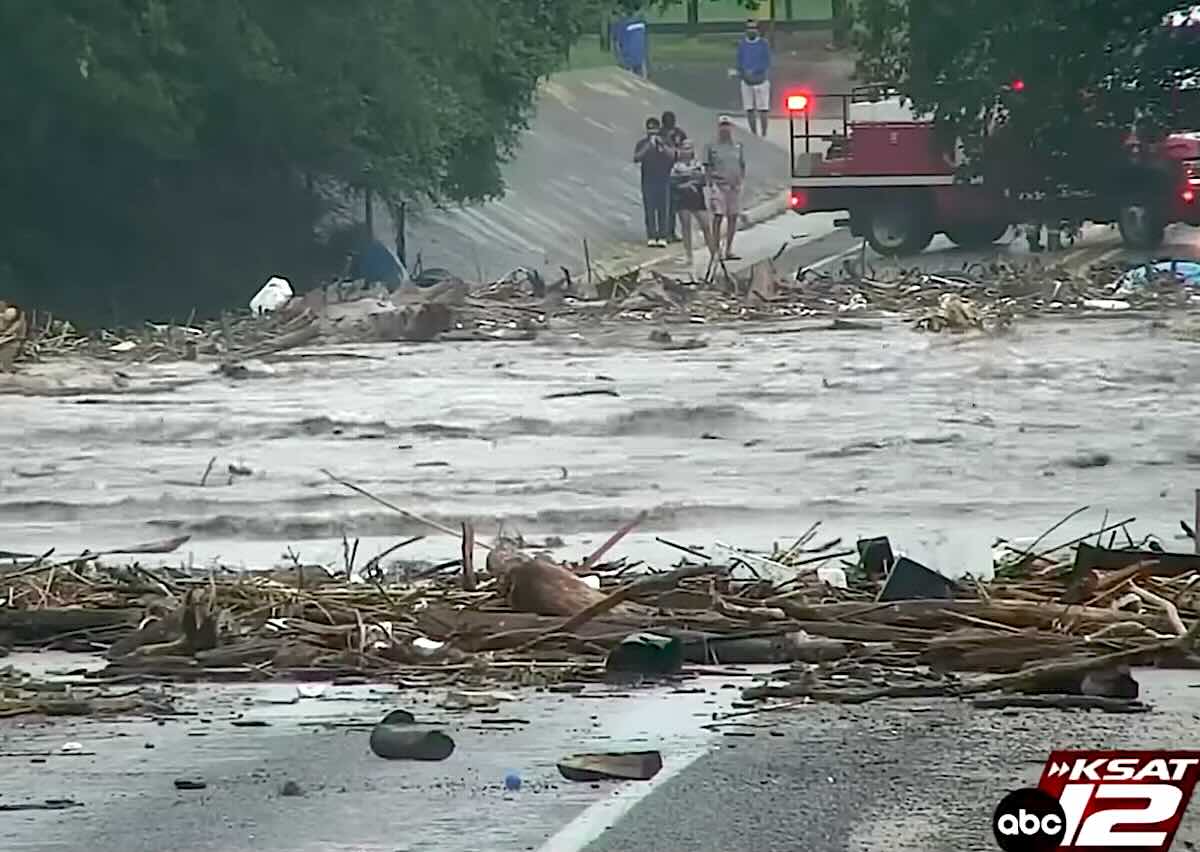
That same river valley experienced major floods more than a dozen times over the past century, and has had worse past floods than the one in 2025; it wasn’t even a record-breaker, which makes it a bad example even among a list of bad examples for the author’s point.
The rest of the article relies entirely on the say-so of climate activist and attribution groups Climate Central and World Weather Attribution.
These are not legitimate scientific bodies, and their claims that recent heatwaves are “virtually impossible” without climate change have been thoroughly debunked in the Climate Realism post by meteorologist Anthony Watts, “No, New York Times, Climate Change Isn’t Causing Modern Heat Waves,” so I will not relitigate them here.
This USA Today article is an embarrassing example of journalistic negligence. It demonstrates a lack of understanding about weather history and how record-setting works when 365 days of an entire planet is your sample size.
Yes, heat waves are deadly, but they have not become more deadly or extreme over time, and their danger is easily mitigated with human innovations like air conditioning. USA Today should know these things, yet they apparently prefer the climate narrative over facts.
Read more at Climate Realism