


The intensity of recent heat waves was strongly influenced by the widespread urban heat island (UHI) effect. Surface temperatures vary widely, depending on the surface properties. [some emphasis, links added]
When we look at microclimates and the urban heat island (UHI) effect, the type of ground cover changes everything when it comes to absorbing and radiating solar energy.
When the surface of a grass field sits at 30°C, the difference in temperature compared to the temperature under a forest canopy and the temperature just above a paved parking lot is profound.
According to studies, that difference is up to 25°C.
The more urbanized the Earth’s surface becomes, the warmer the surface measurements will be.
UHI: Global Impervious Surface Area Growth Is Accelerating
So, how fast has the global surface area of concrete, asphalt, and steel become?
In satellite remote sensing and global geography, the surface area covered by asphalt, concrete, buildings, and other man-made structures is referred to as Artificial Impervious Surface Area (ISA).
According to high-resolution global satellite mapping data, approximately 1.3 million to 1.35 million square kilometres of the Earth’s land surface was covered by these artificial, heat-absorbing materials in 2020:
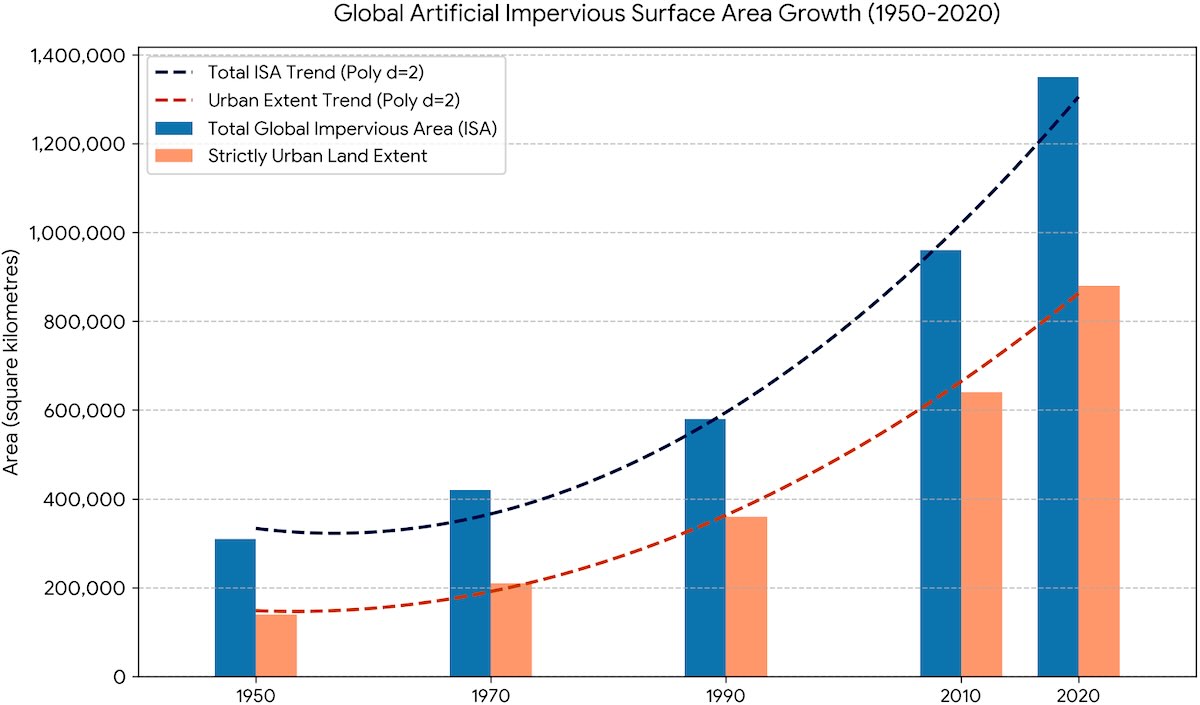
This represents an area three times greater than it was in 1950, or about the size of France, Spain, and Germany combined. This is having a major impact on global surface temperature measurements and urban heating.
To understand why, it’s important to look at the profound differences among surface types.
Assume a warm summer day where the near-surface temperature of a rural grass field is 30°C:
1. Under a deciduous tree canopy
The corresponding near-surface temperature would be ~23°C to 26°C (4°C to 7°C lower than the grass). Trees are nature’s air conditioners. They cool the ground via two main mechanisms:
- Shading: The canopy intercepts up to 80–90% of direct solar radiation, preventing the soil from heating up.
- Evapotranspiration: Trees actively pump water from the soil and release it through their leaves. This phase change from liquid water to vapor absorbs latent heat, cooling the surrounding microclimate.
2. In the middle of an urban asphalt parking lot
Research shows that the corresponding near-surface temperature would reach ~45°C to 55°C (15°C to 25°C higher than the grass) under the same sunny conditions.
Dark, dry, and dense materials like asphalt are incredibly efficient at turning sunlight into pure thermal energy. Asphalt absorbs roughly 85–95% of the solar radiation that hits it.
Unlike the grass or trees, there is zero moisture to evaporate, meaning all absorbed energy goes directly into raising the surface temperature. Asphalt acts like a giant battery, storing immense amounts of heat and continuously radiating it back into the immediate air layer.
This is why nighttime low temperatures in cities remain stubbornly high.
With [hundreds of temperature stations] sited within or near urban areas and huge man-made infrastructure, it’s no wonder that heat waves have been breaking temperature records over the past decades.
It’s the growing heat absorption.
Sources:
- Asphalt vs. Grass Surface Differences
Armson, D., Stringer, P., & Ennos, A. R. (2012). “The effect of tree shade and grass on surface and globe temperatures in an urban area,” published in Urban Forestry & Urban Greening. This study explicitly found that open grass surfaces reduced maximum surface temperatures by up to 24°C compared to bare artificial surfaces (concrete/asphalt) under identical sunny conditions. -
Tree Canopy Cooling Capacity
Rahman, M. A., et al. (2018). “Vertical air temperature gradients under the shade of two contrasting urban tree species during different types of summer days,” published in Science of the Total Environment. This research details the precise temperature declines under tree canopies. It highlights that the combination of deep shade and active transpiration creates a microclimatic buffer that drops air temperatures nearest to the ground surface by 3°C to 7°C compared to open unshaded areas, directly mitigating the near-surface heat. -
The 5 cm Near-Ground Gradient
Source: Jenerette, G. D., et al. (2016). “Microclimate Variation among Urban Land Covers: The Importance of Vertical and Horizontal Structure in Air and Land Surface Temperature Relationships,” published in Journal of Applied Meteorology and Climatology.
Findings: This study measured microclimatic conditions at the near-surface boundary layer (0.1 meters / 10 cm and below) across multiple land covers, including asphalt, turf grass, and tall trees. It confirmed that the correlation between land surface temperature (LST) and near-ground air temperature is highest at the 10 cm layer for asphalt and bare surfaces, proving the existence of the massive, localized near-ground temperature spikes (exceeding 20°C variations horizontally across land types) that dissipate rapidly as you move higher into the ambient air.
Read more at No Tricks Zone








There is nothing to worry about. In the NL we only had some warm days 30 degrees C in this overall miserable summer. Even end May we had temperatures between 12 and 15 degrees C.
You won’t hear them if it’s to cold for the time of the year. But if there are only three days of 30 degrees all the bells are ringing about the supposed “climate change”. “It’s the the hottest Summer since 1947”! Totall BS it is. In London the tires of cars were melting? Nonsense.
Most days the permanent artificial grey misery is covering the sky. Still they deny any climate engineering. I do remember clear deep blue skies for weeks in the past. Natural beautiful clouds.
You won’t see them any more. Don’t wake the fools, they will tear you down.
The Earth’s surface area of both land and water, totaling about 510.1 million km²
Only 1.3 million square kilometres of the earth’s land surface was covered by these artificial, heat-absorbing materials in 2020 (26 year old data) Less than 3% of earth’s surface
The increase of UHI from year to year does cause a small amount of global warming
No Trick Zone recently published a biased article claiming poor siting at one weather station that had the hottest temperature in germany
My comment, which No Tricks Zone refused to print, said that many weather stations in germany set a new record, including many rural stations: During the record-breaking European heatwave, approximately 250 to 252 weather stations across Germany registered new all-time local temperature highs
Did the author say anything about UHI contributing to global warming? No because his point was that media and politicians use the excess heat that are in the cities to claim that CO2 is the cause, not all the asphalt and concrete while the lack of greenery to mitigate that heat. And that the UHI is the cause for cities to stay warmer at night. Nor did he deny that there is a heat dome right now in Europe causing unprecedented high temperatures all over. Again that has nothing to do with his points. Either you know that but chose to ignore it to make your points or you have reading comprehension issues.