As Europe and much of North America endured record heat in recent days, headlines quickly appeared claiming that the heat wave was “virtually impossible” without human-caused climate change. [some emphasis, links added]
To many readers, that sounds like a conclusion drawn directly from observations. It is not. It is the product of a branch of climate research known as extreme weather attribution, which relies heavily on computer models rather than direct measurements.
This was not an isolated claim.
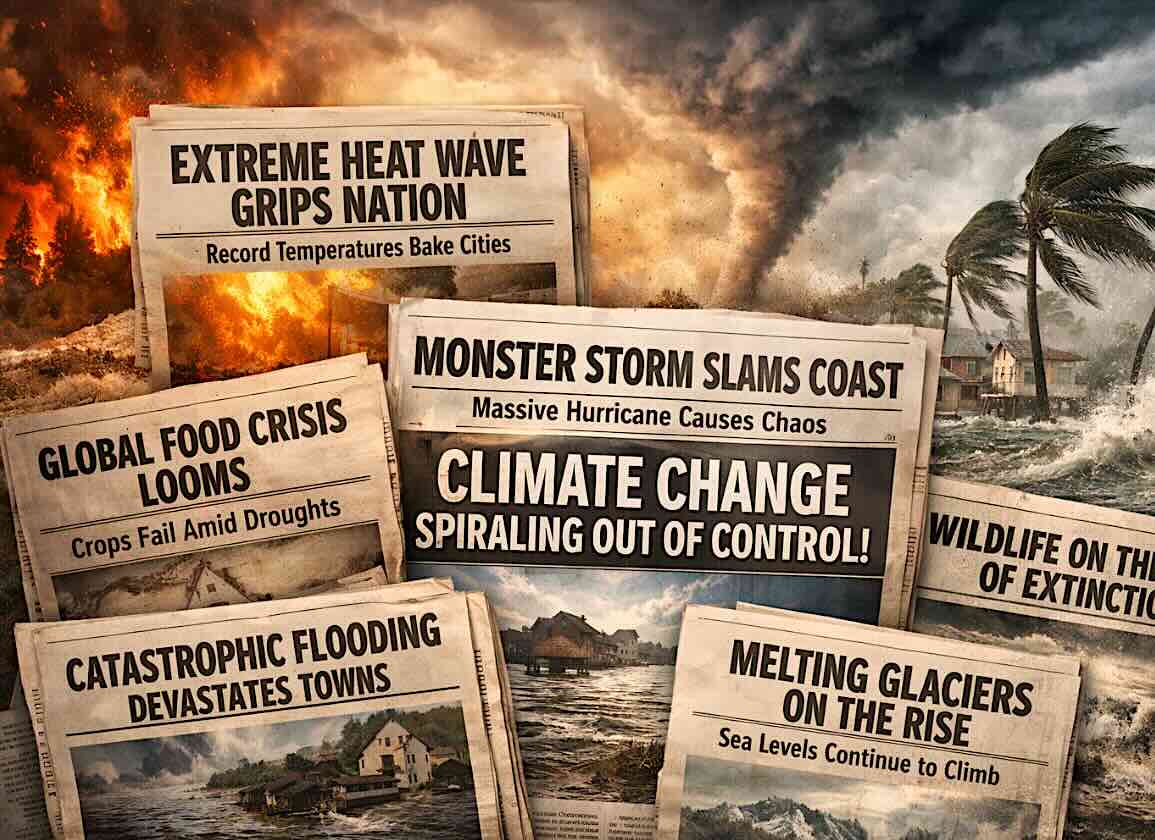
Whenever a major storm, wildfire, flood, or heat wave occurs, similar headlines soon follow. We are told that climate change made an event “twice as likely,” “35 times more likely,” or even “virtually impossible” without human influence.
These figures are widely repeated by politicians, journalists, and activists as though they were direct scientific observations.
They are not. They are estimates derived from computer models.
This distinction matters because modern climate policy is increasingly built not on observed evidence but on simulated realities generated by mathematical models.
The growing field of “extreme weather attribution” illustrates this transformation perfectly. Rather than simply studying weather events after they occur, attribution studies attempt to [quantify] how much more likely an event is to have become because of human CO2 emissions.
The numbers appear precise and authoritative, yet they rest upon assumptions that deserve far greater scrutiny than they usually receive.
Extreme weather attribution did not emerge in isolation. It represents the next stage of the same modelling paradigm that produced speculative emissions scenarios such as RCP8.5.
Once those scenarios were accepted as plausible descriptions of the future, it became possible to use similar modelling techniques to attribute individual weather events to human emissions with apparently precise numerical confidence.
In other words, attribution science is not a departure from the climate modelling enterprise—it is its logical extension.
Most people assume these studies compare today’s weather with historical observations. In reality, they compare the present world with a hypothetical world that never existed—a computer-generated version of Earth’s climate in which industrial carbon dioxide emissions never occurred. The difference between the two simulations is then presented as the human contribution to the event [i].
Attribution studies typically compare today’s climate with a simulated preindustrial climate to estimate how human emissions altered the probability of a particular event.
That sounds scientific until one asks a simple question: how do we know the model accurately represents a climate that no one has ever observed?
Climate models have long struggled to reproduce observed temperature records accurately, with many projections diverging significantly from other observational datasets [ii].
They have difficulty reproducing important regional climate patterns, and one of their most important tests—hindcasting, or reproducing known historical climate changes—remains problematic.
If a model cannot reliably reproduce the past, confidence in its simulation of an imaginary pre-industrial climate should naturally be limited. Yet attribution studies depend precisely upon this capability.
The growing reliance on attribution studies reflects a broader pattern within modern climate science. For years, speculative emissions scenarios such as RCP 8.5 and its successor SSP5-8.5 shaped thousands of climate-impact studies, policy reports, and media narratives, despite repeated criticism that they did not represent realistic future pathways.
More recently, the scientists responsible for designing the next generation of climate scenarios acknowledged that these highest-emissions pathways had become implausible. Yet projections derived from them have already influenced climate litigation, net-zero policies, and public perceptions worldwide.
Attribution science extends this same modelling paradigm by using simulated climates to assign numerical probabilities to individual weather events.
The issue is not whether computer models have scientific value, but whether increasingly speculative model outputs are being treated as empirical evidence rather than as hypotheses open to testing and revision.
A more fundamental question is whether carbon dioxide is the dominant driver of climate, as the IPCC claims, and whether current climate models can isolate its influence with the extraordinary precision implied by modern attribution studies. If the models themselves remain highly uncertain, then the confidence attached to attribution claims becomes equally questionable.
Many highly qualified scientists argue that CO2 is not the dominant driver of climate and that natural variability plays a far greater role than is commonly acknowledged.
Another problem is that the weather itself is extraordinarily variable. Floods, droughts, hurricanes, heatwaves, and wildfires have always occurred. Long historical records often reveal cycles, clusters, and natural fluctuations extending over centuries. In many cases, the evidence does not show the simple upward trends portrayed in media coverage.
Historical datasets from recent attribution science research show little or no long-term increase in many categories of extreme weather, and some records even show declining trends over the periods examined.
This does not mean that the climate never changes. Of course it does. Earth’s climate has always changed. The question is whether modern attribution studies can confidently separate natural variability from human influence to the extraordinary degree claimed.
Consider how attribution studies are reported. A study may conclude that an event became “twice as likely” because of climate change.
The media rarely explain that this conclusion depends upon dozens of climate models, numerous assumptions about historical temperatures, statistical methods, and confidence intervals that may span a wide range of possible outcomes. Instead, the public receives a single dramatic number stripped of its uncertainty.
This creates the illusion of certainty where considerable uncertainty still exists.
Read rest at American Thinker