

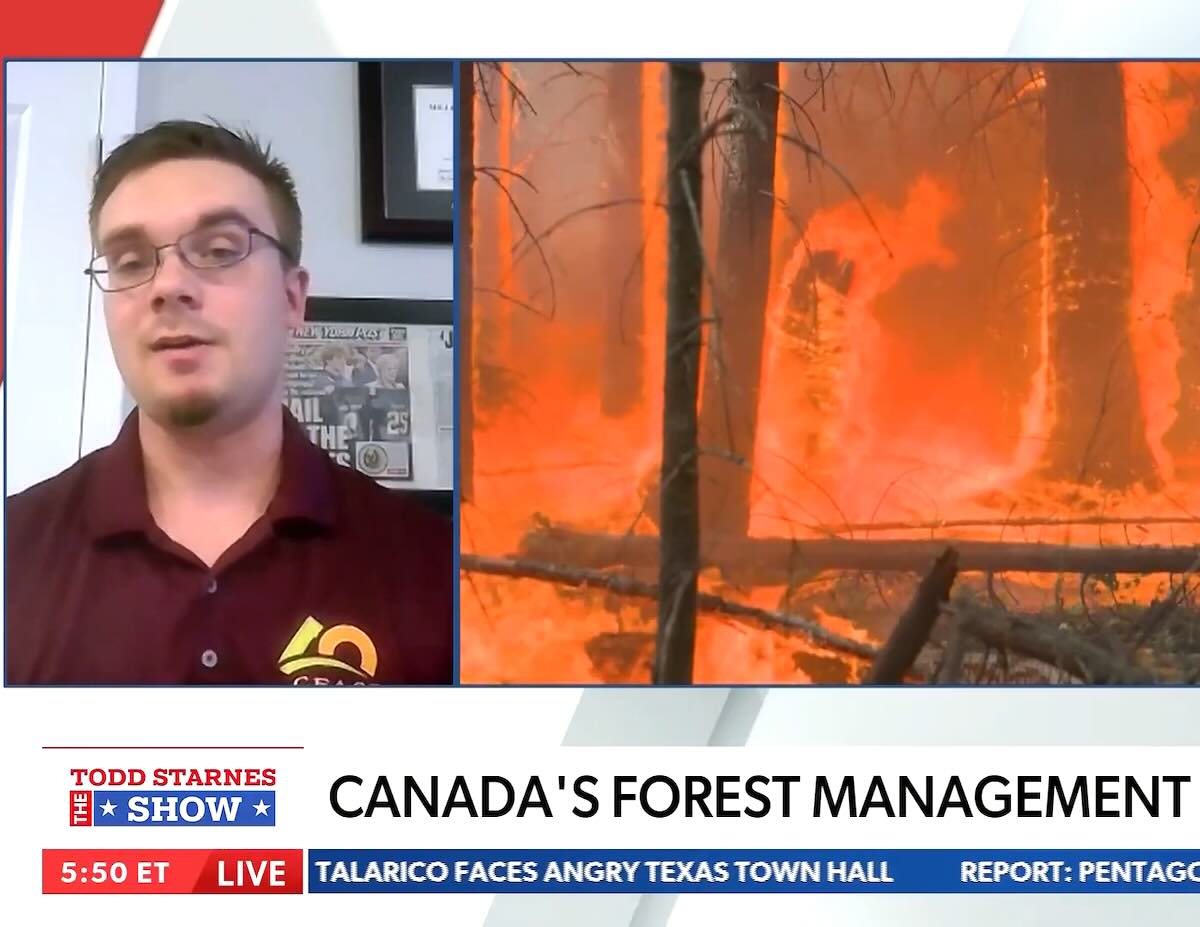
In this segment of The Todd Starnes Show, meteorologist and science policy analyst Chris Martz discusses the ongoing issue of Canadian wildfires, challenging the common narrative that attributes their increased frequency solely to climate change.
Key takeaways:
- Historical Context: Martz notes that smoke drifting into the U.S. is not a new phenomenon, using historical events such as New England’s “dark days” in 1780 and 1881, which were also accompanied by extreme heat and smoke (timestamp: 0:50–1:23).
- Causes of Wildfires and Climate Change: He explains that over 50% of Canadian wildfires are triggered by lightning. Furthermore, he argues that the data does not support a significant increase in drought or heat-wave frequency in Canada since 1910, suggesting that the underlying weather conditions are not necessarily becoming more conducive to fire (timestamp: 1:34–2:18).
- Forest Management Challenges: Martz distinguishes between forest management in the U.S. and Canada. While techniques like mechanical thinning (clearing underbrush and small-diameter fuels) and prescribed burning (controlled burns) are effective, he points out that these are much harder to implement in Canada because the forests are vast, isolated, and difficult to access compared to the U.S. (timestamp: 2:45–4:17).
- Policy vs. Environmentalism: Regarding the influence of environmental policies, Martz suggests that while focusing on the environment is positive, an overemphasis on “net zero” or emissions-reduction policies may be ineffective at mitigating immediate wildfire risks. He advocates for better infrastructure, city planning, and more firefighting resources, such as water bombers (timestamp: 4:48–5:37).
Watch the ~6-minute video here:
h/t CFACT







about 90% of the smoke and acres burned from canadian forest fires are in the boreal forest which cannot be reached by humans for forest management
For nearby american cities in northern US states there has been a problem in the past 50 years But heavy Canadian smoke reaching chicago for one example was actually rare in the 20th century
The explanation, in my opinion, would be shifting winds in the past 50 years during the period of global warming. On the other hand that correlation may just be a coincidence