

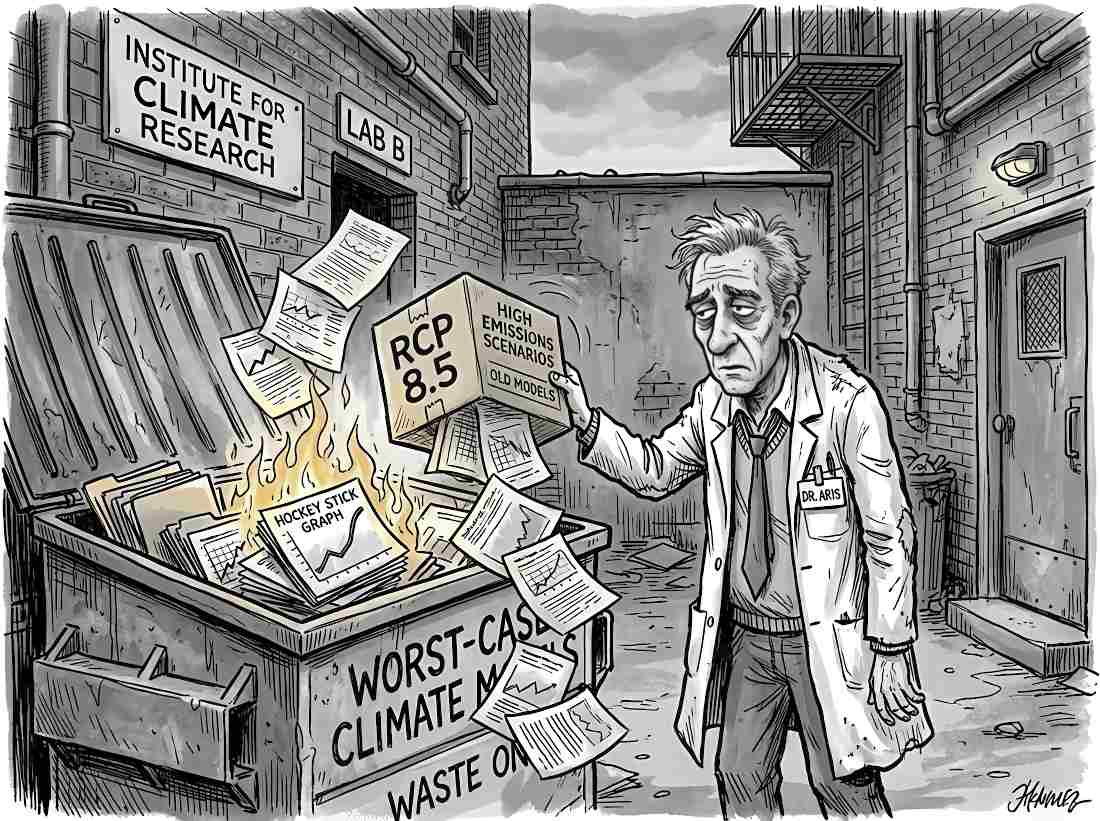
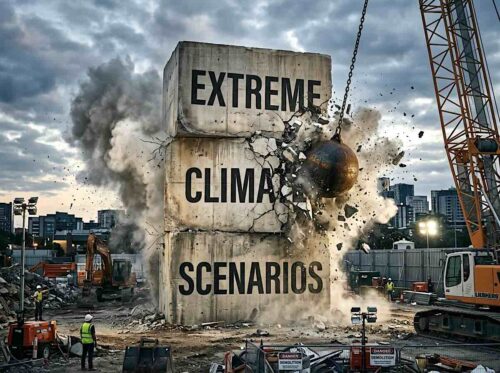
The United Nations’ Intergovernmental Panel on Climate Change threw out one of its most extreme emissions scenarios last week, a major development in climate science that will likely echo across markets, federal and state government policy, and education. [some emphasis, links added]
What is RCP 8.5?
RCP 8.5 is the stuff of climate-apocalypse nightmares.
RCP stands for Representative Concentration Pathway, a future climate scenario Earth could face by the end of the century if no policies were adopted to address climate change.
‘Concentration’ refers to greenhouse gas concentrations in Earth’s atmosphere, and the 8.5 refers to the amount of additional heat those gases would trap by 2100.
RCP 8.5 became the highest-emission climate scenario widely used in both academic research and media coverage over the past decade.
But last week, the panel determined that RCP 8.5 described a future that subsequent data has shown to be too implausible to remain a useful benchmark for climate projections.
Why is the panel’s decision-making headlined?
The panel’s decision was significant because of the influence of RCP 8.5, not only within the field of climate science but also in academia, the media, business and government.
It became foundational in climate science education, shaped outward-facing climate communication, and was sometimes utilized in localized climate-impact modeling.
It influenced corporate climate-risk assessments used by insurance companies, banks, and investment firms to evaluate long-term property and infrastructure risks, which can affect insurance costs and investment decisions.
It also informed some taxpayer-funded climate planning and policy analysis at the federal level.
Reactions to the IPCC’s decision are varied
Some scientists and policy analysts have welcomed the change, saying that RCP 8.5 was obviously an unreliable benchmark since its inception.
Travis Fisher, director of energy and environmental policy studies at the Cato Institute, believes the warming scenario was based on “implausibly, absurdly ridiculous” assumptions from the start.
“What if we decide to dig up every ounce of coal on planet earth and burn it at the same time? Yeah, what if?” Fisher said in an interview with The Center Square. “This world where we find every hydrocarbon on planet earth and burn it — that [was] the scenario.”
Others say the panel’s retirement of RCP 8.5 is evidence that climate policy is working.
“Although often slow and incomplete, our efforts to tackle climate change have made a tangible difference,” wrote Andrew King, an associate professor in climate science at the University of Melbourne. “[But] the job is far from done. Emissions are at record highs, and global warming is speeding up.”
Still others say that RCP 8.5 remains a relevant scenario for modeling future climate impacts.
In an article titled “RCP 8.5 is Fine, Actually”, published by the Center for Progressive Reform, the writers contend it is, in fact, a “crucial tool to help us understand the climate impacts that lie ahead — even as the emissions trajectory it represents, fortunately, becomes less likely.”
They argue, among other things, that it’s possible that lower levels of emissions in other warming scenarios could “lead to temperatures conventionally associated with RCP 8.5” because the Earth’s climate sensitivity to greenhouse gas concentrations isn’t fully understood, and neither is Earth’s carbon cycle.
Climate and emissions modeling is also extremely complex and subject to significant scientific uncertainties.
Where does climate science go from here?
The IPCC also introduced seven new overarching emissions pathways for use in modeling and projections meant to better reflect contemporary conditions and climate policy.
How the panel’s retirement of the widely used worst-case warming scenario will affect public perceptions of climate science remains unclear.
Fisher thinks it may cause some to be less trusting of the panel and other authorities on climate science, but that it’s also a good thing for the field as a whole.
“It’s gonna basically red pill a bunch of people,” Fisher said, but “I think it actually does the world of climate science a favor by basically hitting reset on the most outlandish claims and getting back to reality.
“There’s a history of overstepping and trying to be alarmist and catastrophic, but I think it’s a positive thing [they’re] correcting it now instead of doubling down on it.”
Read more at The Center Square


since April last year the global temperature has fallen half a degree C. Cherry picked figure but where’s this accelerated warming?
RCP 8.5 was last used in the major report in 2013
It was not used again and that made your report in 2021
there will be another high end CO2 growth rate scenario for 2029
many people, including myself,
believe net zero will fail to stop the rise of CO2 in the atmosphere
only the high end CO2 growth rates scenarios assume net zero will fail
all the high end CO2 growth rate scenarios
assume a CO2 growth rates in the past few decades
will continue indefinitely
the high end CO2 growth rate scenarios
are the only ones that make sense
there are many variables in climate models
that are likely to be wrong
but the high end CO2 growth rate
is not one of them
the IPCC has been reducing the high end CO2 growth rate
since 2013 and increasing the low end CO2 growth rate since 2013
the IPCC middle of the road best guess has not changed
recent articles about RCP 8.5 only showed that authors
know very little about what the IPCC has been doing
since 2013, nor do they understand climate models
models are just a wide range of educated guesses
about the global average temperature in 2100
by chance one or two of them might appear
to be accurate in the year 2100
RCP 8.5 may not have been used in officially since 2013, but it has been a favorite of the climate change propaganda machine. Coffee, chocolate, rice, and many others items were going to become scarce and expensive due to studies based on RCP 8.5.
I have said to multiple posts by Green on the same topic and yet he continues to spew the same thing. It may be a fact that RCP 8.5 is not used by the IPCC but the media and many non-scientific “scientists” continue to use the worst case scenarios that came from CEP 8.5. But as long as the media keep using these scenarios in articles and the are posted here Greene will continue with this same “cut-and-paste” comment. Maybe he’ll read one of our replies to realize how ignorant he looks.