

A recent New York Post (NYP) article, titled “Billions have been wasted on UN’s climate change lies,” describes how billions, if not trillions, of dollars have been spent worldwide attempting to slow or stop the world from experiencing the extreme climate change as forecast by the flawed, but widely used RCP 8.5 computer model projections. [some emphasis, links added]
The NYP is absolutely correct. The future climate conditions described by the RCP 8.5 high-end emissions scenario, and subsequently cited in hundreds of papers warning of likely disastrous outcomes, were never going to happen, and all the investment into climate policy has been a total waste.
RCP 8.5 has officially been retired from consideration by official climate researchers at the Intergovernmental Panel on Climate Change (IPCC).
Opinion writer Jonathan Lesser writes that the IPCC “is responsible for the “climate catastrophe” and “the world is burning scenarios that environmentalists, academics and many politicians have promoted to force high-cost, coercive energy policies on Americans,” which “relied on academics whose careers depended on using RCP 8.5 and several other worst-case scenarios to predict everything from the demise of French wines and the end of pasta to aliens destroying the earth. (No, really.)”
Over the past decade, The Heartland Institute and Climate Realism have published dozens of articles refuting studies slavishly promoted by various media outlets that relied heavily on computer-modeled emissions scenarios like RCP 8.5 and SSP5-8.5.
The stories referenced by Lesser here are familiar; the supposed destruction of French wine (or overproduction!), pasta, and aliens of a different kind, all have been covered and much more.
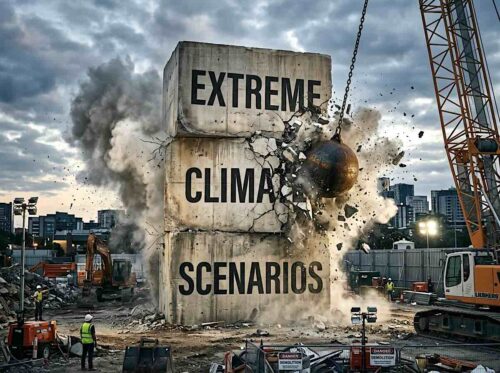
RCP 8.5 was used to say Gila monsters would be decimated by climate change, that climate change would spread lethal fungal outbreaks around the world, that climate change would cause a dramatic uptick in deaths from sedentary lifestyles, and The Daily Mail went so far as to create AI-generated apocalyptic images of the world’s future, all based on RCP 8.5 projections.
Scientists have been moving away from promoting RCP 8.5 as the business-as-usual scenario for a while now. The United Nations Framework Convention on Climate Change (UNFCCC) abandoned it years ago, yet it has still been regularly used as a realistic high-end emissions scenario in hundreds of papers published by prestigious journals like Nature.
It was never realistic. It was always implausible and likely impossible, even assuming a rapid, large, and sustained increase in coal consumption – a scenario that would require five times more coal than we actually have reserves of.
Climate scientist Roger Pielke Jr. explains in a Substack post, “A scenario requiring five times proven coal reserves is not plausible by any standard,” and that the scenario also required an increase in the use of coal-to-liquids instead of petroleum, and that other technologies would stagnate.
None of this was realistic, even at the time the scenario was first created.
RCP 8.5 was always nonsense, and though some scientists admitted as much a few years ago, others kept using it to generate peer-reviewed scare stories. The mainstream media were all too willing to promote them, complete with headlines touting the next scientifically proven catastrophe that was soon to occur.
The NYP story lists economic policies that were informed by the climate scare, especially those in the Northeast United States, such as fracking bans, and “shutting down” all fossil-fuel electric generators in the state and promoting a fantasy electric system of wind, solar, and batteries, together with “dispatchable emissions-free generators” fueled by “green” hydrogen.
Of course, many prominent climate scientists are now claiming that the abandonment of RCP 8.5 is because of the efforts of net-zero initiatives, but that is also false.
Global coal consumption has increased, and atmospheric carbon dioxide continues to rise. Again, the economic assumptions baked into RCP 8.5 were always absurd.
For example, Pielke explains:
What happened after the RCPs were released in 2011 — Paris, the renewables revolution, expansion of US shale — is the unfolding history of the world continuing not to be plausibly characterized by RCP8.5. The scenario did not become implausible. The evidence that it was implausible simply became undeniable as the real world and the RCP8.5 world continued to diverge.
President Trump is now celebrating the abandonment of RCP 8.5, correctly and exuberantly stating that the UN climate committee’s projections were always “WRONG! WRONG! WRONG!”
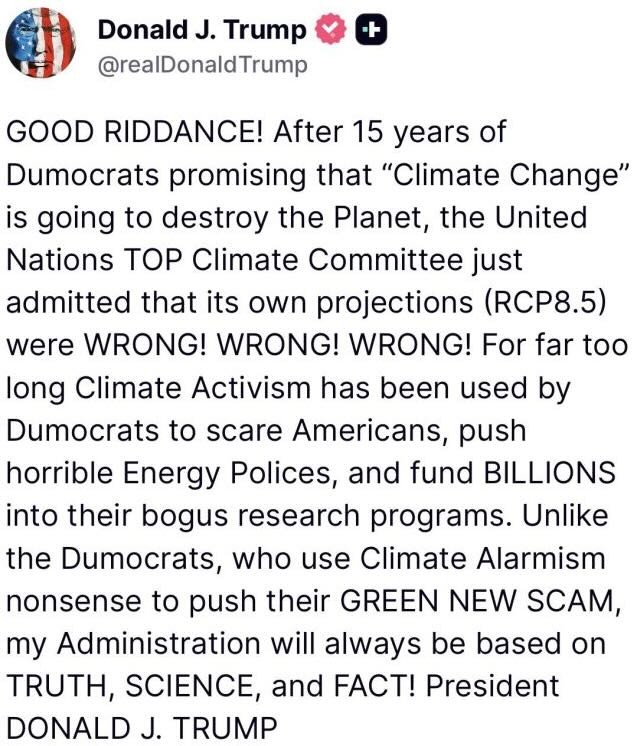
Good riddance, indeed, Mr. President!
And good on the New York Post for publishing Lesser’s piece, which drives home the fact that unrealistic, fearmongering studies have influenced political policy that has harmed people.
It has robbed them of freedom of choice and added to their costs of transportation, energy, and every product or service that uses energy.
Read more at Climate Realism


There was never any reason to be alarmed about warming, and it only happened because people were intimidated by models. Anyone who developed a complex model from scratch would be aware of the limitations and the potential for abuse by manipulating the output.
People who are worried about warming and CO2 emissions need to read a good book on climate science and get up to speed on climate history:)
https://www.amazon.com.au/s?k=Rafe+Champion&i=stripbooks&crid=GZ66NWUYZ193&sprefix=rafe+champion%2Cstripbooks%2C262&ref=nb_sb_noss
Throughout recorded history, the warm times have been good times. In the coldest times, life was truly nasty, brutish and short. The warming since the Little Ice Age has been unequivocally beneficial and we are still a degree or three short of the Roman Warm Period which was the best time for humans and other living things.
If we are lucky, we might get two or three degrees of warming in the colder latitudes before we turn the corner and start the downhill run into the next cold spell.
Besides the war on CO2 is lost outside the deindustrializing net-zero nations and the use of coal is increasing.
https://rafechampion.substack.com/p/losing-the-war-on-co2
RCP 8.5 was last used for the 2013 IPCC report
at the time the IPCC’s middle of the road forecast
was +2.5° C by the year 2100 for global warming
For the 2021 report, without RCP 8.5
the IPCC’s middle of the road forecast
was +3.0° C by the year 2100 for global warming
many people including myself
believe that net zero will be a failed policy
RCP 8.5 was the only CO2 scenario
that assumed net zero would fail,
therefore it was the best CO2 growth
rate forecast
having a logical CO2 growth rate forecast
does not make a climate model accurate
a model must have the correct effect of CO2,
the correct effect of feedbacks and the
correct growth rate of CO2 in the atmosphere
climate models are mainly a summary
of those three guesses
they don’t pay enough attention
to declining air pollution and
the declining percentage of cloudiness
no one today has any idea which climate model
and which RCP will be the best prediction
of climate in the year 2100
arguments over climate models and RCP scenarios
are meaningless because the first issue
is why do we take climate models predictions seriously
it’s safe to predict that adding CO2 to the atmosphere
will make the climate warmer by some unknown amount
that is supported by a lot of evidence and we have had
global warming in the past 50 years
with a large portion caused by CO2 emissions
99.9% of scientists agree CO2 emissions cause warming
(mainly in colder nations, in colder months, at night (TMIN)
+ larger food plants, longer growing seasons).
so what?
i consider that to be good news