

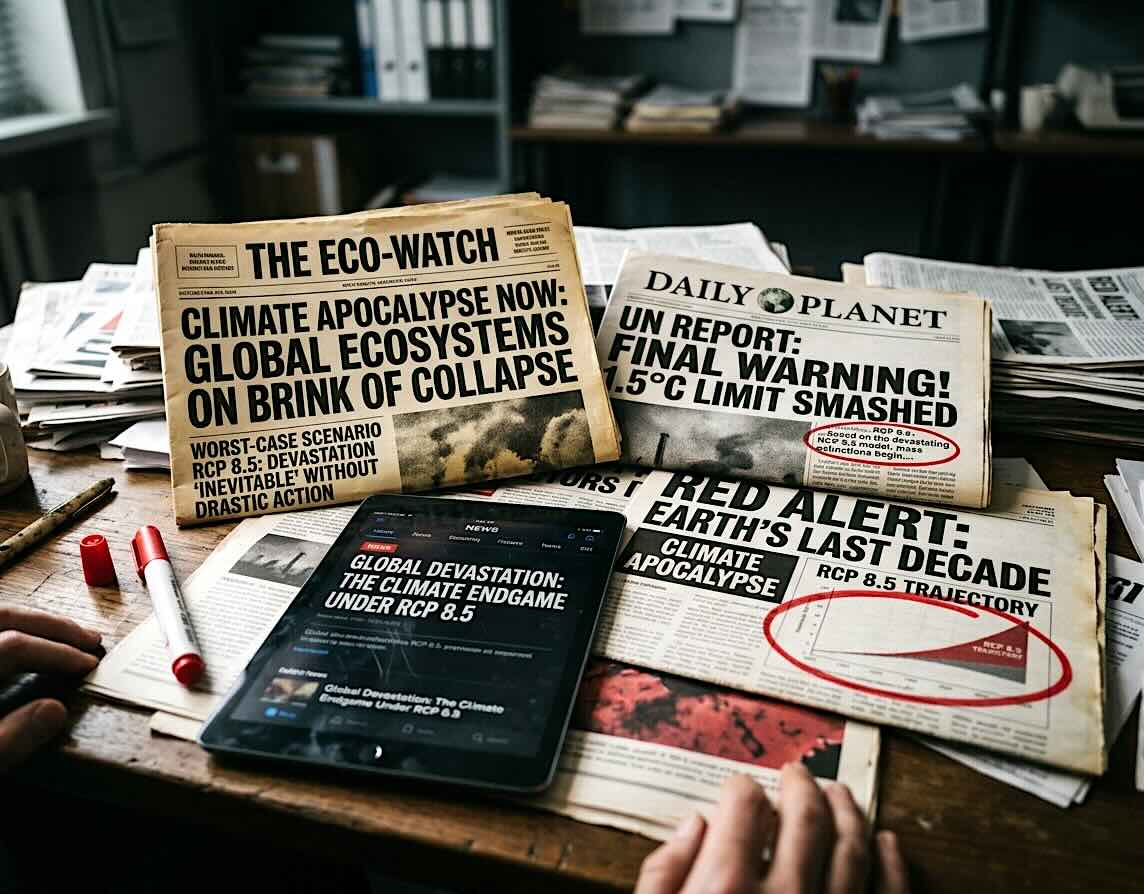
Climate scientists discarded an extreme global warming model that news outlets frequently cited in April after its predictions failed to materialize over a decade. [some emphasis, links added]
The Intergovernmental Panel on Climate Change (IPCC) found that Representative Concentration Pathway (RCP) 8.5 and similar proposed temperature trajectories “have become implausible,” a change they attribute to environmental policies.
Numerous media outlets used RCP 8.5 to justify sensationalist headlines about Earth’s climate.
Though RCP 8.5 was intended by its modelers as a worst-case scenario, publications such as The Guardian cited it as the “business-as-usual path of high fossil fuel consumption and carbon pollution,” running headlines like “Global warming could be more devastating to the economy than we thought.”
“The Guardian, which ran many dozens (hundreds?) of stories premised on RCP 8.5 projections over fifteen years, has run nothing [on RCP 8.5’s withdrawal],” American Enterprise Institute (AEI) Senior Fellow Roger Pielke Jr noted in a May 9 report.
Other headlines from The Guardian relying on RCP 8.5 include “NASA climate study warns of unprecedented North American drought,” and “Inside Australia’s climate emergency: the killer heat.”
The New York Times declared “The Great Climate Migration Has Begun” in 2020, reporting that future crop failures and a hotter South America would drive 30 million migrants to the United States.
“The New York Times has been perhaps the most prominent English-language home for promoting news stories based on studies that rely on RCP8.5. They’ve said nothing about its retirement,” Pielke wrote for AEI.
These predictions were also based on RCP 8.5’s estimated 4.8 degrees Celsius global temperature increase by 2100. The new projection is a three-degree increase, according to the IPCC.
CMIP7 is the overarching climate modeling program phasing out RCP 8.5.
“The practical reason is that it is time for new scenarios on the CMIP and IPCC schedule for the IPCC 7th assessment report,” Pielke said when asked about the rescission’s timing.
“The substantive reason is that the gap between the extreme scenarios and reality has become too large to deny.”
RCP 8.5 relied on multiple assumptions that are no longer feasible, according to Pielke and the IPCC.
“RCP8.5 assumed the world was moving towards coal at breakneck speed and every other energy source was going down,” Pielke said. “None of that has any relevance for the real world, where coal is declining, and solar is booming.”
Though many headlines were premised on RCP 8.5’s now-defunct estimates, few publications have noted the IPCC’s reversal or publicly commented on years of potentially inaccurate reporting.
“Some of us have been talking about this for almost a decade. The fact that it took so long is a big problem. There will be significant consequences as the world unwinds from the extreme scenarios,” Pielke said in response to previous media reliance on RCP 8.5. “Science is self-correcting, but sometimes that process takes too long.”
CCD Editor: As of press time, most legacy media outlets were giving this short shrift, saying that investments in renewable energy made the scenario obsolete. Read why that’s bonkers.
Read more at Daily Caller


The Intergovernmental Panel
on Climate Change (IPCC)
last officially used the RCP 8.5 scenario
in 2013 and last officially used SSP5-8.5
in 2021
the IPCC middle of the road estimate
for global warming in 2100 changed
from +2.5° C to +3.0 degrees C. in 2021
why should this old news
be a story in may 2026?
IPCC announced a new set of climate scenarios for 2029
Expect the 2029 IPCC middle of the road estimate
for global warming in 2100 to be from
+2.5° C to +3.0 degrees C. … as usual … since 1990
Why is it news? Because the media have continued to use the worst scenarios to scare the general public who don’t have a clue. It also has the media and some so-called scientists to insist that RCP8.5 is no longer valid because of what has been done to stop the worst of the “climate change” from happening and that we must continue to go to Net Zero. One would think you’d understand this but apparently you don’t.