

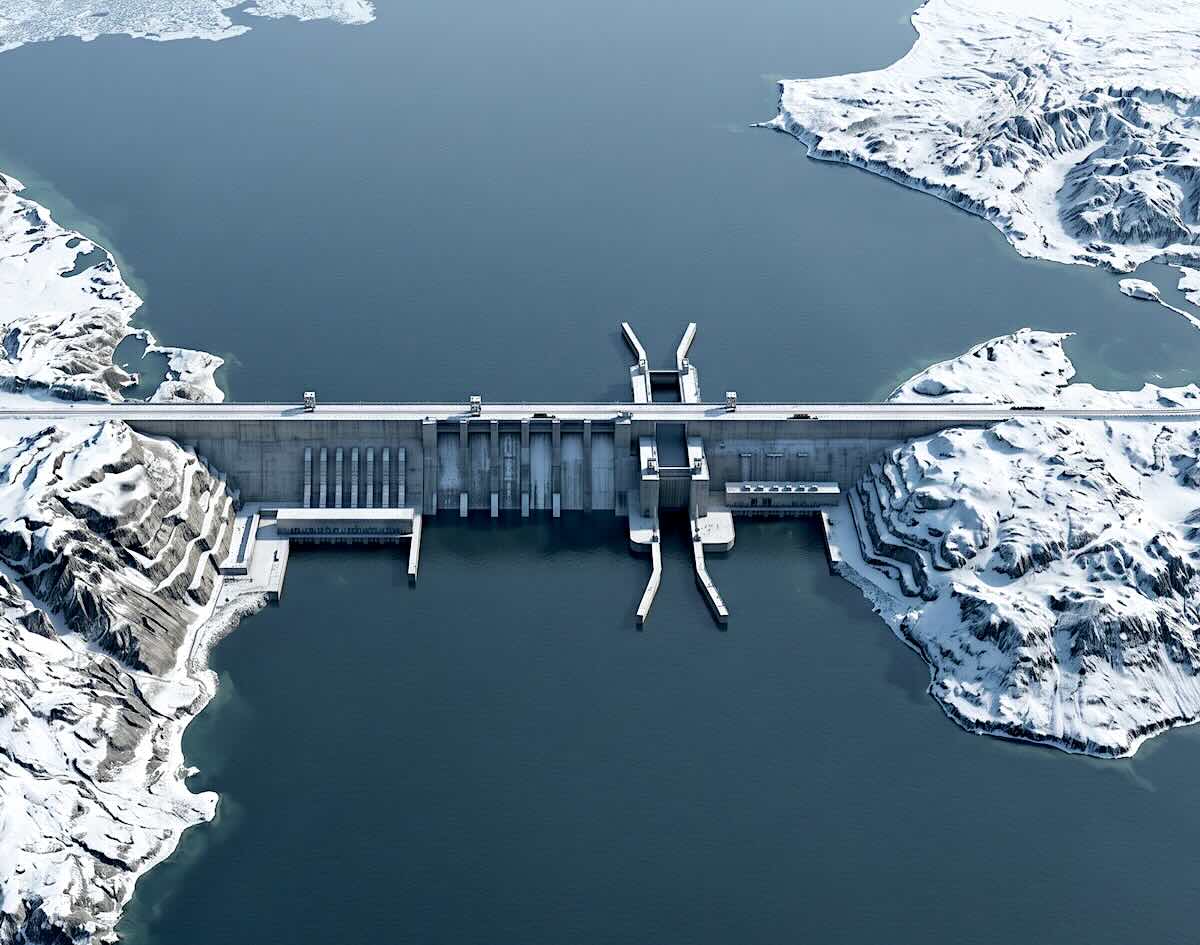
The New York Times (NYT) reports in “A New Idea to Save the Climate? Dam the Bering Strait” that scientists have proposed building a 50-mile-long dam between Alaska and Russia to stabilize the Atlantic Meridional Overturning Circulation (AMOC) to prevent a climate catastrophe. [some emphasis, links added]
This is a seriously risky idea.
The proposal is not an engineering plan grounded in observational need. Rather, it’s a computer-model thought experiment based on speculative tipping-point scenarios not justified by data on the AMOC or an understanding of the possible future consequences for humans, the oceans, and marine life.
The author describes an article published in Science Advances proposing a cross-continent dam across the Bering Strait as a “proof of concept,” noting that the dam could, under certain modeled conditions, prevent an AMOC collapse.
It further explains that the findings come from a computer model of Earth’s climate, not from direct evidence that the AMOC is about to fail. That distinction is critical.
As Climate Realism has reported in dozens of articles, the AMOC has been the subject of repeated alarmist headlines over the past decade. Some studies have projected weakening. Others have suggested relative stability.
Still others have found mechanisms, such as Southern Ocean wind-driven upwelling, which may be strengthening the AMOC. The scientific literature has moved in three directions: collapse, steady-state persistence, and even partial strengthening depending on assumptions.
What has not emerged is observational evidence of imminent shutdown.
The NYT acknowledges that “the uncertainty is very, very large,” quoting a climate scientist who says researchers do not know how close the AMOC is to collapse.
The proposed intervention described in the study would block the Bering Strait, altering freshwater flows between the Pacific, Arctic, and Atlantic Oceans.
The model simulations suggest that if the AMOC remains strong, closing the strait might help maintain salinity and stabilize circulation. But if the AMOC is already weak, the same intervention could accelerate its collapse.
In other words, the intervention could help, harm, or do nothing depending on timing and initial conditions.
That is not a control mechanism; it is a Las Vegas-style gamble on a global scale.
The proposal relies on climate model outputs run under specific forcing assumptions. Models are useful tools, but they are not reality.
Ocean circulation at the scale of the AMOC involves complex thermohaline processes, wind forcing, stratification, and deep-water formation, most of which aren’t well understood and when included in climate models are only imperfectly represented, even in state-of-the-art systems.
Moreover, the underlying modeling framework uses coarse resolution that does not fully resolve the Bering Strait’s dynamics, instead parameterizing throughflow behavior. From that abstraction comes a proposal to physically block a major ocean gateway.
The AMOC is critical to coastal communities and the health and life cycles of sea life. There is no evidence that the models accounted for ancillary impacts on these communities or species; the only focus was keeping the AMOC from collapsing, though, it turns out, the proposed cure may, in fact, cause the collapse.
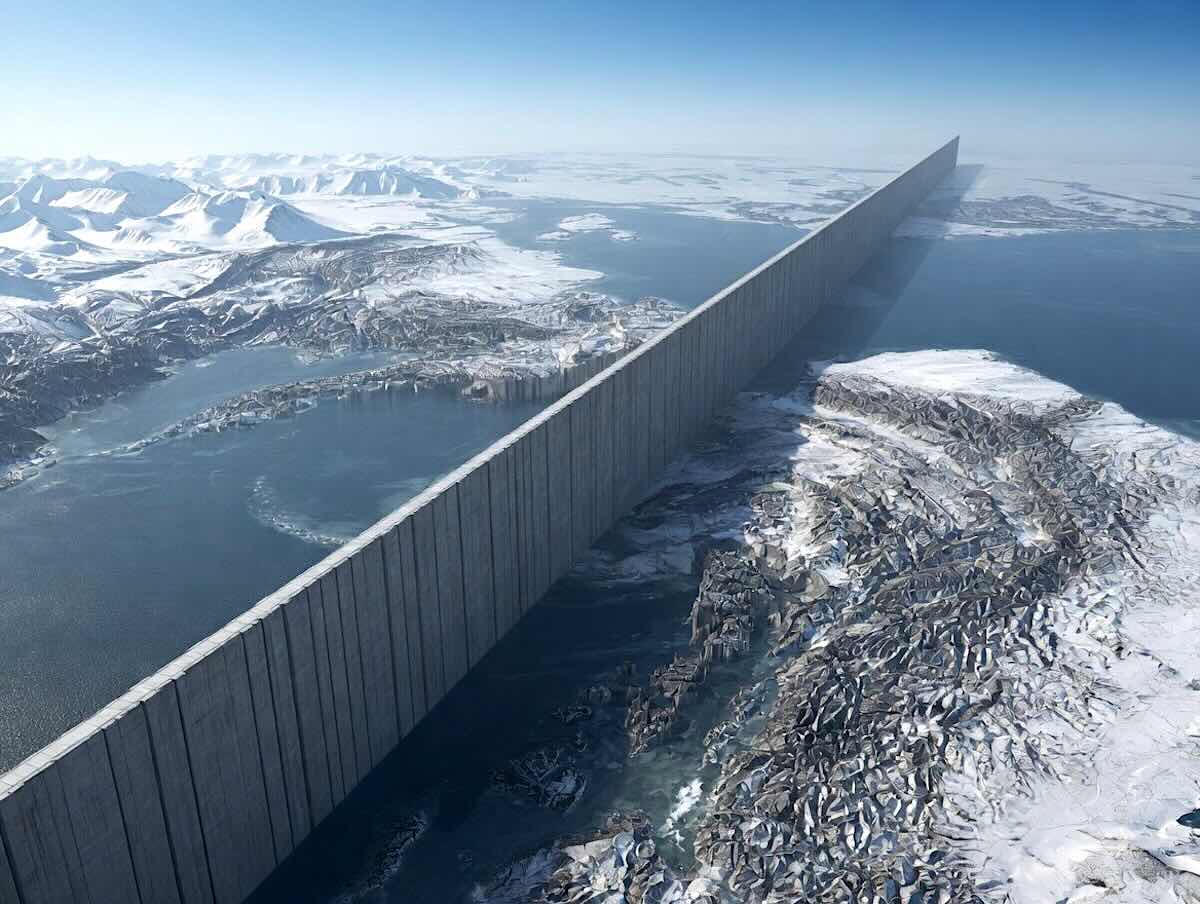
The scale of the proposal itself should give pause. An 80-kilometer barrier in Arctic conditions across an international boundary is not comparable to ordinary coastal infrastructure.
The NYT notes that once built, such a structure “couldn’t easily be taken down.” Geoengineering does not come with an undo button.
The Bering Strait is also a biological choke point linking Pacific and Arctic ecosystems. Blocking it would alter nutrient transport, salinity gradients, and marine migration pathways. The ecological consequences are acknowledged only briefly in the NYT coverage, yet they could be profound.
There is also a glaring contradiction embedded in this narrative.
For years, readers have been told that the AMOC is fragile, sensitive to freshwater perturbations, and prone to tipping points. If that is true, why would deliberately shutting off a major ocean exchange be considered a sane idea? If the system is robust enough to tolerate such intervention, then perhaps the entire AMOC collapse narrative deserves reconsideration.
The Intergovernmental Panel on Climate Change (IPCC) Sixth Assessment Report (AR6) states that while AMOC weakening is likely under high-emissions scenarios – scenarios that are not just improbable but likely impossible; there is low confidence in a collapse before 2100.
That is a far cry from an imminent shutdown requiring Arctic mega-dams. The NYT article concedes that scientists do not know how close the AMOC is to collapse.
What we are seeing is a pattern. As climate modeling grows more dramatic, proposed interventions grow more extreme: carbon capture and permanent storage; solar radiation blocking; and now ocean dams. Each rests on the assumption that models reliably predict nonlinear system behavior decades in advance.
Before entertaining planetary-scale geoengineering, a simpler question should be asked: where is the observational evidence of near-term failure? The RAPID array has been monitoring the AMOC since 2004 and shows variability but not collapse.
Paleo records indicate multidecadal fluctuations long before industrial emissions.
Ocean circulation is complex. Uncertainty is high. Models disagree. And now, on that uncertain foundation, we are asked to consider blocking an ocean strait. This is “mad scientists from the movies” type of stuff. The NYT shouldn’t have even given this proposal an audience.
This is not sober climate reporting by The New York Times. It amplifies a speculative modeling exercise as if it were visionary thinking. When the cure involves restructuring planetary oceanic circulation based on uncertain and likely flawed simulations, skepticism is not denial; it is prudence in the face of a crazy idea with unknown consequences.
The evidence that humans actually control the climate is exceedingly weak, but this proposal, if enacted, would certainly cause unforetold and unpredictable climate disruptions that we haven’t even begun to consider.
Crazy plans don’t become reasonable just because some group of scientists proposes them. And crazy plans, just because they are floated, don’t necessarily merit the attention of a major media outlet, promoting them as a reasonable idea.
Images rendered by AI
Read more at Climate Realism






It is a good thing such a dam will never be built. There is a very high potential for unintended consequences.