

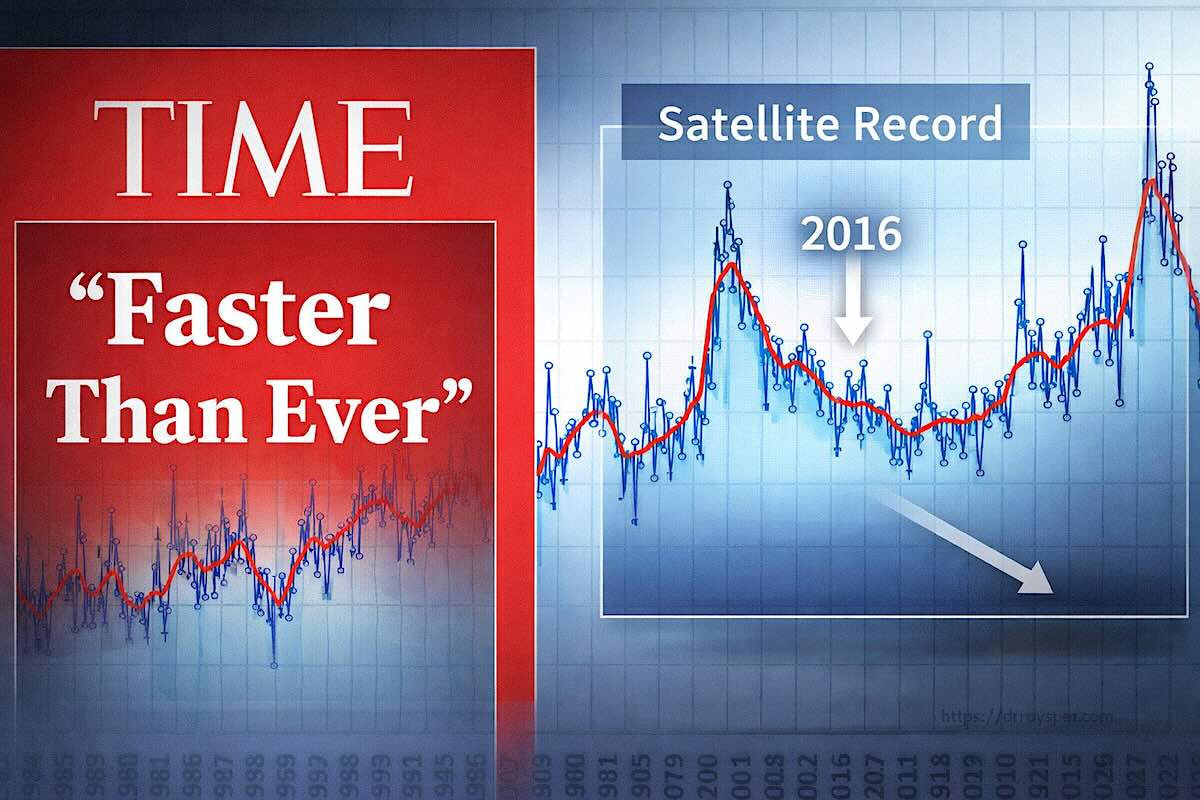
TIME, in a recent article, “The Planet is Heating Faster Than Ever Before,” claims that global warming has dramatically accelerated since 2015. This is demonstrably false. [some emphasis, links added]
Observational satellite data disagree with that claim, showing short-term variability driven by natural, short-lived events, with current temperatures now below the 2015–2016 El Niño peak.
In addition, proxy data from the past also show many periods over which temperatures shifted much more rapidly and steeply, both upwards and downwards, than during the recent period of modest warming.
The TIME article cites research that claims warming has nearly doubled in pace since 2015, representing a sharp acceleration and warning the world could cross 1.5°C of warming within a few years.
The claim rests on statistical adjustments that “filter out” natural variability such as El Niño and volcanic effects. That filtering is central to the narrative.
The acceleration appears after removing natural influences from the temperature record, which are clearly displayed in the raw data.
When we examine the observational satellite record itself, shown below, the story looks very different.
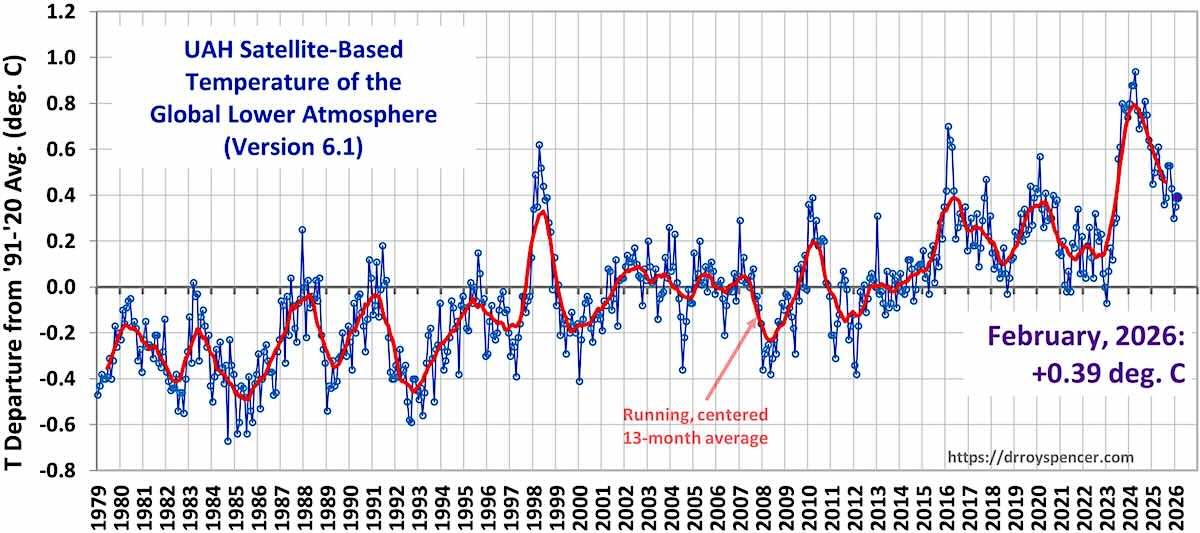
The University of Alabama in Huntsville (UAH) Version 6.1 global lower troposphere dataset shows a long-term warming trend of +0.16°C per decade from January 1979 through February 2026. That trend has remained essentially stable for years.
There is no visible post-2015 inflection point in the long-term slope.
The chart shows the strong 2015–2016 El Niño spike rising above +0.7°C relative to the 1991–2020 mean. After that peak, temperatures declined. The most recent value — +0.39°C in February 2026 — remains well below that earlier El Niño high-water mark in 2016.
If warming had truly “doubled” in rate beginning in 2015, today’s anomalies should sit well above the 2016 peak. They do not.
It is also important to understand what caused some of the more recent spikes in the record. The unusually warm values in 2024 stand out in the UAH time series.
Those occurred in the wake of the 2022 Hunga Tonga–Hunga Ha’apai volcanic eruption, which injected an unprecedented amount of water vapor into the stratosphere.
That injection temporarily enhanced radiative forcing, aka the greenhouse effect, because water vapor is in fact the strongest greenhouse gas. It was a short-term perturbation — not evidence of a structural acceleration in the underlying greenhouse-driven trend.
The UAH report itself describes 2024 as “anomalously warm,” and the data show a return toward the longer-term trend through 2025 and into early 2026. That behavior — spike and partial retreat — is characteristic of natural variability superimposed on gradual warming.
TIME’s framing relies heavily on adjusted surface datasets where natural influences are mathematically removed.
But climate is a long-term average of what actually happens in the real world, including El Niño events, volcanic eruptions, and short-term atmospheric changes.
Removing those factors to produce a smoothed “underlying” curve does not demonstrate that the observable climate system has entered a new accelerated regime. However, it does conveniently serve to advance the human-caused global warming narrative.
The long-term satellite trend remains modest and steady at +0.16°C per decade.
That is not a doubling. It is not a sharp upward trend; it is a continuation of a decades-long gradual increase punctuated by temporary spikes and dips.
Climate change is measured over decades, not from one El Niño peak to the next. When the full satellite record is considered — including the 2016 peak, the 2024 anomaly, and the current February 2026 value — the claim that the planet is heating “faster than ever before” since 2015 is not supported by the observational data.
Paleo-climate proxy data doesn’t support this claim, which shows much more significant temperature shifts over short periods, multiple times throughout history, long before humans began emitting large amounts of carbon dioxide into the atmosphere.
The first takeaway from this article is that TIME needs some basic fact-checkers with an understanding of the English language. Data clearly demonstrates that the present warming is not “faster than ever before,” and certainly not larger.
The UAH record shows gradual warming with natural variability superimposed. It does not show runaway acceleration.
If TIME had bothered to look at the actual data rather than uncritically regurgitating a press release, perhaps, if they were honest, it would have published a significantly different story — one with a far less alarming and patently inaccurate headline.
Read more at Climate Realism


It is sad how desperate conservative writers had become they now make more false climate science claims than the liberals do and that was quite a big target to exceed
the usual conservative lies to claim that CO2 does little or nothing but this lie is more sophisticated
the author cherry picks a brief very strong el nino temperature spike years ago and then claims it hasn’t been exceeded so the temperature is not rising
this is dishonest data mining not an honest trend line
Honest Comparison of UAH Temperature Trends:
Prior 30-Year Trend:
For much of the satellite era, the observed trend was consistently cited near
+0.125 C. per decade.
Recent 10-Year Acceleration:
Since approximately 2015, multiple analyses—including those using UAH data—have identified a “near-doubling” of the warming pace in the global climate system. In the UAH dataset specifically, recent 30-year rolling trends have reportedly accelerated
from roughly 0.125 C. to 0.175 C. per decade.
that is called acceleration which the author is denying
without that data mining the uah data do show acceleration
It may not be dangerous acceleration but it is acceleration
and the surface measurements show the same thing
the rise in the global average temperature in the past 50 years is the fastest in the past 5000 years and likely the fastest rise in the past 10,000 years
You keep repeating the lie that CO2 has some kind of control of our temperature. The level it’s concentration in the atmosphere CO2 can no longer cause any kind of warming. But somehow only conservative writers lie while you ignore the continuous lies from any and every left wing outlet (which is almost all of them) about the supposed climate crisis and every unusual weather event is caused by CO2.
people who claim CO2 does not cause global warming are fools who are never taken seriously
i don’t waste my time reading liberal websites on the subject of climate or energy because they are inaccurate and a waste of my time
conservative websites have become inaccurate on the subject of climate science & this article unfortunately is one example
i wrote an article on the CO2 is saturated myth which you should read and learn from but you probably won’t:
https://honestclimatescience.blogspot.com/2024/04/tthe-greenhouse-effect-co2-is-saturated.html
my climate and energy website set a new daily record with 1,445 page views yesterday
You keep asserting that carbon dioxide acts a major control of the earth’s temperature. I guess I’m a fool for believing data that says otherwise. The dust bowl in the United States occurred before carbon dioxide was considered a significant factor. This was part of a world wide phenomenon. There were also impacts in parts of Europe and Asia. Australia had severe drought and heat at that time. They didn’t have severe heat but at this time South America and Africa had severe drought. There is not only the hot period of the 1930’s, the medieval warm period, and the roman warm period. In 1896 was the worst Australian heat wave. In the US it is credited with killing 1,500 in New York City. Arizona also had their record heat wave that year. In England there were numerous deaths. Cooling periods or a stall in warming during times of high and raising carbon dioxide concentration also undermine the carbon dioxide forcing theory. After 1998 the increase in global temperature stalled for 17 years, despite massive amounts of increased CO2 into the atmosphere during this time. Also, there was an abrupt cooling period from 1950 – 1975 despite significant increases in CO2 emissions after WW2. There was concern that we were entering another ice age.
my climate and energy website set a new daily record with 1,445 page views yesterday
Wow, somehow you got some ignorant fools to read your website or those who want to get a laugh? Your expertise in the very complicated science of the climate is exactly what? Oh yeah, you got an MBA but somehow that is enough for you to discount and actually attack scientists who have been studying the complex science of the climate for decades.
Why don’t simply acknowledge that albedo variation is an excellent predictor of mean global temperature? No need to invoke stupid greenhouse forcing. There is an elephant in the room and almost no one sees it.
the majority of the warming since 1975 is at night which is not affected by albedo even though albedo change does cause most of the warming in the day. mainly the reduction of air pollution since 1980
A major cause of that night-time warming is from an effect you continue to deny–Urban Heat Island–due to the daytime heating from all the asphalt, concrete and a lack of greenery.
the increase of UHI from year to year is a tiny cause of warming at night because 85.5% of the globe is uninhabited and therefore has no UHI. increased UHI is only possible in the inhabited 14.5% of the global surface, but only 0.6% of earth is urban
i do not deny UHI warming it is one of many causes of climate change but CO2 emissions and reduced air pollution are the main causes of the warming since 1975,
followed by a reduction in the percentage of cloudiness
https://honestclimatescience.blogspot.com/2025/12/the-following-variables-are-known-to.html
Richard, you are cheery picking. You admit that night time temperatures better support your narrative so that is what you chose to use. This is an issue about warming; remember the term “Global Warming?” It makes no more sense to measure the extent of warming by the cooler night time temperature than it would be to use the average flow of water in rivers in the summer to measure flooding. You cheery pick in another way. You consistently use 1975 as a base line. Many others do this and it is a big red flag. That year was at the end of 25 year cooling period.
All excellent points as well as your other retorts to Greene elsewhere, many that I’ve made to him but to no avail because he can’t address the comments. I did that as well as you did about how well “green energy” and EVs have done under the first year of Trump’s administration. All the giveaways to buyers of EVs and subsidies to green energy products were ending late last year so those who wanted to take advantage of that gravy train had to do so before they end.
And your point about his using 1975 is spot on. Here in Colorado we just had our second warmest winter. Wonder what winter season was the warmest? Oh, 1933/34 in the midst of the “Dust Bowl”.