

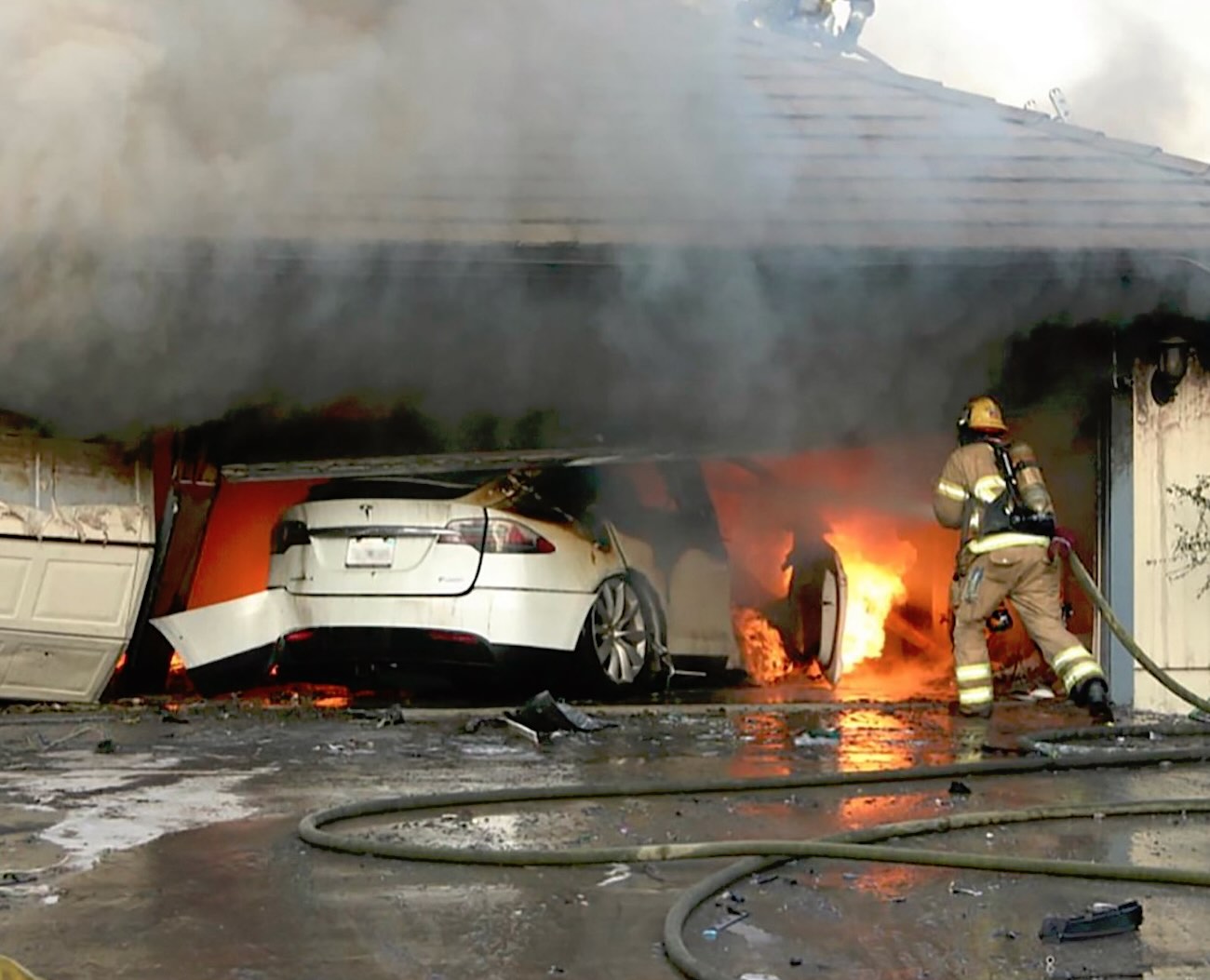
The article from Blackout News here reports on how a severe fire was triggered by an electric car at a charging station in Schwaigern (Baden-Württemberg) on February 16, 2026. [some emphasis, links added]
Avoid parking next to electric cars
Blackout News reports that an electric car connected to a public charging station caught fire on Monday morning, and the fire quickly spread to a motorhome parked next to it. Since the motorhome contained gas cylinders, the intense heat triggered several explosions.
Multiple other cars in the immediate vicinity were damaged by the flames and heat. Two buildings were damaged as well – one directly adjacent to a residential house and a building on the opposite side of the street.
Property damage was estimated to be in the mid-six-figure range. The report describes a local “inferno”.
According to Blackout News, extinguishing the fire proved difficult due to the burning EV battery, which required continuous cooling to prevent reignition.
Electric cars are notorious fire risks, banned in some parking garages and ferry lines.
It’s little wonder that some ferry companies and parking garage operators have introduced bans or restrictions on electric vehicles (EVs).
The primary reason cited is fire safety, as electric vehicle battery fires are notoriously difficult to extinguish once they start, especially in confined spaces like ship decks or underground garages.

Several shipping companies have made headlines by banning or restricting EVs: In 2023, the Havila Kystruten (Norway) shipping line made the high-profile decision to ban electric, hybrid, and hydrogen cars from its coastal ferries.
They argued that their onboard firefighting systems were not equipped to handle a battery fire and that such an event could endanger the ship and passengers.
Since April 2024, the Greek Shipping Ministry has implemented a regulation requiring many ferries to allow EVs and plug-in hybrids on board only if their batteries are charged to 40% or less. This is to reduce the risk of “thermal runaway.”
Alaska Marine Lines recently introduced a ban on EVs and plug-in hybrids on its vessels, citing the lack of specialized firefighting equipment at sea.
BC Ferries (Canada) recently introduced a policy prohibiting non-operational (towed/broken-down) EVs from boarding, due to the inability to verify if the battery has been damaged (which increases fire risk).
Parking Garages
In 2024, the UK Parliament banned EVs from its underground parking facilities as a “precautionary measure” following a fire safety assessment.
At various times, small numbers of parking garage operators in Germany (e.g., in Kulmbach or Leonberg) made headlines for banning EVs after local fire incidents.
However, many of these bans were later lifted or challenged because modern building codes and fire department equipment have evolved to handle such risks.
Instead of a full ban, many newer garages now require EVs to park in specific “monitored” zones near exits to allow easier access for emergency services.
Hotter, More Difficult To Extinguish
The risk is that lithium-ion battery fires burn much hotter than gasoline fires. And when they are on fire, they release toxic fumes (like hydrogen fluoride) that are dangerous in enclosed spaces.
Moreover, an EV battery can appear to be extinguished but reignites hours or even days later, which is particularly dangerous on a ship in the middle of the ocean.
Read more at No Tricks Zone








Two EV’s had a head on collision on Highway 2 in Washington State, and they did more than burn. They exploded on impact as if there was a bomb in each one. The two vehicles had a total of three people, all of which were killed. Do ICE vehicles ever explode, the answer is definitely. However, though fires in EV’s are well known, explosions from the batteries haven’t been expected.
But according to our resident “expert”, Richard Greene, EV fires happen less frequently than ICE fires. He totally ignores the fact that the fires generated by the EV’s battery are much worse than gasoline fires from an ICE. Also EVs make up less than 10% of all vehicles on the road.
In Sweden, EVs and hybrids caught fire at a rate of 3.8 fires per 100,000 vehicles, whereas combustion-engine cars caught fire at 68 per 100,000, making ICE vehicles nearly 29x more likely to ignite.
these are the best ev fire data in the world and no trick zone left them out because they are a biased website
I assume you read the article and yet ignored the clear facts. So you are what you claim websites you dislike–you are a LIAR. You didn’t refute a single fact in the article about fires from EVs or how companies that actually have to deal with what has happened when an EV auto-ignites–they refuse to allow them on ferries or in parking garages. They and their insurance companies have to pay out large settlements if an EV starts on fire from nothing.
But your post is biased because you don’t like the “No Tricks Zone”.