

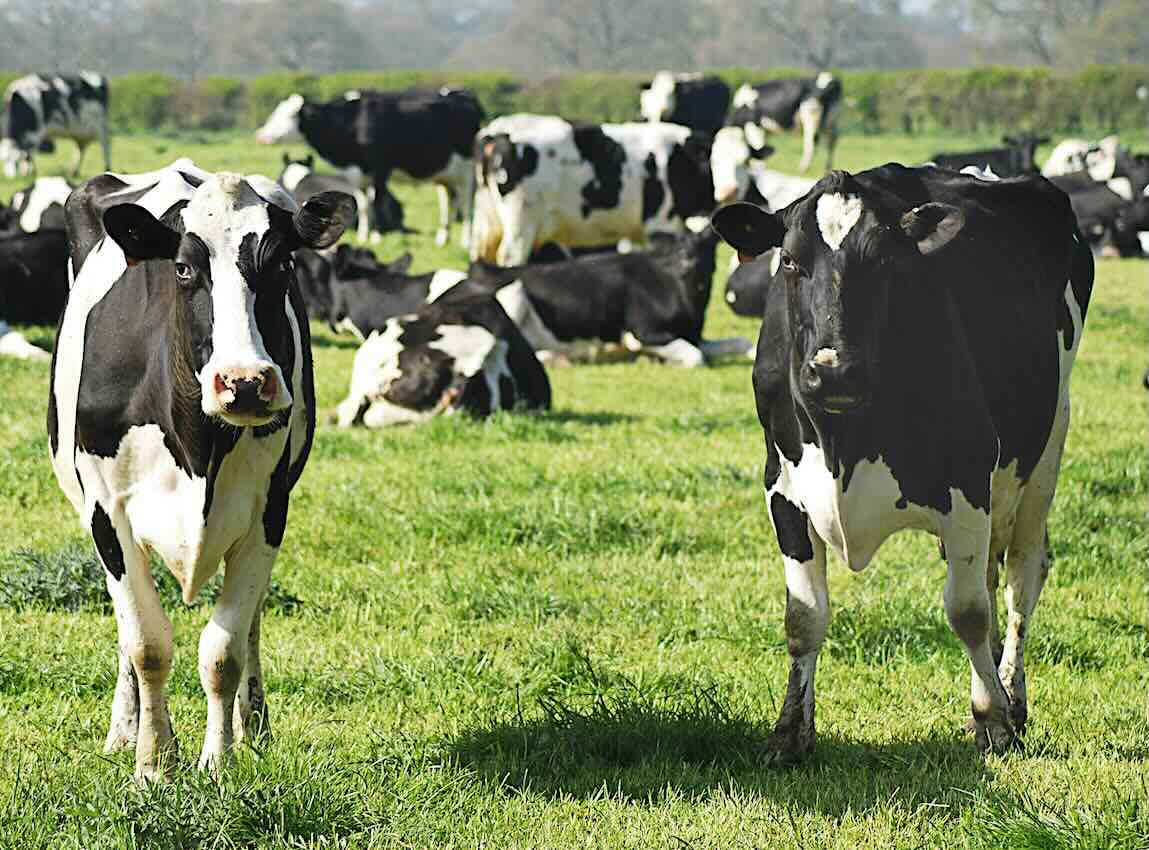
Policymakers are demanding that farmers scale back meat production, reengineer agricultural systems, and burden consumers with higher grocery bills to prevent a fabricated climate catastrophe. [some emphasis, links added]
This fearmongering is based on false claims that methane, a byproduct of livestock digestion, significantly contributes to allegedly dangerous atmospheric warming.
Happily, the pseudoscience of this campaign against ruminants—mainly cattle and sheep—is refuted in a paper published by the CO2 Coalition, Fairfax, Virginia.
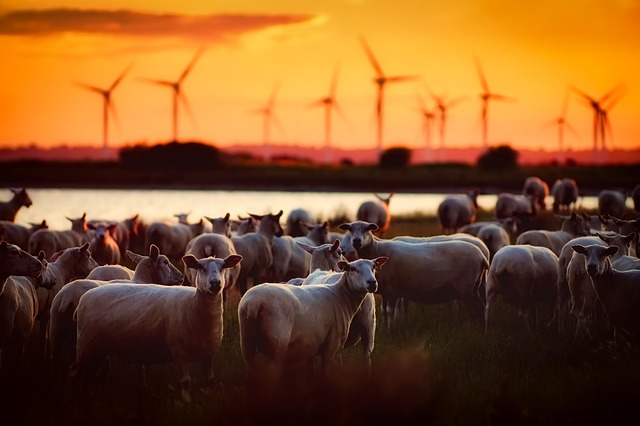
Even if all 1.6 billion of Earth’s cattle were killed, the amount of warming averted would be an immeasurably small 0.04 degrees Celsius, according to the paper. The temperature reduction from killing all 1.3 billion sheep would be 10 times smaller.
Even more absurdly, New Zealand’s national goal of reducing emissions from cattle and sheep would affect the temperature by no more than 0.000008 degrees Celsius. That is eight one-millionths of a degree.
Even these tiny amounts would be further reduced by emissions of wild ruminants, such as deer and termites, as agricultural lands reverted to forests and grasslands.
“No rational person would invest a single dollar to achieve such insignificant temperature reductions,” says the paper, which was authored by Deborah Alexander, Methane Science, Accord, Clevedon, New Zealand; James D. Ferguson, professor emeritus, University of Pennsylvania School of Veterinary Medicine; Albrecht Glatzle, Rural Association of Paraguay; William Happer, professor emeritus, Department of Physics, Princeton University; and William A. van Wijngaarden, Department of Physics and Astronomy, York University, Canada.
The digestive systems of ruminants convert certain carbohydrates like cellulose into usable energy that other animals, including humans, cannot digest.
The “controversy” over ruminant digestion emitting methane through burps overlooks the value of these animals’ transforming otherwise low-value vegetation into highly nutritious meats and milk, in addition to valuable hides and wools.
Animal husbandry produces some of the most nutrient-dense foods—packed with protein, iron, zinc, and vitamin B12—that many plant-based alternatives do not.
Millions of families in developing countries rely on small-scale livestock farming not just for sustenance, but for economic survival. A cow or a small herd of goats represents a family’s financial reserve, their source of daily milk, and their insurance against hard times.
When international bodies demand global reductions in livestock, they are calling on the poorest people to surrender their path to upward mobility.
The anti-methane campaign is built on exaggerating the trace gas’s small warming effect, turning what ordinarily would be the esoteric interest of atmospheric physics into apocalyptic headlines about climate doom.
As a greenhouse gas, methane is a distant third behind water vapor, whose atmospheric concentration can be as much as 50,000 parts per million (ppm), and carbon dioxide (CO2), at 420 ppm.
Water, in the form of clouds, has the most significant impact on temperature. It cools the Earth by reflecting sunlight into space and warms it by providing an insulating layer at night.
CO2, the most demonized of the greenhouse gases, has limited ability to further warm at its current concentration. Even doubling CO2 would result in a warming of less than 1 degree Celsius.
With an atmospheric concentration of less than 2 ppm, methane has little influence relative to CO2. Both these gases warm through their interaction with the infrared region of the electromagnetic spectrum, much of which is saturated by current gas concentrations.
This means that additional molecules of the gases have an ever-diminishing warming potential.
The exaggeration of warming potency is one misrepresentation of greenhouse gasbags. Another is the characterization of warming as a negative.
Along with plant fertilization from elevated CO2 levels, natural, modest warming since the 19th century, and the ending of the Little Ice Age, these have had beneficial effects on ecosystems and crop production.
Growing seasons are longer, the Earth is greener, and more food is available for an increasing population.
There is also a fundamental misunderstanding of basic biology. As experts have outlined in a detailed analysis of cows, methane, and the climate, livestock methane is part of a natural circulation of carbon through a food chain that includes manure fertilization of grasses and vegetation, and photosynthesis.
Nonetheless, political leaders embracing doomsday propaganda have abandoned basic logic.
In Denmark, to meet strict emissions quotas, dairy farmers are mandated to feed cattle chemical additives designed to inhibit methane-producing bacteria. In places like the Netherlands and Ireland, governments have seriously discussed shutting down thousands of farms to meet irrational climate targets.
For global climate policy, agriculture is an ideological football rather than a means to feed people.
Meat taxes, public procurement rules, and “sustainable diet” campaigns push the same message: Eat less meat and pay more for expensive food, despite no benefits.
The case for attacking livestock methane is nonexistent, and the cost is enormous. Policymakers must start paying attention to real science and common sense.
Read more at CO2 Coalition


several very important points were missed
methane only remains in the atmosphere for 9 to 12 years
steers eat corn and produce methane
while cows eat grass and produce methane
if the cows didn’t eat the grass it would rot every winter
and release carbon dioxide
the infrared absorption frequencies of methane
water vapor overlap. Methane absorbs IR radiation strongly at specific wavelengths, most notably in the 7.7 mu m band. Water vapor also absorbs heavily across this exact same wavelength region.. : Because water vapor is vastly more abundant in the atmosphere than methane (parts per thousand vs. parts per million), water vapor absorbs the majority of the photons in the shared 7.7 mu m range before they can ever reach a methane molecule.
increased global warming from more methane over a 9 to 12 year period
is so small that is difficult, if not impossible, to measure