

Canada’s Prime Minister has a difficult problem of optics. So difficult that allusions to quantum physics are not out of order.
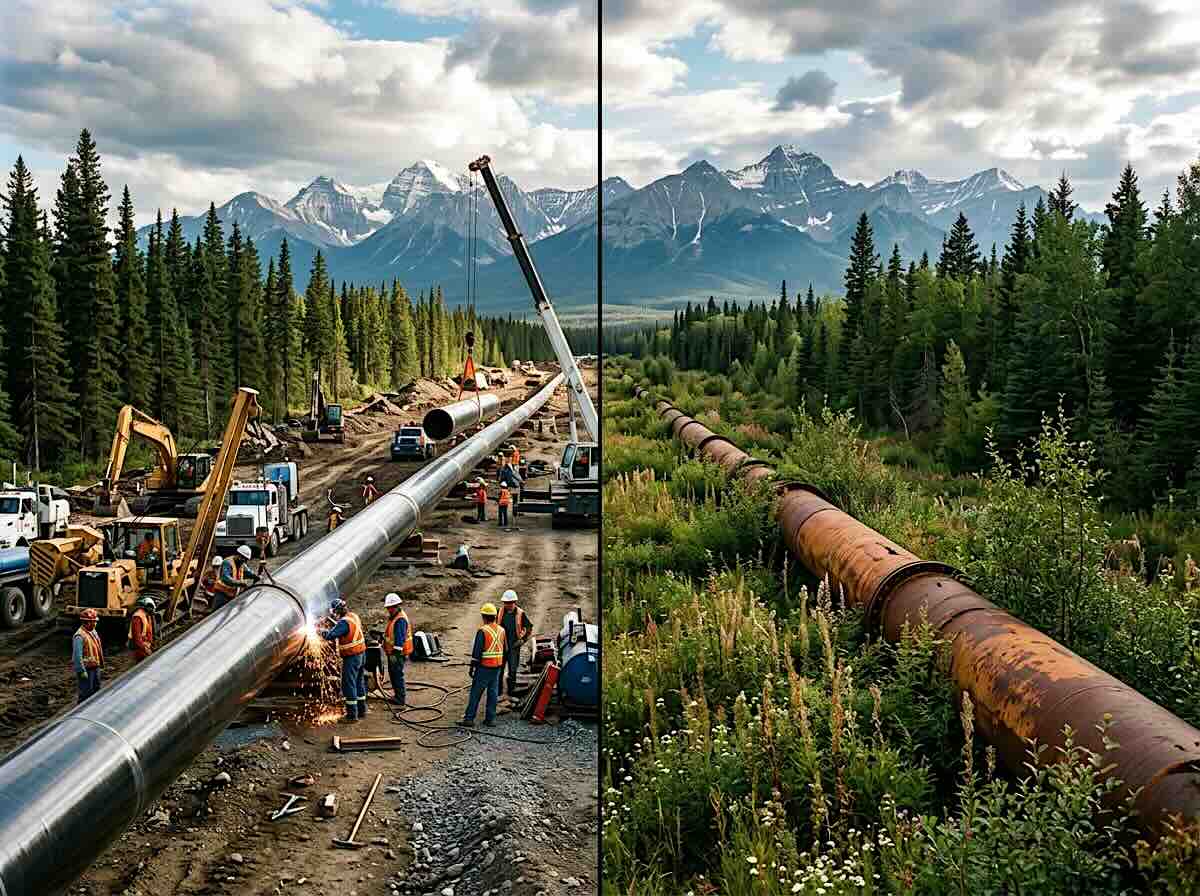
He has just announced that a major one-million-barrel-per-day pipeline to the west coast of Canada for oil export to Asia will be deemed a project in the national interest. This will enable fast-track approvals with construction commencing as early as September 2027.
Carney has also placed enough roadblocks to stop the pipeline. His optics problem is that he wants different voters to see different policies.
In the long decade of his predecessor’s (Justin Trudeau) government, Canada’s economy, by any reasonable comparison to peer countries, has been swirling down the drain. (Now there’s an aspect of physics the average citizen can visualize.)
In Carney’s first year as prime minister, the situation has been complicated by tariffs from the U.S., Canada’s largest export market. Conventional wisdom is that the single biggest and fastest way to create national wealth is to expand Canada’s bountiful oil and gas industry into Asia. Carney touts Canada as becoming a clean energy superpower.
Mark Carney’s voter base is the same as Trudeau’s, and his caucus includes a holdover of a few climate-obsessed net-zero carbon dioxide (CO2) ideologues holding the balance of power in parliament.
If the pipeline goes ahead, it could kick-start the economy. Still, Carney might lose his parliamentary majority to defections by disgruntled members and lose the next election to disaffected ex-Trudeau voters.
If the pipeline doesn’t go ahead, Canada’s economy might continue to swirl down the drain, and in Alberta, the major oil-producing province hit hardest by net-zero policies, it will energize an already significant movement for secession from Canada.
To convince both camps that Carney is delivering what they want, the proposed pipeline is a new incarnation of Schrödinger’s Cat.
The famous feline had its origin in 1801 with an ingenious experiment by Thomas Young that proved light was an energy wave. A century later, Albert Eienstien ran the same experiment with advanced equipment and proved light was also a particle. Neither experimenter was wrong, even though the results in classical physics were considered mutually exclusive.
This dual existence phenomenon was observed only in the smallest units of mass or energy, called quanta. Thus, quantum physics was born.
Quantum physicists speculated that, since everything is made up of quanta, even large objects could be two vastly different things at once. Still, any attempt to observe both realities results in only one being seen.
Erwin Schrödinger mocked the idea that larger objects could exhibit this quantum behavior by saying that if he put a cat in a box, it could not be both dead and alive at the same time, and that its fate would not be decided until the lid was lifted to look in the box.
Mark Carney has attempted to convince voters that his net-zero CO2 policy can be both dead and alive at the same time, and hopes each observer only sees their preferred version.
For the corporate investment community and the separatists in Alberta, the net-zero CO2 cat appears dead. Mark Carney has given the oil pipeline to the West Coast a fast-track designation and his personal support.
For the Trudeau-era climate zealots, Carney needs to stay in power; when they lift the lid off the box, the net-zero cat appears very much alive.
Carney has now imposed a higher CO2 emissions tax on oil production and has insisted that the oil industry commit to a large-scale carbon capture and storage project that rivals the cost of the pipeline and generates no revenue. Together, these measures will deter the investment required to increase oil production by one million barrels per day.
Without that level of new oil production, there is no use for the pipeline. And if they did build it, there is still a Trudeau-era tanker ban in place that prevents oil shipments to Asia.
For over one hundred years, quantum physicists have been struggling to explain how a cat in a box can be both dead and alive simultaneously, and the mere lifting of the lid results in only one state becoming our reality.
Schrodinger ridiculed the possibility of a dead/alive cat, while Carney is taking credit for promoting a major pipeline project while dooming the oil production to fill it and forbidding the tankers from transporting it away.
Based on almost 50 years of experience in the domestic and international oil industry, it’s easy to predict what will happen next. Global net-zero CO2 is a futile and vanishing cause, and oil companies are simply going to wait out Carney.
The electoral horizon for Carney’s government is three years or less, while a one-million-barrel-per-day oil production increase with an export pipeline is ten years in the building phase and a generation in the production phase.
In the coming cycle of high oil prices, Canadian oil companies will align with their shareholders and continue to export profits out of Canada by paying out large shareholder dividends, buying back their own stock, and investing in more profitable foreign oil jurisdictions.
When the industrial CO2 emissions tax, the carbon capture and storage requirement, and the west coast tanker ban are gone, then they will consider committing to oil production increases to fill a new pipeline of national importance.
The net-zero cat needs to die first before Canada becomes a clean energy superpower, and it doesn’t take quantum physics to understand that.
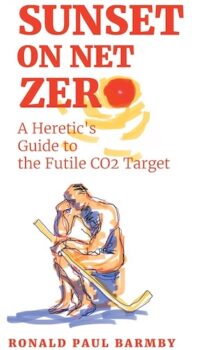
Ron Barmby (www.ronaldbarmby.ca) is a Professional Engineer with a master’s degree, whose 40+ year career in the petroleum sector has taken him to over 40 countries on five continents. His latest book, Sunset on Net Zero: A Heretic’s Guide to the Futile CO2 Target (Amazon, Barnes & Noble), explains in layman’s terms why net zero is pointless, unachievable, and unfair. Ron is a proud member of the CO2 Coalition.


You hit the nail on the head Ron. Ask any energy expert about Net Zero and the answer is “never going to happen worldwide” or in this country any time soon or by 2050. There is currently no replacement for the our use of oil or fossil fuels…. home heating, transportation, ships, aircraft, cars, transport trucks, excavators, agriculture plus the replacement of fossil fuel power generation. Then there is the massive cost of all of this and the mining required if renewables were thought to be the answer…. not going to happen.
Thanks Terry! I think you would enjoy my latest book on Net Zero!
The Schrodinger’s cat problem is a “tempest in a teapot” as it ignores that the only uncertainty is in the mind of the observer. Whether the cat is alive or dead is very clear to the cat’s body (heart and brain). Just because the observer is uncertain, it is wrong to extend or pretend that this mind-question reality extends to the inside of the box. It is sort of like the infant’s “objects permanence” thinking in which a parent ceases to exist for the infant when the parent goes out of sight. Looking in the box settles the question immediately, for sure.