

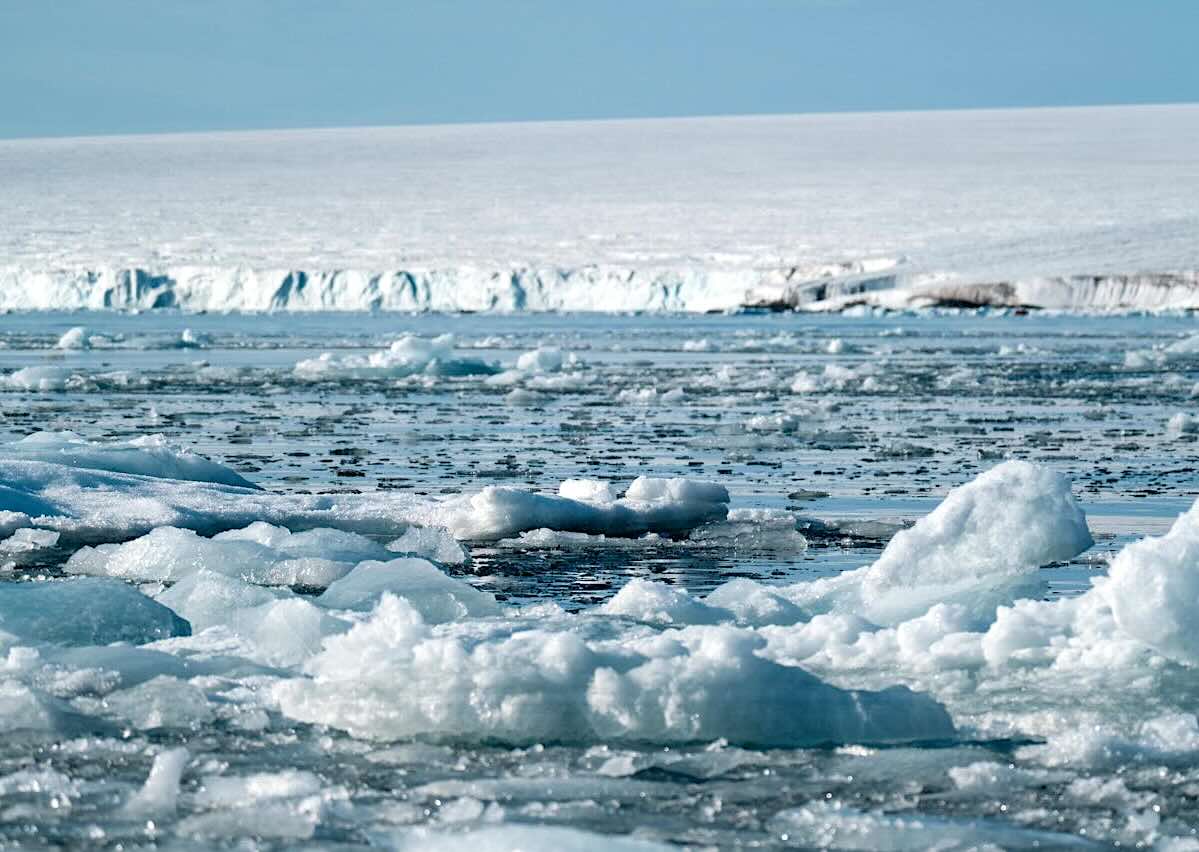
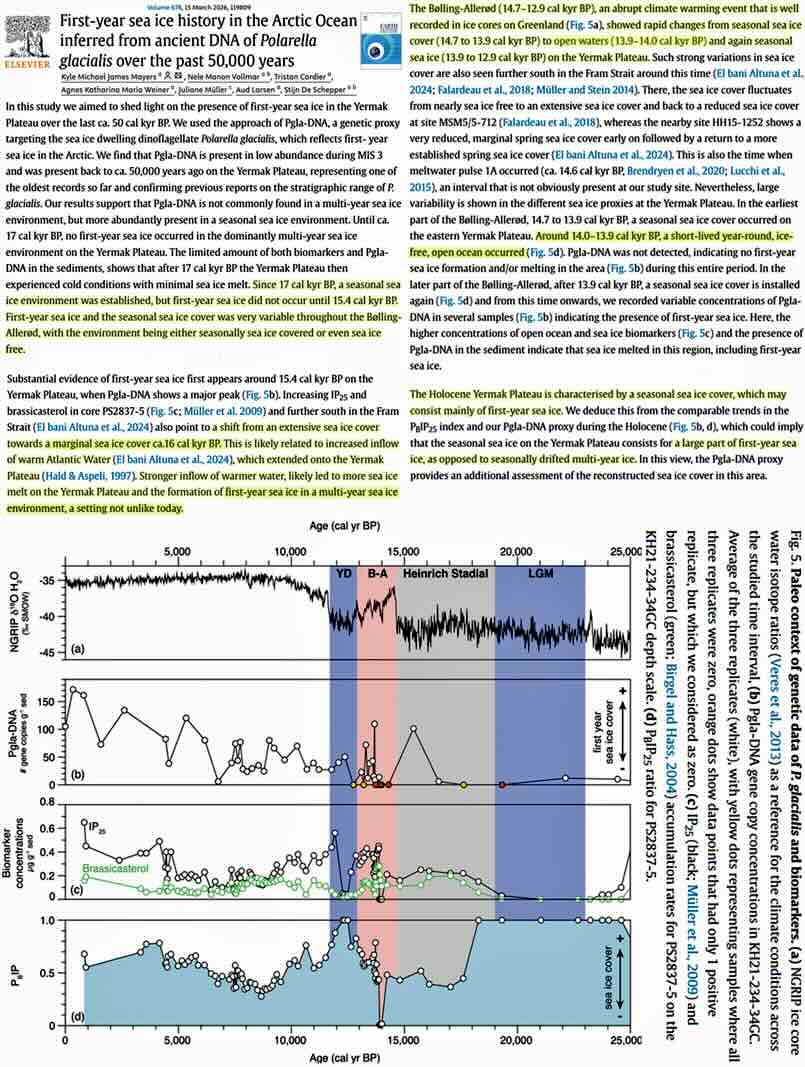
New research utilizing the DNA of dinoflagellate (Polarella glacialis) indicates that, 14,000 years ago, when the atmospheric CO2 concentration is thought to have been 230 ppm, the studied Arctic region (Yermak Plateau) was sea ice-free year-round. [some emphasis, links added]
“Around 14.0-13.9 cal kyr BP, a short-lived year-round, ice-free, open ocean occurred.”
During the Early to Middle Holocene (10,000 to 4,000 years ago), Arctic sea ice was seasonal, dominated by first-year ice that did not survive the summer melt season.
“The Holocene Yermak Plateau is characterized by a seasonal sea ice cover, which may consist mainly of first-year sea ice … a large part of first-year ice, as opposed to seasonally drifted multi-year ice.”
Today, at 430 ppm CO2, Arctic sea ice is increasingly first-year, but a “multi-year environment” persists.
Multi-year sea ice has survived at least one summer melt season, and it continues to thicken over multiple years.
The current phase is similar to the sea ice conditions that predominated ~16,000 years ago, or during the last glacial.
“…a marginal sea ice cover ca. 16 cal kyr BP [characterized by] first-year sea ice in a multi-year sea ice environment, a setting not unlike today.”
If the Arctic Ocean can be ice-free year-round when CO2 was 230 ppm, but is dominated by multi-year ice when CO2 concentration is 430 ppm, this does not support the alarmist claims that high CO2 concentrations are responsible for enhanced Arctic sea ice melt.
Read more at No Tricks Zone







The Yermak Plateau
the plateau serves as a primary gateway for warm water entering the Arctic Basin
The interaction of this warm Atlantic Water with storm-driven ocean mixing causes sea ice entering the plateau’s vicinity to melt rapidly—usually within a few weeks.
Because of this heat delivery, the southern portion of the Yermak Plateau is generally covered only by seasonal sea ice, while its northern edge transitions into the central Arctic’s perennial ice pack
Mooring data collected across a decade-long gap showed that the average sea ice concentration over the plateau dropped from 74% down to just 39%, with some recent years experiencing completely ice-free conditions all year round
The Coastal Polynya System
The primary mechanism behind a year-round or seasonal ice-free Yermak Plateau during the late Pleistocene deglaciation (around 14,000 years ago) was the formation of an extensive coastal polynya system.
Glacial Winds: Strong, freezing katabatic winds blew off the massive Svalbard-Barents Sea Ice
Sheet.Ice Pushing: These fierce offshore winds mechanically pushed sea ice away from the marine ice margin and out of the plateau area.
Open Ocean Enbayments: This process opened up persistent, ice-free areas of open ocean directly adjacent to the crumbling ice sheet walls, keeping the region open even during global cooling periods.