Sky News claims that a recent Alaskan tsunami was caused by a climate change-induced landslide. This claim is speculative at best, since it is difficult to determine whether the particular tidewater glacier is retreating due to warming or other factors impacting glacial movement. [some emphasis, links added]
Climate change and glacial retreat have always occurred, but the media’s overuse of the former conflates natural shifts with supposed human-caused change. This has made it difficult, if not impossible, to discuss natural hazards.
The Sky News article, “Alaskan megatsunami bigger than Empire State Building triggered by climate change,” tries to convince people that using fossil fuels is causing megatsunamis.
Sky News writes, “[t]he wave at the Tracy Arm Fjord in the Tongass National Forest was triggered by a rock landslide which was driven by climate change,” and the “climate change” link goes to a list of Sky News articles connecting natural phenomena to human use of fossil fuels.
This is not true. Recent warming is not entirely human-driven, except locally due to the urban heat island effect.
The amount of warming humans contribute through industry and other activities that release carbon dioxide (CO2) is a matter of ongoing debate. Industrialization has indeed increased the amount of CO2 in the atmosphere.
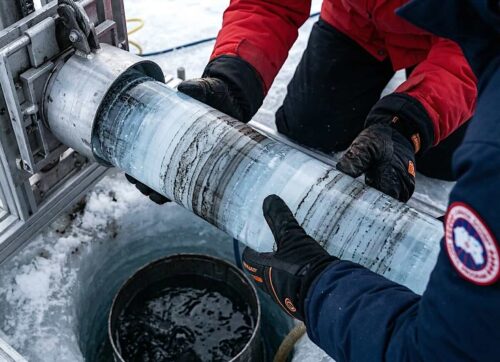
Still, ice core data show that CO2 was gradually rising even before that, most likely due to outgassing from the oceans as the world warmed after the end of the Little Ice Age, as discussed in Climate at a Glance: Natural vs. Human Contributions to Greenhouse Gases and Global Average Temperatures.
Human contributions to greenhouse-gas-related warming are very small, probably around 0.28 percent, because the vast majority of the greenhouse effect comes from water vapor, not CO2.
Modern warming is likewise not unprecedented; in fact, global average temperatures are still lower today than they were during the Holocene Climate Optimum.
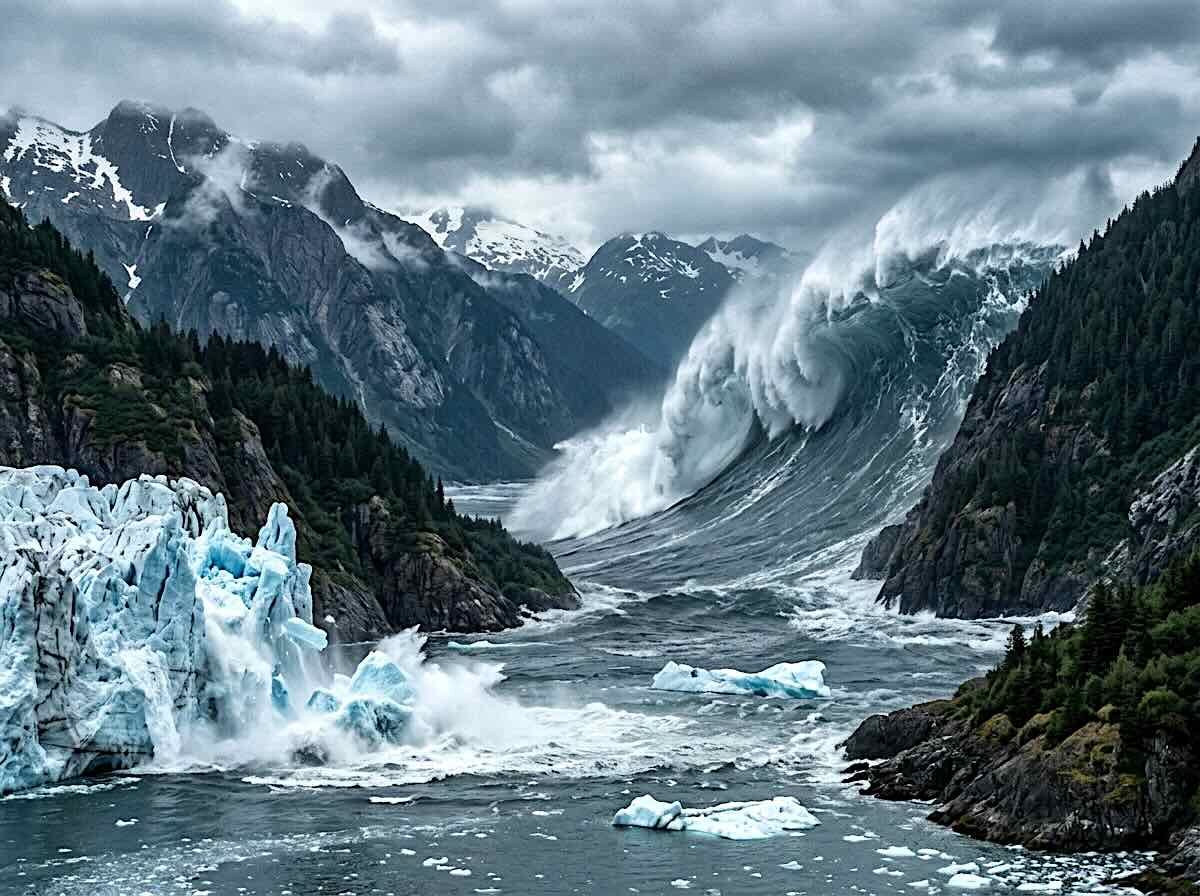
In the case of this tsunami, glacial retreat is said to have destabilized a section of the fjord walls, resulting in a massive landslide, and causing the second-tallest tsunami on record (i.e., that we are aware of) at 1,578 feet high.
The record is still held by the 1958 Lituya Bay landslide-caused tsunami, which reached an incredible 1,720 feet high. No one was blaming climate change back then.
Gradual retreat of glacier ice can destabilize valley walls, as in the Tracy Arm fjord, but whether climate change (human or otherwise) is the main cause of this specific glacial retreat remains unknown.
NASA reports that moderate rainfall was a contributing factor to destabilizing the slope, as is the case with many landslides.
Tidewater glaciers like the South Sawyer Glacier undergo hundred-plus-year-long retreat and advance cycles, and are unique in that they lose ice primarily through calving, or breaking off massive chunks, rather than gradual melting.
Notably, tidewater glaciers are less sensitive to climate during their retreat and advance cycles than other kinds of glaciers. Calving is influenced by water depth (which changes as the ice retreats or advances) and other physical conditions such as mass imbalances.
Today, tidewater glaciers in Alaska are advancing, not retreating, amid the modest warming of the past century.
The Johns Hopkins Glacier is one of them; it has advanced a mile since 1948. It is unclear how global climate change could be causing one tidewater glacier to collapse while others, in the same climatic region, are expanding.
Because there are a lot of factors that influence tidewater glacier cycles, and some Alaskan glaciers’ advances are unaffected by recent modest warming, it is unclear whether to blame climate change – natural or otherwise—for the recent megatsunami, and even more specious for Sky News to blame human activity for it by extension.
Read more at Climate Realism