

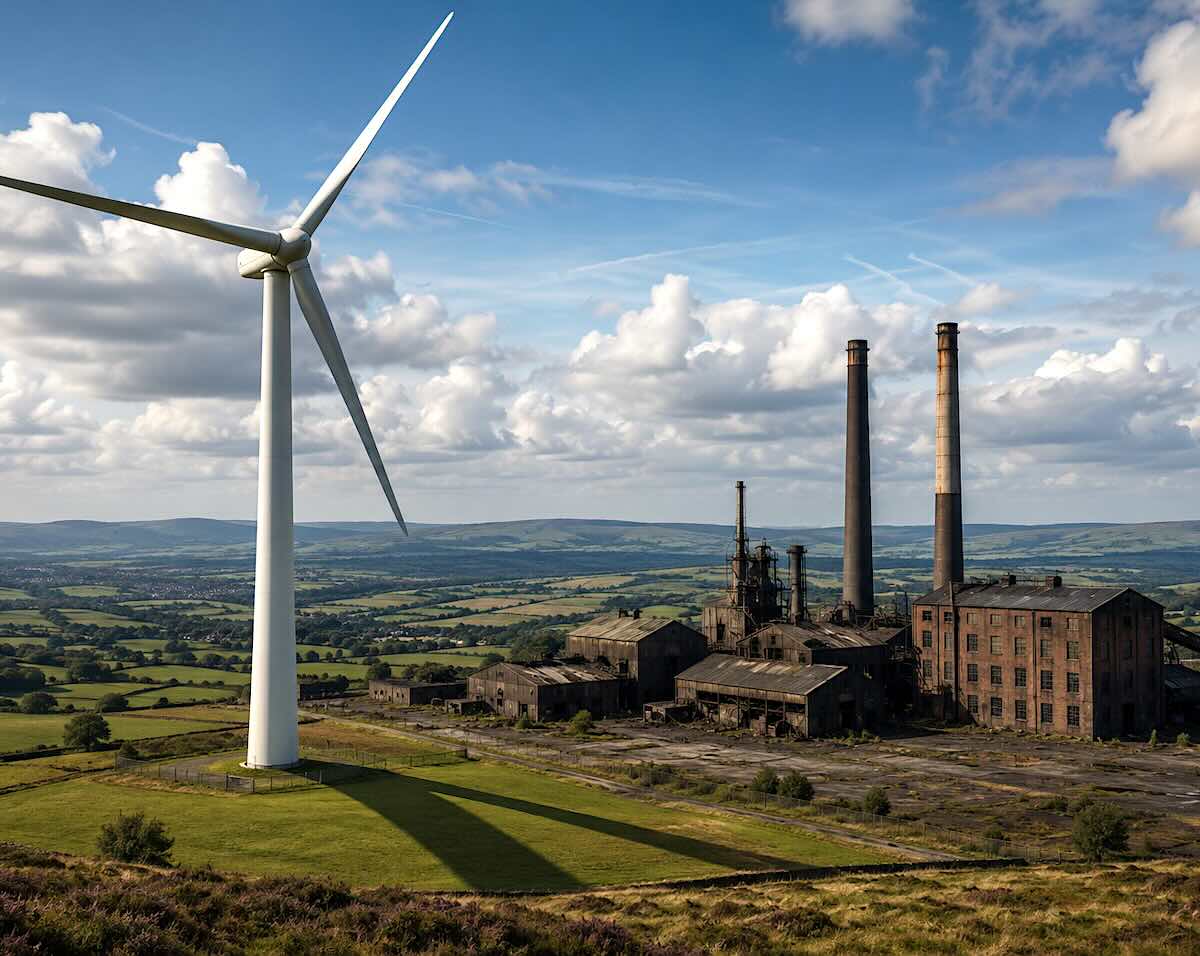
Climate change is real, but Britain can do almost nothing about it. The war against global warming has been lost, with only grievous collateral damage to show for it. We have crippled British industry, hammered consumers and pushed the grid to the brink of blackouts, all with no discernible impact on global emissions and the climate. [some emphasis, links added]
It’s time to accept this sobering reality, cut our losses, cease tilting at (and building) windmills, ditch the despicable con that is net zero, and learn to cope with, and whenever possible, even enjoy a warmer, drier, more volatile Mediterranean climate, if that is indeed to be our fate.
Hubris has ruined us, a tiny nation accounting for 0.8 percent of global CO2 emissions from combustible fossil fuels. We were fooled into believing that we could single-handedly lead the way in saving the world, a futile gambit if there ever were one.
Britain slashed its own discharges by 44 percent between 2000 and 2023, according to the International Energy Agency, yet what good has it done? England is facing a drought, the fields and forests of France and Spain are burning, and a canicule is crippling swathes of Europe.
Britain’s re-embrace of collectivism, of energy rationing, our advanced case of suicidal empathy has achieved little other than putting us at the mercy of China.
The Communist state accounts for 32.1 percent of emissions, pumps out 262 percent more CO2 than in 2000, and is making the most of net zero in Britain and Europe to bolster its own industry and its grip on crucial commodities.
All of our efforts at carbon reduction (and those of the European Union) have been offset many times over by the increase in Chinese emissions; Britain could return to the Stone Age and cut our GDP to zero, and it would still make only a trivial difference.
Even a global government would not have enforced net zero.
Forget worthless treaties: such a body would have been controlled not by Western eco-warriors but by a coalition of Chinese, Russian, Indian, African and South American powers desperate for growth.
Our lanyard classes should have known better than to believe they could re-engineer the world from Whitehall, or even No10 North.
Net zero represents the pinnacle of arrogance, a case study in the illusion of control, a landmark in human vanity and, in Britain’s case, exposes a ludicrously exaggerated view of our own importance given the UK’s negligible economic and environmental footprint in 2026.
Many will disagree with me, of course. It doesn’t matter what is happening globally, they argue: Britain should do what is right regardless. Many in our post-Christian society adopted net zero as a new religion, a code of conduct to replace traditional notions of personal morality.
Cutting carbon emissions was good in and of itself, a moral act, an ethical imperative, irrespective of whether this puritanical zeal actually achieved anything.
Down that road lies madness. We must judge policy purely by real-world consequences. On that metric, net zero must be scrapped.
Yes, climate change will impose many well-rehearsed costs on Britain, and there will be plenty of losers, but it is pointless seeking to prevent the inevitable. There will also be benefits and winners. We need to help the former group, but focus on maximizing the size and gains of the latter.
Adaptation, not useless mitigation, is the rational solution to unstoppable climate change. We need universal air conditioning and irrigation. We must stop building horrible flats that turn into furnaces in the summer, and construct more pools. We may have to plant more Mediterranean vegetation.
We need to maintain our fields and forests to reduce the risk of fires, and purchase firefighting planes, lessons that the French are also promising to take more seriously. We will require water reservoirs, pipelines and desalination plants; for that, abundant, cheap electricity will be a must.
Read rest at The Telegraph


Having visited the UK two times in my life, it is my opinion that a little global warming would be very good news there, and should be celebrated
Even if it was important, net zero will fail because there is no reliable and affordable substitute for fossil fuel energy
Yes indeed. There is no place for wind and solar on the grid, quite apart from the windless nights, which are the immovable object in the way of the transition. Schernikau and Smith explained that wind and solar are too inefficient to reproduce themselves, and so they are parasites on the grid and they are a net drain on the energy economy of the world.
CO2 he is greening the planet, and more will be better. Its modest warming effect was exhausted due to diminishing returns many decades ago.
What are the well-rehearsed costs that will arise from mild warming?
The warming since the Little Ice Age has been unequivocally beneficial, and we are still short of the best times in recorded history during the Roman warm period.
Within the bandwidth of temperatures experienced in recorded history, warming has been beneficial, which is not surprising because warmth favours growth. The corals in warmer waters grow faster than the corals on the Great Barrier Reef in Australia, and yet we are told if we don’t stop burning coal, warming will kill the reef. This is preposterous.
Meanwhile, trillions have been spent around the Western world on the scientifically meaningless quest of decarbonization. Consequently, we have crippling power prices, looming blackouts in Great Britain, Germany, and Australia, and incalculable damage to forests and farmlands to make way for short-lived intermittent energy generators.
There are no local proxies, when averaged, that show any period in the past f5000 years was warmer than the past 10 years. The warming in the past 50 years is unusually large for an interglacial period, but most people prefer warm periods so what’s the bad news
Warming caused by CO2 alone is especially good news because it is mainly in colder climates during the colder months of the year and at night
Warming during the day is mainly caused by a reduction of air pollution, so I suppose we could bring back the air pollution of the 1970s to cool off the days?
What damage has been done by warping in the last ten years?