

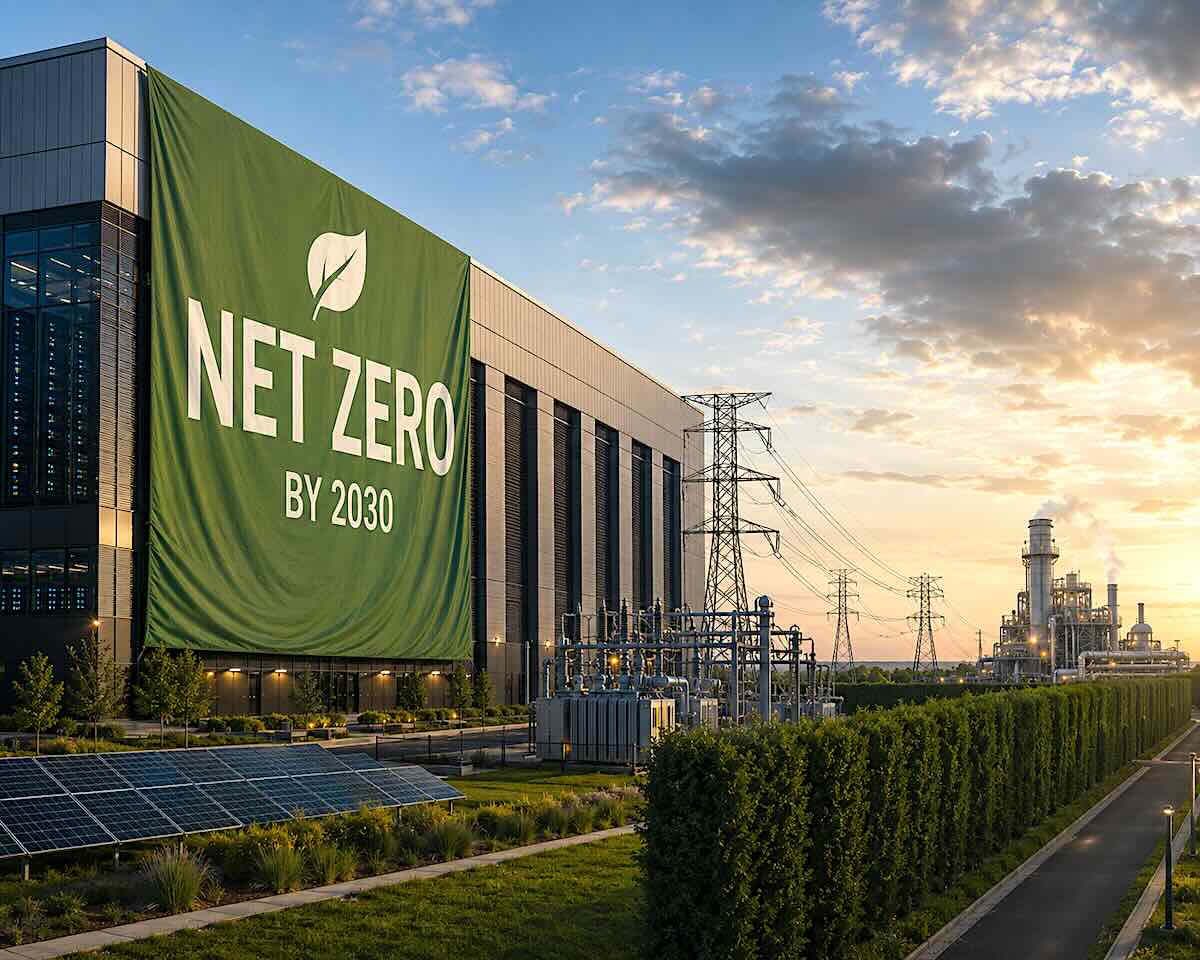
Back in July 2024, I had a post titled “Big Tech On The Path To Net Zero.” Here was the introductory paragraph [some emphasis, links added]:
“Among the adherents to the cult of climate change, nobody can claim a higher level of sanctimony than the Big Tech behemoths — the likes of Google, Microsoft and Meta. These new economic titans fancy themselves to be totally unlike the dirty and grubby industrial companies of the past, like the steel, automobile or oil producers with their belching smokestacks. Each of these new tech powerhouses loudly proclaims its sacred and unwavering commitment to ‘net zero’ emissions by some early date, typically 2030.”
At the time of that post, all three of those Big Tech behemoths, besides maintaining their own supposed paths to “net zero,” were also engaged to one degree or another in censoring and/or demonetizing and/or downgrading anybody who dared to deviate from the so-called “climate consensus” — whatever that may be.
And as they censored and demonetized anyone who deviated from the climate religion, each of those tech giants published their own annual “environment” or “sustainability” reports proclaiming their own strict adherence to the official orthodoxy.
My 2024 post linked to the 2024 Reports from Google and Microsoft, and to the then-most-recent 2023 Report from Meta. Those Google and Meta Reports can be found here and here; the Microsoft 2024 Report seems to have mysteriously disappeared from the internet.
In 2024, the AI craze and the accelerated infrastructure buildout by tech giants were just getting started.
Today, all of them are engaged in a mad race to build the most and the fastest. In this light, the bloviation of the 2023 and 2024 “sustainability” reports makes truly entertaining reading today.
Here are a few excerpts from the intro to the Google 2024 Report:
“Since our earliest days, we’ve been on an ambitious journey to help build a more sustainable future. … To help minimize our environmental footprint, we’ve built world-leading efficient infrastructure for the AI era. … We strive to build the world’s most energy-efficient computing infrastructure. … In 2017, Google became the first major company to match 100% of our annual electricity consumption on a global basis with renewable energy, which we’ve achieved every year since [what does that mean?]. … Building on our first two decades of progress, in 2020 we launched our third decade of climate action—our most ambitious yet. … We have a bold goal to reach net-zero emissions across all of our operations and value chain by 2030. …”
And from the Meta 2023 “Sustainability” Report:
“We are now reaching toward the goals of net zero emissions across our value chain and becoming water positive throughout our operations, aiming to achieve both of these milestones in 2030. Meta’s net zero in 2030 goal focuses on embedding sustainability into everything we do, whether designing products, commuting, selecting construction materials or working with suppliers to set their own net zero targets.
“For example, through our Net Zero program, we work closely with suppliers to determine their Scope 1, 2 and 3 emissions, set reduction targets and promote strategic action. … We are committed to protecting what is truly important: The well-being of people and our planet. … [We] take bold climate action by minimizing our footprint, championing renewable energy, restoring water resources, engaging our suppliers and supporting climate justice.”
Blah, blah, blah, blah, blah.
Well, fast-forward to July 2026 — with the AI and data center buildout in full swing — and Google is just out with the 2026 version of its Report (PDF) — 116 pages long.
You would think that they would simply give up and walk away from this nonsense, but instead they try to keep up the brave talk.
The Executive Summary is all about misdirection:
“At Google, we’re deeply committed to responsibly managing the environmental footprint of our operations and unlocking the power of AI for the planet. … The AI revolution has made the last five years especially transformative, and we’re proud of the progress we’ve achieved. In 2025 alone, we signed agreements for over 12 GW of net-new clean energy. By combining this record-breaking procurement with our industry-leading infrastructure, we’re working to ensure that every megawatt is used as efficiently as possible. …
“It was with this same bold spirit that, at the beginning of the decade, we set net zero and 24/7 carbon-free energy2 (CFE) moonshots that were intentionally aspirational and designed to push the frontiers of what’s possible in energy systems and data center operations. …
“Our moonshots pushed us to meet this moment, and the scale of our impact has similarly undergone a step-change. In 2025, we contracted for eight times more clean energy than we did in 2019. Furthermore, the emissions we successfully avoided in 2025 represent seven times the size of our 2019 ambition-based carbon footprint.…”
More blah-di-blah-di-blah.
Guys, your promise was not to procure more “clean energy” or to “make every megawatt as efficient as possible.” It was “net zero” by 2030. Any progress on that?
To get the answer, you’ll need to make it all the way to page 69, to a section titled “Progress update/carbon footprint”:
“In 2025, our total ambition-based emissions were approximately 14.5 million tCO2e [tons of carbon dioxide equivalent]. … Our total ambition-based emissions increased 18% compared to 2024—primarily driven by increases in supply chain activities that supported the rapid expansion of our business. We recognize that our climate impact has been growing alongside the unprecedented growth of AI, and we’re actively working to minimize this impact.”
What a joke.
Over at Meta, they’re still a year behind in reporting. But the basic story is no different. Here is a link to their (most recent) “2025 Sustainability Report.” Here’s the same sort of misdirection in the introduction:
“We are taking a multifaceted approach to implementing emissions reduction strategies that includes procuring clean and renewable energy and exploring innovative technologies like energy storage and geothermal energy. As a result of our clean and renewable energy procurement, we have reduced our emissions by 23.8 million metric tons (M MT) of carbon dioxide equivalent (CO2e) since 2021.”
I’ve gone through this entire Report, and I can’t find any actual comparison of 2025 emissions versus 2023. Maybe I missed it.
On page 70, there is a link labeled “environmental metrics.” It doesn’t even say what is there, but if you go there, you will find a chart headed “Total GHG Emissions.” Those are reported to have been 7,443,182 MtCO2e in 2023, and 8,150,595 in 2024 (most recent year reported).
That’s an increase of about 9.5% in that one year.
And here’s the latest about Meta, not from Meta itself, but from Yahoo Finance on July 24:
“Meta quits clean energy pledge amid gas-powered data center push. Meta has abandoned a global pledge by leading companies to source all of their electricity from renewable sources, the social media giant confirmed Friday. Meta joined the pledge in 2016 according to a Wayback Machine archive of RE100’s website. The departure comes amid a frenzied data center buildout by leading tech companies. Meta has struck deals paying utilities to bring new natural gas power plants online, including 10 to power its Hyperion data center in Louisiana alone.”
I understand that a little hypocrisy is inevitable in this world. But after the level of sanctimony that these guys have engaged in, let alone censorship of others, nobody should forget that it was all a scam from the outset.
Read more at Manhattan Contrarian







Do these companies also take into account what it takes to manufacture all those computers, storage arrays, and everything else that goes into the data centers not to mention all the concrete (very CO2-intensive), steel, refrigeration units, and everything else needed to construct those giant data centers? Or it is just the electricity needed to run them?
Very good article but it failed to mention that this technique is called greenwashing