The Independent claims in “Vital Atlantic current likely to collapse with catastrophic consequences, scientists warn” that the Atlantic Meridional Overturning Circulation (AMOC) is significantly more likely to shut down within decades, plunging Europe into extreme winters and triggering global disruption.
This is wrong-headed speculation.
The article relies heavily on extreme computer model simulations built on high-emissions assumptions, ignoring the observational record of the AMOC, which shows little or no evidence of an imminent collapse.
The article asserts that AMOC “could pass the shutdown tipping point within the next couple of decades,” and that a slowdown of 42 to 58 percent by 2100 is “almost certain to end in collapse.”
That strong claim is based solely on modeling exercises, not direct measurements of a system in free fall.
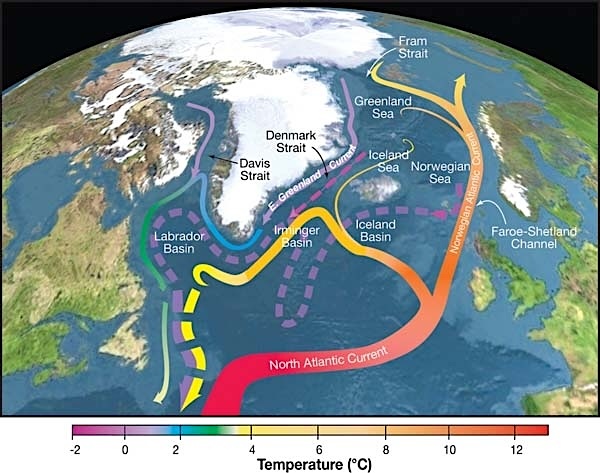
Even the article acknowledges that analyzing the AMOC, shown in the figure below, is “an incredibly complex process” with “widely varying results” ranging from no drop at all to a massive slowdown. That admission is key.
Published science over the past decade has pointed in three different directions: some studies projecting collapse, others indicating relative stability, and still others suggesting potential strengthening in certain regions depending on wind-driven upwelling and Southern Ocean dynamics.
In fact, the article itself references a recent Nature study showing that wind-driven upwelling in the Southern Ocean can prevent total collapse this century, even under extreme scenarios.
It also notes that 34 climate models analyzed under extreme forcing scenarios showed weakening of 20 to 81 percent over 90 years, yet none predicted a complete collapse.
That is hardly evidence of a near-term collapse being in the offing.
The core issue is model dependence. The study highlighted by The Independent blends limited real-world observations with climate models run under high-end emissions pathways and large freshwater influx scenarios.
These are stress tests. They are not forecasts. They assume strong anthropogenic (human-caused) forcing and then examine how models behave.
The high-end emission scenarios have increasingly been rejected, even by those who argue humans are causing climate change, as being unrealistic and likely impossible.
Climate models are useful tools, but they are not reality. Their reliability in simulating ocean circulation over century timescales remains limited. Small changes in parameterization, freshwater flux, wind forcing, or vertical mixing can dramatically alter projected AMOC strength.
That is why scientific literature shows divergence rather than convergence on the idea of a collapsing AMOC.
The observational record does not show a collapse. Direct measurements of AMOC strength from the RAPID array at 26.5°N, which has been operating since 2004, show variability but no clear long-term downward trend indicating imminent shutdown. Paleo proxies used in that study suggest multidecadal variability has always occurred.
The tipping-point rhetoric also deserves scrutiny. “Collapse” implies an abrupt and irreversible shutdown.
But the article itself acknowledges that even studies showing significant weakening do not necessarily predict a full switch-off. Weakening is not collapse. Variability is not collapse. Modeling a threshold is not observing one.
This is not the first time dramatic AMOC headlines have circulated.
Over the past decade alone, media coverage has oscillated between declaring imminent collapse, reporting stabilization, and highlighting studies showing wind-driven mechanisms that sustain circulation. Climate Realism has debunked over a dozen such stories in the last few years.
Ocean circulation depends on temperature gradients, salinity, wind forcing, freshwater input, and deepwater formation processes. It has fluctuated throughout the Holocene without industrial CO2 forcing. Abrupt events in the paleoclimate record occurred under vastly different boundary conditions.
What The Independent presents is a single model-derived study framed as the most “realistic outcome.” It selects the most alarming end of a wide range of outcomes and presents it as the likely future.

Based on realistic assessments of the emission scenarios driving the model and real-world data, the presentation of the scenario as realistic is false.
The Intergovernmental Panel on Climate Change (IPCC) Sixth Assessment Report states that while AMOC weakening is likely over the 21st century under high emissions scenarios, there is low confidence in a collapse before 2100. That cautious assessment stands in contrast to headlines suggesting shutdown within decades.
Extreme simulations produce extreme headlines, but extraordinary claims require extraordinary proof, and none have been presented here.
Ocean circulation science is unsettled. Models disagree. Observations show variability. Published studies over the past decade have projected collapse, steady-state behavior, and even strengthening under certain dynamics.
The Independent declaring a looming catastrophe based on one modeling study doesn’t represent balanced, informed science reporting. Rather, it is acting as a promoter for an alarming, unlikely climate narrative, which may attract readers but simultaneously does a disservice to them and sound science itself.
Read more at Climate Realism