


Religion has been a force throughout history that has helped societies flourish and given people meaning, but it has also been a vehicle for fundamentalism and intolerance. [some emphasis, links added]
A religion can be characterized by a common set of beliefs about the nature of existence, ritual practices, moral codes, and a community of people who share these same faiths.
From this standpoint, climate alarmism has become nothing short of a religion, one that has been taking over societies around the world.
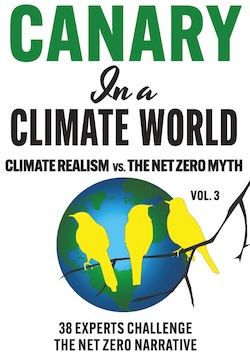
The newly released book, Canary in a Climate World: Climate Realism vs. the Net Zero Myth, is an eye-opening compilation of essays by 38 experts about the science of climate change, the fallacies of net zero, and the story that the government and media are not telling.
Margaret Anna Alice, a writer focusing on propaganda and psychology, writes in her Canaries’ essay how she lost her “religion” of climate alarmism, which for her had been an “inviolable belief.”
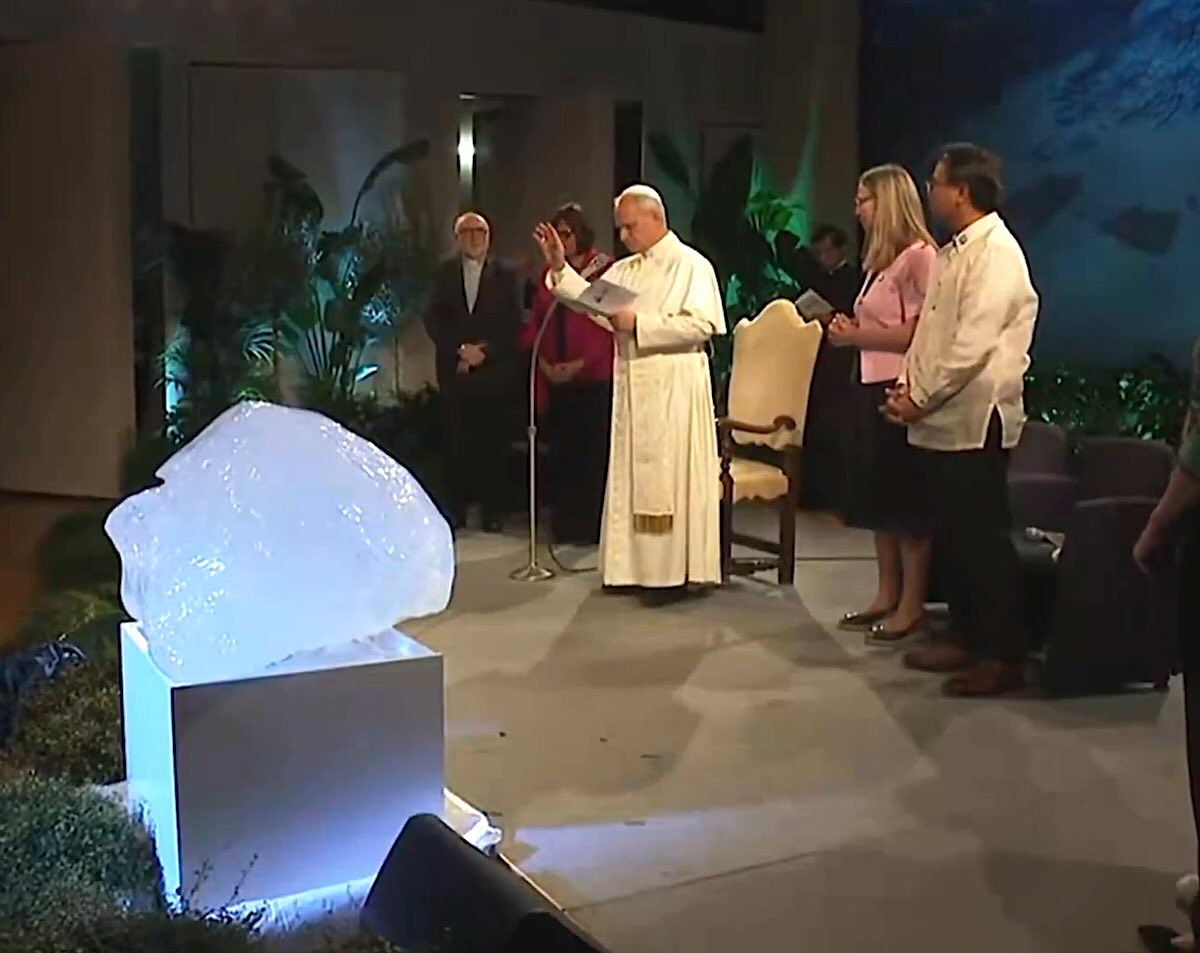
She writes that “In this religion, gods such as the United Nations carve out the Ten Commandments in the form of Sustainable Development Goals (SDGs), Agenda 21, Agenda 2030, and the SDG7 Global Roadmap for achieving Net Zero emissions by 2050.”
Additionally, “sermons” cite the “sacred texts” of the United Nations’ Intergovernmental Panel on Climate Change (IPCC), shaming everyday citizens into believing that they are contributing to a devastating environmental catastrophe.
It is only by aligning themselves with the religion of climate alarmism that they will be redeemed for their sins by giving up their standards of living and putting their hard-earned money toward expensive projects to reduce carbon dioxide (CO2) or subsidize intermittent, expensive renewable power such as wind and solar.
Just like the church in Medieval Europe, the climate doctrine is widespread and encroaches on our daily lives.
Yet data corruption abounds at the IPCC and other official institutions, and for decades, few scientists have dared to speak out against it with their livelihoods on the line.
These “heretics” are ostracized, lose their jobs, or are refused funding. But the tide is shifting. With the serious consequences of climate policies being enacted, now is the time to reveal that the climate scare is based on corruption and flawed ideology.
Governments will spend trillions of dollars and drive their citizens into poverty if we continue down the route to net zero. IPCC contributor Mike Hulme admitted that “[t]he debate around climate change is fundamentally about power and politics rather than the environment.”
And the scientists and experts writing in Canary in a Climate World: Climate Realism vs. the Net Zero Myth are also disseminating crucial information to help us better understand the climate and the policies that have stifled our society’s growth for decades.
In physicist Dr. William Happer’s essay “Canaries,” he explains how “climate science” has corrupted true scientific disciplines and become a cult. That cult’s fundamental tenet is that “carbon dioxide is the control knob of Earth’s climate.”
Yet true science is about how well a theory’s predictions agree with observations and how well it can predict previously unobserved phenomena.
Climate alarmism has failed this crucial test, and so it “is not a scientific theory, since it has made many alarming predictions and none have turned out to be true.”
Dr. Happer compares climate alarmism to the geocentric view of the universe in the 1600s during the time of the scientist Giordano Bruno. Bruno was burned alive by Pope Clement VIII for promoting the idea that the Earth revolves around the Sun, and later that century, Galileo Galilei was nearly subjected to the same fate for similar views.
But the church did not want to look at the evidence: dogma is what ruled, and scientists today are facing ostracism, threats, and “cancellation” due to their views on climate change, even if they are well supported scientifically.
For another inside view, astrophysicist Dr. Willie Soon writes in his Canaries essay that “Climate research today is overwhelmingly dependent on government funding…research that reinforces existing frameworks is rewarded with continued funding…while research that challenges foundational assumptions becomes increasingly difficult to pursue.”
Researchers are trained to ask “safe” questions that align with the current dogma; reviewers censor any research papers that question the status quo. “The result is a form of scientific monoculture,” Dr. Soon writes. Indeed, it has become an orthodoxy that parallels a religious sect.
But science is antithetical to dogma: at its core, the scientist’s goal is to question assumptions and probe the inner workings of the world. And so most research into climate change is running counter to science entirely.
Science is always evolving, and when evidence arises that contradicts a scientist’s previous theories, they must question their previous assumptions and adjust their theories accordingly.
Read rest at America Out Loud


True