


Consider how prominent voices in the climate discussion describe the link between fossil fuels and extreme heat [some emphasis, links added]:
- World Weather Attribution claims that scientists can now “predict how heat waves will grow more frequent and intense unless emissions are cut drastically.”
- A climate scientist, David Faranda, argued that to prevent severe early-season heat across India and Pakistan: “The only sustainable solution is to stop burning fossil fuels and reduce emissions.”
- UN Secretary-General António Guterres, in his Call to Action on Extreme Heat, agreed: “To tackle the root cause, countries must phase out fossil fuels — fast and fairly.”
Such claims are ubiquitous: fossil-fuel emissions are framed as a control knob for extreme weather, and turning the knob down will reduce extreme weather incidents.
In fact, much of climate advocacy is grounded in claims that climate change causes undesirable weather, and the solution must therefore be to transition away from fossil fuels quickly.
Today’s post takes such claims seriously and explores the science behind them in the context of European heat waves.
Could decarbonization actually increase European heat?
Recall the causal structure from Part 1. Atmospheric circulation generates a heat wave, and dry soils, brightened skies, warmer upwind seas, and city surfaces make it hotter. Greenhouse gases raise the energy in the climate system but do not cause the weather.
Cutting carbon dioxide (CO2) therefore acts on one input only, and slowly: soil moisture, jet-stream patterns, and the heat already stored in the Mediterranean and the Atlantic do not respond to an emissions cut the way a room responds to a thermostat.
Part 1 also discussed the hypothesis that cleaner air drove a large part of Europe’s rapid summer warming since 1980; as sulfate pollution fell, more sunlight reached the surface, adding about a half degree of regional warming (Schumacher et al. 2024) and possibly reshaping circulation patterns toward conditions more favorable for heat waves.
If that hypothesis is correct, then reducing the burning of fossil fuels, and thus CO2 emissions, would also contribute in the near term to increased heat waves in Europe: Stopping the burning of coal, oil, and gas also reduces particulate pollution. Those aerosols mask some warming by reflecting sunlight.
Globally, aerosol cooling offsets a substantial share of greenhouse warming; removing the aerosols unmasks that warming. In some projections, the near-term warming from reducing aerosols rivals the warming avoided by cutting CO2 itself (Palazzo Corner et al. 2023).
The point here is not against cutting CO2 emissions. It is against the claim that reducing those emissions is a solution to Europe’s heat waves, as cutting emissions might not deliver what is promised.
When would we detect the effects of reducing emissions?
Let’s assume that the world achieves net-zero CO2 emissions: When would we detect the effects on the climate?
The scientific literature provides a clear answer: not soon. Tebaldi and Friedlingstein (2013) found that even under an assumption of strong mitigation, a change in the global mean temperature trajectory might not be detectable until later this century (e.g., “up to 60 y[ears] for RCP4.5 vs. RCP2.6”).

At the regional scale, the time of emergence for climate-mitigation impacts would necessarily be longer than at the global scale. For extreme events, longer still.
For European heat waves under strong mitigation policies: When would European heat-wave frequency stop climbing, and when might they turn down?
A sensitivity analysis of a modeled climate under net-zero CO2 emissions — and no other changes to forcings, including aerosols — finds that extreme heat frequency over the Northern Hemisphere might be reduced by 40% over a century after reaching net-zero (Cassidy et al. 2023):
“Land-based hot temperature extreme frequencies are projected to decrease as much as 40% within the century after net zero CO2 emissions, with largest reductions over land in the Northern Hemisphere. Reduction in land-based local monthly temperature extreme frequency within only a century after CO2 emissions cessation is a promising result, as heat extremes can have severe infrastructural impacts and can lead to loss of life.”
We can take these idealized numbers and perform a quantitative thought experiment. The figure below shows the same data that I shared in Part 1 — European heat-wave days have increased since 1950 — as the dark blue bars.
I assume that the increasing trend of 2.6 more heat-wave days per year continues until 2060, when I assume that the world hits net zero. At that point, I assume a 40% reduction in the number of heat-wave days over the following 100 years (to 2160), following Cassidy et al. 2023.
For the entire projected time series of 2019 to 2160, I have included random variability of the same magnitude as in the data from 1950 to 2018.
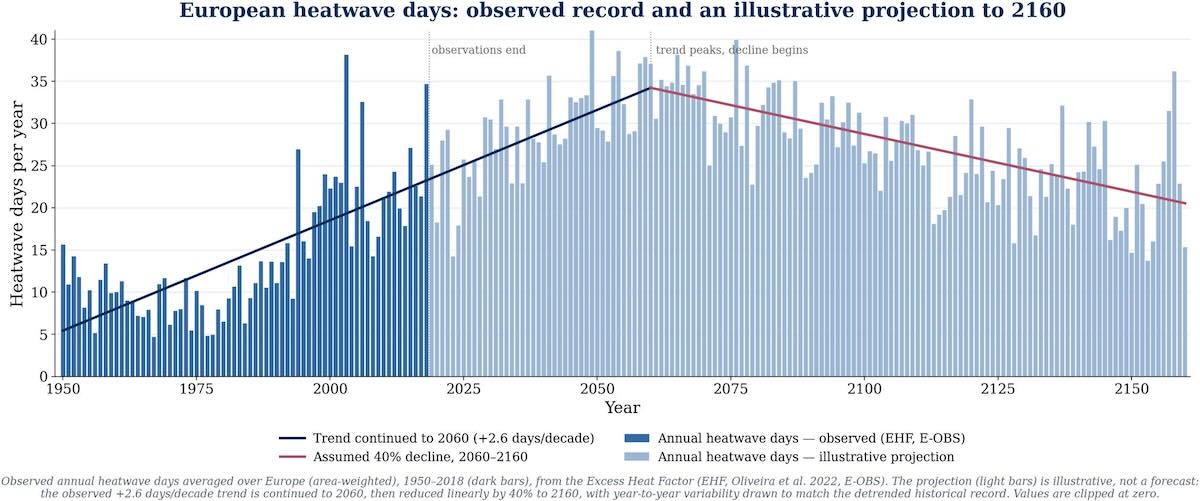
The thought experiment illustrates clearly why reducing emissions — even to net zero by 2060 — is not a “solution” to heat waves.
In this idealized example, mitigation does have benefits in the form of reducing heat-wave days over the century after reaching net zero. Yet, at the same time, there would be no detectable reduction across the lifetimes of anyone alive today.
Even in 2160, the number of European heat-wave days (~20 per year) would be similar to that of the 2020s (~20 per year). And in reality, net-zero by 2060 is a questionable assumption.
This gets to a core challenge of framing mitigation as weather control — the time scale of promised benefits, even in the best of cases, is far, far longer than the time frame for the costs of action.
Aligning costs and benefits closely in time makes good political sense, in most any policy contexts — but it also means leaving behind promises of better weather through climate policy. I do wonder if climate advocates are too vested in such promises ever to leave them behind.
This thought experiment does not include the possibility that unmasked aerosols might increase heat-wave days following net zero or that internal variability is larger than suggested by the period covered by the original time series.
Other literature suggests that the climate system’s response to achieving net-zero is more complex than simply reversing changes leading up to net zero (see, e.g., Smith et al. 2025 and King et al. 2025).
Such possibilities mean that this thought experiment might be unrealistic in assuming that CO2 emissions reduction is actually a “control knob” for heat wave days. But even under this scenario, reducing CO2 emissions does not fundamentally change the nature of the heat-wave problem facing Europe.
The Honest Broker is written by climate expert Roger Pielke Jr and is reader-supported. If you value what you have read here, please consider subscribing and supporting the work that goes into it.
Read rest at The Honest Broker





There is no chance that the rise in the Keeling curve however generated will be checked in our lifetimes. So relax and realise that CO2 emissions do not affect the weather