The Honolulu Civil Beat article “How Is Climate Change Shaping Tropical Storm Lala?” claims that then-Tropical Storm Lala demonstrates how climate change is making hurricanes stronger and that Hawaii should expect more powerful tropical cyclones as the planet warms. [some emphasis, links added]
This is highly misleading, if not outright false.
The best available evidence suggests that hurricanes remain highly variable from year to year; long-term observations do not show that climate change is causing stronger hurricanes overall; and the article repeatedly conflates a single weather event with long-term climate trends, despite no evidence of a trend toward more intense hurricanes.
Perhaps the biggest weakness in Civil Beat’s reporting is that it starts with a storm and works backward to climate change. That is not how science works.
A single hurricane, no matter how unusual, cannot demonstrate a long-term climate trend. Meteorologists have always distinguished between weather, which describes individual events, and climate, which describes long-term statistical patterns.
Civil Beat repeatedly blurs that distinction, suggesting Tropical Storm Lala is evidence that climate change is reshaping Hawaiian hurricanes without showing that long-term hurricane activity has actually changed.
The historical record does not support that conclusion.
Data and research cited in Climate at a Glance show that neither global tropical cyclone data nor U.S. hurricane records demonstrate a long-term increase in hurricane frequency or intensity attributable to human-caused climate change, as seen in the Figure below.
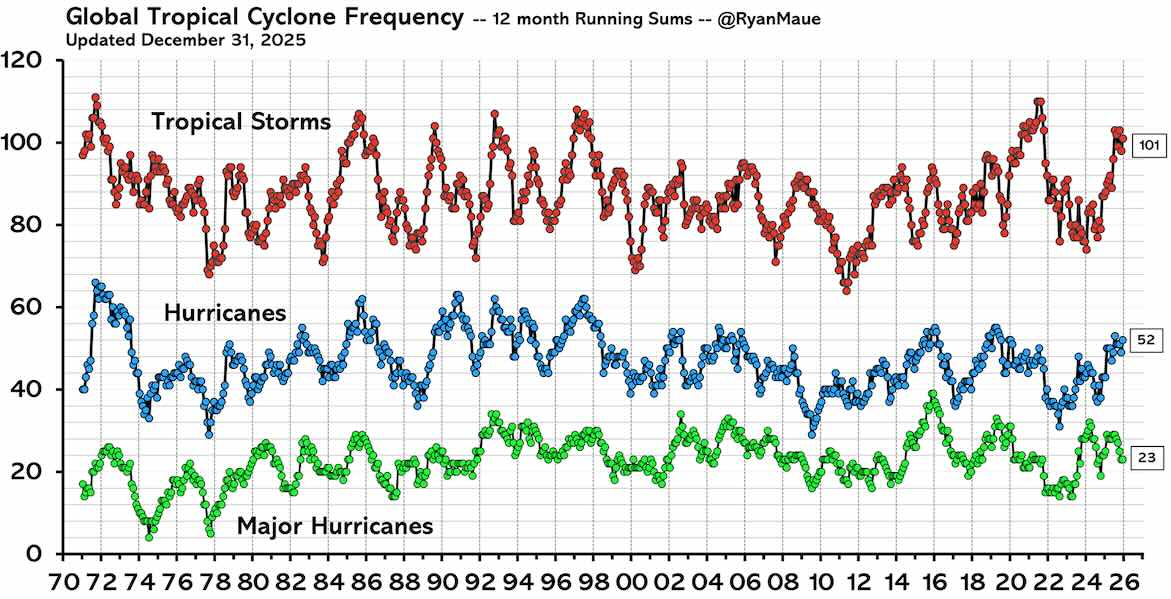
Hurricanes have always varied considerably from year to year and decade to decade, driven largely by natural ocean-atmosphere cycles rather than steadily increasing greenhouse gases.
Ironically, Civil Beat includes evidence that undercuts its own narrative. The article acknowledges that this year’s developing storm is occurring during a strong El Niño and notes that El Niño naturally warms portions of the Pacific Ocean.
It also quotes University of Hawaii professor Steven Businger, who acknowledges that “the relationship between El Niño and climate change is not well-documented or understood” and that Hawaii sits in “a special pocket of very little” long-term sea surface temperature change.
Those are remarkable admissions.
If one of the article’s own experts says the relationship between El Niño and climate change remains uncertain, and that Hawaiian waters have experienced relatively little long-term warming, then attributing Lala’s strength to climate change becomes untenable and [indicates the headline’s connection] is wrong.
Instead of emphasizing that uncertainty, Civil Beat quickly pivots back to climate change being a causal factor in Lala.
The article repeatedly argues that warmer ocean temperatures provide additional energy for hurricanes. That statement, by itself, is true. Hurricanes require warm water to form. But water warmth is only a necessary, not a sufficient, condition for hurricanes to form.
Warm tropical oceans have fueled powerful hurricanes for millennia. The Pacific Ocean routinely exceeds the temperature threshold required for tropical cyclone development during summer. Warm water is hardly a new phenomenon.
More importantly, hurricane intensity depends on far more than sea surface temperature.
Wind shear, atmospheric moisture, upper-level winds, ocean heat content, storm structure, dry air intrusion, and numerous other atmospheric factors determine whether a tropical storm strengthens or weakens.
Civil Beat largely reduces this complex science to a single variable, warmer oceans, while giving readers the impression that stronger storms naturally follow.
The observational evidence says otherwise.
Climate at a Glance’s reviews of both global tropical cyclones and Atlantic hurricanes show no clear long-term increase in hurricane frequency or accumulated cyclone energy attributed to climate change.
Likewise, the proportion of major hurricanes has varied substantially over time without exhibiting the steady upward trend frequently claimed in media coverage.
Nor did the U.N. Intergovernmental Panel on Climate Change cite any evidence that climate change had altered hurricane behavior, formation, or strength in either its 2018 interim report, which stated there is only “low confidence for the attribution of any detectable changes in tropical cyclone activity to anthropogenic influences,” or its most recent AR6 WG1 report.
This is why Climate Realism has repeatedly challenged similar reporting. Time after time, media outlets seize upon an individual hurricane and immediately invoke climate change, even when long-term hurricane records fail to support the narrative. Numerous examples documenting this pattern can be found in Climate Realism’s extensive coverage of hurricane reporting:
Another weakness in Civil Beat’s reporting is its reliance on climate model projections. The article cites modeling from 2016 projecting more hurricanes near Hawaii in coming decades.
Climate models are not observations. Models are useful tools for exploring hypothetical futures under particular assumptions. They are not evidence that those futures will actually occur.
Yet throughout the article, projected changes are presented alongside an ongoing tropical storm, encouraging readers to blur the line between forecasts and observed reality.
Perhaps the most telling sentence appears near the end of the article.
Civil Beat notes that if Lala causes significant damage, scientists may perform a rapid attribution study to determine whether climate change altered the storm’s likelihood or intensity.
Notice what that means: the attribution has not yet been assessed. Yet the headline and much of the story already encourage readers to view the storm through the lens of climate change before any formal analysis has even taken place.
That is advocacy, not objective reporting.
Good science begins with observations and tests hypotheses against long-term data. Good journalism should do the same.
Instead, the Honolulu Civil Beat starts with the assumption that climate change is shaping Hawaiian hurricanes and then assembles supporting quotations while giving comparatively little attention to any confounding evidence, like the observational hurricane record, which would undermine the article’s predetermined thesis.
As a result, the Honolulu Civil Beat is living in la-la land.
Read more at Climate Realism