

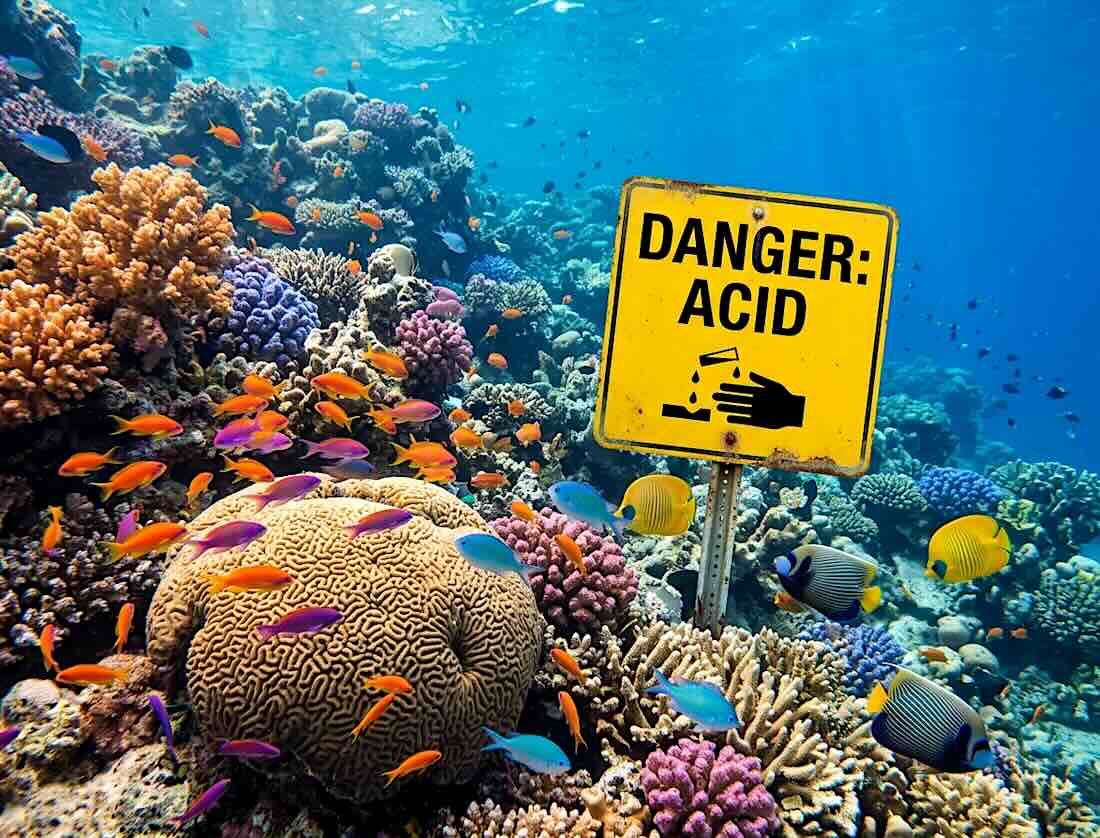
Ocean “acidification” is a somewhat unique branch of the overarching climate scare. It differs from other branches of the big scare in that it does not depend on atmospheric heating as the driver of the supposed scary consequences. [some emphasis, links added]
Instead, with ocean “acidification,” the idea is that increased CO2 in the atmosphere (from the burning of fossil fuels) leads to increased CO2 dissolved in the oceans, which leads to lower pH of ocean water, which then becomes the driver of the alleged scary consequences.
Thus, ocean “acidification” can theoretically work as a scare even if the atmosphere fails to heat with increasing CO2 content to the extent predicted by advocates’ climate models.
But the ocean “acidification” claim has its own frailties. For advocates of apocalypse, it is a problem that the ocean is (somewhat) alkaline, rather than acidic, and that the change in ocean pH from even large increases in CO2 in the atmosphere is small. Some might even call the change in ocean pH “slight.”
And the pH change, even in worst-case scenarios, is not nearly enough to bring it down to the level of neutrality, let alone acidity. The last point is the reason that I have been putting the term “acidification” in quotes.
So, how can advocates make ocean “acidification” into something sufficiently scary to motivate lots of people to hate or fear fossil fuels?
Well, perhaps they could manufacture a claim that a somewhat lower pH would kill all the tropical fish. OK, but the claim could not be that a slightly lower pH will directly kill the fish — nobody would ever buy that. There would have to be a different mechanism.
Several years ago (May 2021), I had a post covering the work of a pair of researchers in Australia who had come up with a claim fitting just this description. The researchers in question were Philip Munday and Danielle Dixson of James Cook University in Queensland.
Over the course of multiple years and some 22 peer-reviewed papers, those two (and coauthors) had put forth a claim that lower ocean pH would drive tropical fish crazy, or at least cause the fish to experience “profound behavioral and sensory impairments” that would imperil their survival.
As should be obvious, this claim gave extraordinary support to the anti-fossil fuel narrative, independent of any claim of global warming, and as a result gave the papers a very high profile and brought the authors great acclaim.
There are >20 papers by the same authors with these massive effect sizes and tiny variability. Has anybody ever conducted a single study where they’ve achieved effects and variability like this? Ever? Let alone in animal behaviour research… #FlumeGate https://t.co/XghvgSWvFp
— Timothy Clark (@Timothy_D_Clark) August 9, 2022
But it was too good to be true. The occasion for my May 2021 post was a paper that had appeared in Nature in 2020, by authors Timothy Clark, et al., reporting on the results of efforts to reproduce the Munday/Dixson results.
Excerpt from the abstract:
“Here, we comprehensively and transparently show that—in contrast to previous studies—end-of-century ocean acidification levels have negligible effects on important behaviours of coral reef fishes, such as the avoidance of chemical cues from predators, fish activity levels and behavioural lateralization (left–right turning preference). Using data simulations, we additionally show that the large effect sizes and small within-group variances that have been reported in several previous studies are highly improbable. Together, our findings indicate that the reported effects of ocean acidification on the behaviour of coral reef fishes are not reproducible, suggesting that behavioural perturbations will not be a major consequence for coral reef fishes in high CO2 oceans.”
The abstract does not contain the word “fraud,” but the article contains strong suggestions of data manipulation. This was a very unusual piece for Nature to publish, given the harm it caused to a significant underpinning of the anti-fossil fuel narrative.
Here we are now, five years on. Does anything remain of the “ocean acidification” narrative as a reason to hate fossil fuels?
The past few months have seen pieces laying out the cases both for and against believing that “ocean acidification” is a significant environmental concern.
On the side of “ocean acidification is really bad and scary,” I will highlight a piece by Dana Nuccitelli that appeared in something called The Invading Sea in March, titled “Fossil fuel pollution’s effect on oceans comes with huge costs.”
On the side of “ocean acidification is way overblown,” I will highlight a May 13, 2026, paper by van Wijngaarden, Ridd, Cornell, and Happer, titled “Acidification of Water by CO2.”
Nuccitelli is a frequent writer at Yale Climate Connections (yet another black eye for Yale). In Nuccitelli’s piece, he appears to have given up on trying to claim that changing pH is killing off the tropical fish.
So instead, here, he emphasizes the effect on coral. He claims that “acidification” is killing off coral, but can’t attribute dying coral just to pH, so he throws in warming as well:
“Florida’s barrier reef is in trouble – and it’s costing us. The reef has been experiencing a severe outbreak of stony coral tissue loss disease over the past decade. The likely cause: stress from the warming climate and acidifying waters, both the result of burning fossil fuels. … Human burning of fossil fuels affects Earth’s oceans via the one-two punch of warming and acidifying waters, which occurs as carbon dioxide is absorbed into the ocean.”
No quantitative information is provided for the amount of coral loss, if any. The “likely cause” of the disease is said to be a combination of “warming” and “acidifying waters.”
How does he know that? How much from each? Is there any actual proof? If so, Nuccitelli does not choose to cite it. I guess it’s just obvious to his readership.
After asserting the “likely cause,” Nuccitelli moves on to calculating the cost, not of the portion of the coral that may be lost, but of the entire tourism industry related to all the coral:
“The financial stake of losing the reef is high. Florida’s coral reefs are estimated to draw in over $1 billion in tourism revenue each year, provide $650 million in flood protection benefits and support over 70,000 jobs. What’s more, coral reefs protect people and property by dissipating up to 97% of wave energy, lessening storm surges.”
And then Nuccitelli goes on to rely on a recent paper from Nature Climate Change (from January 2026) that purports to calculate a new measure of “social cost of carbon” on the assumption that global warming will significantly decrease the productivity of the oceans, not just for coral, but all other life. The NCC paper does not appear to deal with the acidification issue at all.
Here’s my favorite chart from Nuccitelli’s article on the subject of “acidification”:
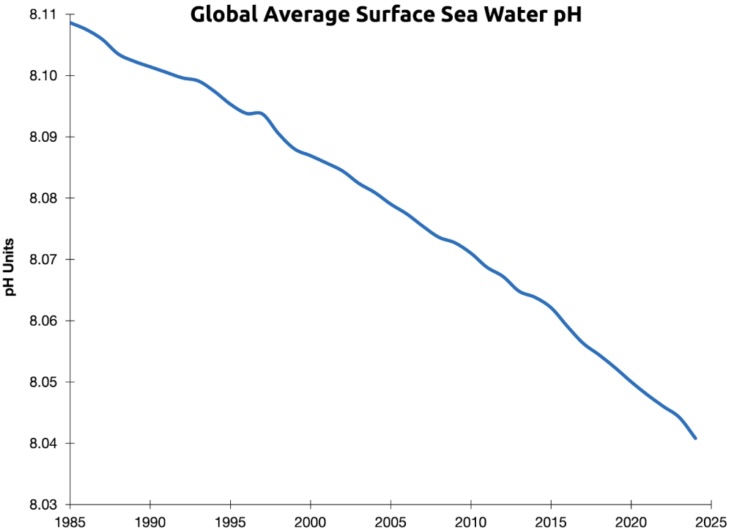
It looks like the ocean pH is dropping like a stone! Do you notice anything odd? The entire vertical scale of the chart goes from pH of 8.03 to 8.11 — less than 0.1 of a pH unit. The full pH scale goes from 0 to 14.
If you plotted this line with a vertical scale going all the way from 0 to 14, the line would be indistinguishable from horizontal.
If you are interested in the question of whether ocean corals are increasing or decreasing around the world, I can recommend several pieces to you from Peter Ridd. Ridd is a guy who actually goes out and studies the corals (he was formerly at James Cook University, like Munday and Dixson, until he got thrown out for heresy).
He is also the same Ridd who is a coauthor on the van Wijngaarden et al. paper, further discussed below. Here is a piece Ridd wrote in 2023 for the Global Warming Policy Foundation called “Coral in a Warming World, Causes for Optimism,” and here is one from August 2025 from the Institute of Public Affairs, titled “Science groupthink flounders on state of Great Barrier Reef.”
The bottom line is that there is plenty of evidence that coral reefs worldwide are thriving (not every one, and not every year, but on an aggregate basis), and no evidence at all of aggregate decline.
In light of that evidence, what is the proof that “acidification” is harming corals? The answer is zero.
In contrast to Nuccitelli’s evidence-free advocacy piece, the van Wijngaarden et al. paper is a serious piece of scientific work. I note that it appears on the website of the CO2 Coalition, rather than in one of the “prestige” scientific journals. I infer that these authors, who actually are the best scientists to address this topic, have given up on the enforced groupthink of these “prestige” magazines.
The paper is long (55 pages), and much of it is technical. But the bottom line is that it is preposterous to believe that the slight decline in ocean pH caused by increased atmospheric CO2 can cause any significant problem for ocean life. In this blog post, I will only provide a summary quote.
From the Abstract:
“Fundamental inorganic chemistry shows that increasing concentrations of atmospheric CO2 will have no harmful effect on organisms that live in the natural waters of the Earth [1], and may well benefit them. Alkalinity and dissolved CO2 give high buffering capacity to most natural waters and minimize the change of pH from external influences.
“For example, doubling the atmospheric concentration of CO2 from 430 ppm to 860 ppm would reduce the pH of representative seawater at a temperature of 25 C from pH = 8.18 to pH = 7.93. This change is comparable to diurnal pH changes in biologically productive surface waters, due to photosynthetic fixation of dissolved inorganic carbon during the day and respiration at night. The change is also less than the variations of pH with latitude, longitude and depth in the oceans.”
A key point is that the pH of the ocean is not a fixed number for the whole world at a given point in time. Rather, pH varies within small ranges based on latitude, longitude, depth, and even time of day.
The result is that ocean life already has to deal with these ranges.
A big part of the paper deals with the chemistry of how much the pH of the ocean might be affected by an increase in the atmospheric level of CO2 from the current 430 ppm up to even a doubling of the same to 860 pm. Some mathematics is involved, but I think it is basic and well-known chemistry.
The conclusion, as stated in the abstract, is that the average pH could go down all the way to 7.93 — still well into the alkaline range (neutral is 7, alkaline above 7, and acid below 7).
If anyone is aware of research establishing that pH variation in the ranges indicated is some kind of grave threat to ocean life, I would be eager to be made aware of it.
Until I see that, my conclusion is that the whole “ocean acidification” thing is no more than an effort to play on the idea that people will find the word “acid” scary.
Read more at Manhattan Contrarian


You want to see dead coral? Go someplace where the crown of thorns starfish has been active.
Friday, April 23, 1970, Green Island off the coast at Cairns. I wasted about half a roll of color film on the ‘glass bottom’ boat tour, on dead coral.
(The actual day – yup. Two days before Anzac Day. On the Sunday, the 25th, we were at the Curtain Fig Tree at midday, listening to the broadcast of the ceremonies from Canberra. All memory? No, we kept a handwritten diary, eventually transcribed to a computer file. I still have a copy. A three-week trip, Brisbane up the coast to Cairns and return via Longreach.)
“The result is that ocean life already has to deal with these ranges.”
Yes. The pH in estuaries and bays, likely including near shore sheltered coral reefs, become alkaline, up to >10 during the day as photosynthesis is an alkalizing process. During nighttime, the pH returns to normal due to waste organic acids given off by all organisms. And seawater passing through a normal (say atoll) reef comes out lower pH due to these waste organic acids. These organisms are more resilient than the climate alarmists would like anyone to know.
It should be pointed out that coral reefs and rainforests are the most stable ecosystems in the world, as they are always warm, even during glacial periods. This is why these ecosystems have such complex species structures and interactions. They have had many millions of years to develop such complexities.
It is places with simpler ecosystems that are fragile. In particular, Canada will be wiped clean by the next glacial period and will have no ecosystem—not even polar bears (too far from the ocean).
Ocean acidification is one of the worst incidents of scientific fraud in the climate change movement. The researchers cherry picked 1988, the year where ocean pH was furthest from acid, as their base line. This guaranteed that subsequent years would be closer to acid by comparison. The pH data prior to 1988 did not support their narrative, so they replaced the real data with simulated data.
A pH change from 8.11 to 8.03 represents a 20.23% increase in acidity
it may sound like a lot but it’s actually below the margin of error in oceanwide average pH measurements. The pH of ocean water varies across different regions.
Both ai and climate alarmists lie about the margin of error
No Richard, pH ranges from 0-14 so the math would be (8.11-8.03)/14 which is 0.57% increase in acidity or actuall 0.57% less basic.
Doh! Ritard Greene yet again displays his mathematical innumeracy. He does that on CFACT constantly. Now he’ll be compelled to bleat due to his ever-growing butthurt, whereupon he’ll humiliate himself by displaying his scientific illiteracy and mathematical innumeracy… starting the process all over again. He just can’t help himself. LOL
The entire “rising CO2 is going to kill the corals and mollusks and It’s All Your Fault” narrative flips reality, misattributes cause and effect… which seems to be a common theme for those pushing the poorly-told and easily-disproved AGW / CAGW climate scam. You’ll often find their claims to be diametrically opposite to reality.
Why “diametrically opposite to reality”? Because the easiest lie to tell is an inversion of reality, a misattribution of cause to effect. If they came up with some off-the-wall claim, they’d have to invent entirely new physics to explain and describe it, and that claim would be exposed very quickly as just a tool to push their scam. But by being diametrically opposite to reality, they need merely flip causality and use standard physics to explain and describe, because most people are too scientifically-illiterate to discern between reality and flipped-causality inverted-reality.
“We must protect the corals! CO2 is going to kill all the coral! It’s an existential crisis!”, we’re told.
For instance:
https://www.surfrider.org/news/washington-state-re-ups-leadership-in-addressing-ocean-acidification
“Global carbon dioxide (CO2) emissions over the past two centuries have altered the chemistry of the world’s oceans, threatening the health of coastal ecosystems and industries that depend on the marine environment.”
“Calcifiers are marine organisms that depend on the mineral calcium carbonate to make shells, skeletons, and other hard body parts. Ocean acidification makes an essential component of calcium carbonate – the carbonate ion – more scarce. As a result, calcifiers have to use more energy to pull carbonate ions out of the water to build their shells. Calcium carbonate also dissolves more easily as acidity increases. These changes can result in slower growth and/or higher mortality among calcifiers, especially in shellfish larvae and juvenile shellfish.”
Corals and mollusks, which evolved during the Cambrian Explosion which had many times higher CO2 concentration (which was arguably the cause of the Cambrian Explosion), evolved no carbonate transporters, instead evolving bicarbonate transporters… because as CO2 concentration rises, ocean pH falls which means carbonate practically disappears at ~pH6, whereas as CO2 concentration rises, ocean bicarbonate concentration rises, thus that makes it easier for coral and mollusks to undergo the calcification process. Calcification is currently rate-limited because atmospheric CO2 concentration is nearly at historic lows, and thus oceanic bicarbonate concentration is comparatively low.
IOW, if you want to ‘save the corals’, emit more CO2.
But all of the “muh CO2 bad” blather about CO2 harming corals is predicated upon the corals using carbonate transporters. To date, several bicarbonate transporters have been found across a wide taxa of corals and mollusks, whereas no carbonate transporters have been found.
[1] CO2 (carbon dioxide) + H2O (water) ==> H2CO3 (carbonic acid)
[2] Aqueous: H2CO3 (carbonic acid, from [1]) ==> H+ (hydrogen cation) + HCO3- (bicarbonate anion)
[3] In-vivo: Bicarbonate transporter transports HCO3- (bicarbonate anion, from [2]) across cellular membrane
[4] In-vivo: HCO3- (bicarbonate anion, from [3]) ==> CO3-2 (carbonate anion) + H+ (hydrogen cation)
[5] In-vivo: CO3-2 (carbonate anion, from [4]) + Ca+2 (calcium cation, dissolved in water) ==> CaCO3 (calcium carbonate)
[6] In-vivo then excreted: H+ (hydrogen cation, from [4]) + H2O (water) ==> H3O+ (hydronium cation)
Yes, coral and mollusks excrete acid.
pH = −log_10 [H+]
And that excreted H3O+ (hydronium cation, from [6]) then goes on to interact:
[7] Aqueous: H3O+ (hydronium cation, from [6]) + CO3-2 (carbonate anion, dissolved in water) ==> H2CO3 (carbonic acid) + OH- (hydroxide anion)
[8] Aqueous: H2CO3 (carbonic acid, from [7]) ==> H+ (hydrogen cation) + HCO3- (bicarbonate anion)
[9] Aqueous: OH- (hydroxide anion, from [7]) + H+ (hydrogen cation, from [2] or [8]) ==> H2O (water)
You’ll note that the hydronium (H3O+) cations actively scavenge carbonate anions (CO3-2) (which the coral and mollusks cannot use) and coverts them into carbonic acid (H2CO3), which then undergoes the first aqueous reaction above to convert to H+ (hydrogen cation) and HCO3- (bicarbonate anion… which the coral and mollusks can use).
Kind of strange that coral and mollusks can handle the extreme acid of undiluted H+, and H3O+ (the strongest acid that can exist in water), but purportedly they can’t handle a tiny change in ocean pH, despite evolving at a time when atmospheric CO2 concentration was many times higher than today and thus the ocean was less alkaline.
Almost as if we’re being lied to. Hmmmm…
Oh, it’s worse than that.
pH is a base-10 logarithmic scale, not linear.
Acidity at pH 0: 10^0 = 1.0 mol L-1
Acidity at pH 8.11: 10^-8.11 = 0.00000000776 mol L-1
Acidity at pH 8.03: 10^-8.03 = 0.00000000933 mol L-1
Acidity at pH 14: 10^-14 = 0.00000000000001 mol L-1
The entire pH scale is effectively 0 mol L-1 to 1 mol L-1.
0.00000000933 mol L-1 – 0.00000000776 mol L-1 = 0.00000000157 mol L-1
Percentage of 0 – 14 pH scale: 0.00000000157 mol L-1 / 1.0 mol L-1 = 0.000000157%
So Ritard Greene was only off by 128,853,503.1847 times. Making it one of his less-egregious mathematical faux pas. LOL