


Dr. Peter F. Mayer at Austria’s online TKP has published a new article titled: “3,000 Years of Climate History: What Solar Cycles Have to Do with Temperature Trends.”Based on reconstructions (such as the Temperature 12k database published in 2020), Dr. Mayer argues that the Holocene climate optimum occurred about 6,500 years ago. [some emphasis, links added]
Since then, a long-term cooling trend with superimposed fluctuations has prevailed.
Mayer criticizes popular publications (such as the 2013 paper by Marcott et al.), alleging that statistical artifacts or improper blending of proxy data with modern measurements are misused to depict an extreme temperature rise.
Mayer finds a pattern that runs throughout the paleoclimatological literature:
“The closer one gets to the present, the more blurred the line becomes between proxy data and instrumental measurements, between reconstruction and model assumptions.”
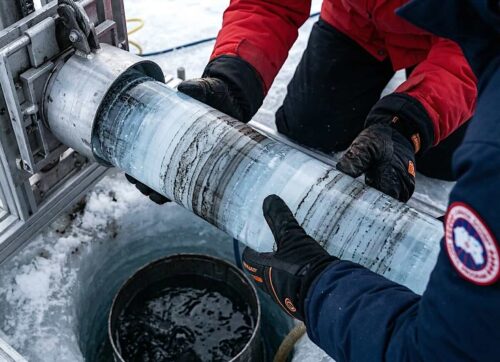
Historical solar activity and the solar cycle (Schwabe cycle) can be reconstructed using isotope analysis (such as tree rings). In addition to changes in total solar irradiance, the article notes that the solar magnetic field shields cosmic rays.
Weak solar activity allows more cosmic radiation to reach Earth, which can promote cloud formation and contribute to cooling.
Mayer presents historical climate periods that are directly linked to reconstructions of solar activity:
- Roman Warm Period (~250 BCE – 400 CE): High solar activity and mild temperatures (1–2 °C above pre-industrial levels).
- Migration Period & Early Middle Ages (~400–750 CE): Drops in solar activity (Grand Solar Minima), cold spells, crop failures, and plagues.
- Medieval Warm Period (~900–1300 CE): Stable, high solar activity resulting in warming, thriving agriculture, and ice-free Alpine passes.
- Little Ice Age (~1300–1850 CE): Troughs in solar activity (Spörer, Maunder, and Dalton Minima) led to global cold snaps and advancing glaciers.
- Modern Warming (from 1850 onwards): The warming over the last 170 years is interpreted primarily as a natural recovery from the cold peak of the Little Ice Age.
Mayer concludes that the Sun is the dominant external driver of Earth’s climate.
He criticizes mainstream climate science (such as the IPCC) for focusing primarily on the Sun as the main cause, arguing that natural solar cycles must be given greater weight in the climate debate.
Read more at No Tricks Zone





“Historical solar activity and the solar cycle (Schwabe cycle) can be reconstructed”
No accurate measurements of top of the atmosphere solar energy before the 1970s
TOA TSI has remained nearly constant for the past 50 years