


It could be Ed Miliband’s oddest and costliest legacy. Just days before leaving his role as energy secretary, he signed off on a proposal to make Britain a “global leader” in greenhouse gas removals – technologies that literally strip carbon dioxide (CO2) from the air around us. [some emphasis, links added]
The commitment, tucked away in a response to a review released just before Andy Burnham moved Miliband to the Foreign Office, is a minor footnote in his tenure. But the task he has left for his successor Miatta Fahnbulleh is huge.
The atmospheric concentration of CO2 is just 0.04 percent, meaning that removing it requires cleaning at least 1,600 tons of air for each ton of CO2.
Moreover, humanity pumps another 40 billion tons of CO2 to the atmosphere each year – adding to the 2.5 trillion tons emitted since the Industrial Revolution.
Less than 1 percent of that is produced in the UK. But in a report signed off by Miliband this month, the Department for Energy Security and Net Zero (DESNZ) committed Britain to kick-start the clean-up.
“The UK is well-positioned to be a global leader in greenhouse gas removal (GGR) technologies with our world-class research institutions, engineering expertise and access to geological storage,” it said. “We are progressing a world-leading, holistic GGR policy framework to enable UK deployment at scale.”
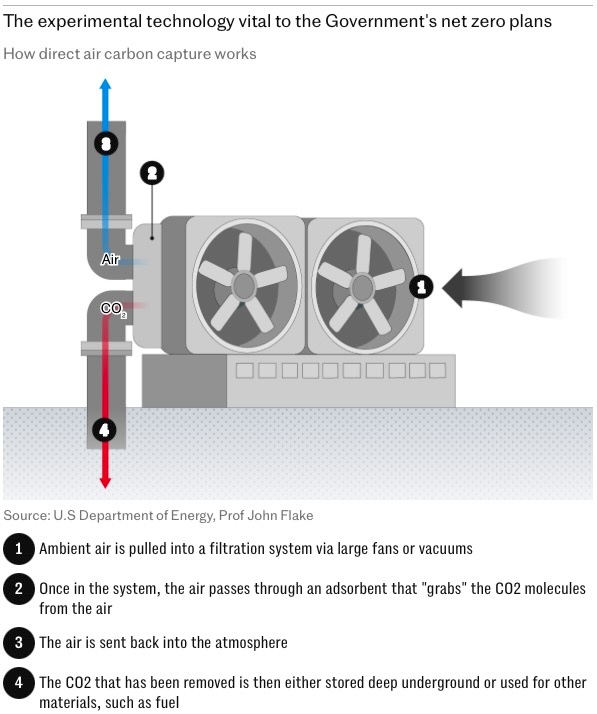
The Energy Department has even put taxpayers’ money into the plan, investing £56m in a dozen trials of Direct Air Carbon Capture and Storage (DACCS).
Why, though, would Miliband want to commit the UK to the Sisyphean task of stripping CO2 from the atmosphere?
At the heart of the matter is Labour’s net zero push.
Britain may be doing well in replacing petrol and diesel vehicles with electric vehicles, substituting heat pumps for [water heaters] and making electricity from wind rather than coal.
But there are some sectors that the UK will always struggle to decarbonize without adopting a puritanical lifestyle. The most obvious are aviation and farming – especially livestock – which are each expected to generate 40 million tons of CO2 a year by 2050.

Demanding that the public give up meat and flying would be electoral suicide, so last year Miliband asked the former junior energy minister, friend and fellow eco-enthusiast Lord Whitehead to set out new ways for Britain to tackle those emissions.
Whitehead concluded that direct air capture of CO2 was essential to get the UK to net zero. The alternative, he warned, was “a low-carbon future with no industry, little transport and difficult-to-swallow mass behaviour change”.
Two key technologies lie at the heart of these quixotic proposals to clean up the atmosphere.
One is Direct Air Carbon Capture and Storage (DACCS), which typically sees giant fans pump ambient air through chemical filters that strip out CO2.
The other is BECCS – Bioenergy with Carbon Capture and Storage – a process in which plant matter is burnt for power generation, and the waste gas is stripped of CO2.
In both cases, the captured CO2 would be compressed into a liquid and pumped into depleted oil and gas fields beneath the North Sea. Or, in some cases, it could be converted into minerals and buried.
Supporters point to existing trial projects such as the commercial-scale Mammoth facility in Iceland, which can permanently remove up to 36,000 tons of CO2 each year. Texas-based 1PointFive, a subsidiary of oil giant Occidental, is being engineered to capture up to half a million tons of CO2 annually.
But opposition is growing. Critics argue that the costs and energy needed to extract CO2 from air will always make such schemes uneconomic.
Real Zero Europe, an umbrella group for organizations including Friends of the Earth and the Corporate Europe Observatory, argues that carbon capture projects are merely attempts to whitewash the fossil fuel industry by making aviation look “clean”.
Some scientists agree.
“DACCS only increases CO2 and air pollution,” says Prof Mark Z Jacobson, at Stanford University. “They are just pretending they are doing something while really doing nothing except making the climate and pollution problems worse.”
Nevertheless, the UK’s Climate Change Committee has enthusiastically adopted the idea. Its reports have repeatedly stated that while emissions reductions will do the heavy lifting for net zero, engineered removals such as DACCS will be essential for sectors such as farming and aviation.
Read rest at The Telegraph





CARBON DIOXIDE
One would think that any rational and responsible government would convene an inquiry to determine if it is true that only CO₂ can increase the temperature of Earth’s atmosphere before going down the “green” ditch to collective economic suicide. NASA’s moon program had a motto: “In God we trust, everyone else brings data”.
There is no scientific “warming” theory that is proven by empirical data. Climate models are producing programmed results that have been proven to be wrong. Actual weather balloon data proves that there is no “greenhouse effect”, and mathematical analysis of the last 2,000 years of temperature data shows that there is no trend, and that temperature varies somewhat by the sum of cycles. Also, the Ideal Gas Law is proven to be valid by actual balloon data.
Temperature in Kelvin T ≝ PV/nR, where P is pressure, V is volume, n is mass/molecular mass, and R is the Gas Constant. How can CO₂ change temperature in an open atmosphere? Almost all heat transfer in the troposphere is by convection, not radiation. CCS is a total waste of resources as CO₂ in the oceans (71% of the Earth’s surface) is in equilibrium with CO₂ in the atmosphere. This is known as Henry’s Law. There is ~ 50 × more CO₂ in the oceans. CO₂ is also in ⇆ with HCO₃⁻ in the oceans and there are ~ 1,500 active underwater volcanoes. Then there is all the limestone (CaCO₃) in the world. The idea that a radiation “lapse” rate is changed by gases that absorb in the IR spectrum is absurd as radiation travels at speed of light. Also, energy transfer is always from higher temperature to lower temperature.
Politicians are too deep into the green dung to save face while it is still possible. CCS is a total waste of resources, usually other people’s taxes. It is a giant money transfer scheme, from your pockets… follow the money…
The US Navy did IR research after WWII and found that a 300 m path of air at sea level is opaque (100 % of energy absorbed) to infrared transmission at the 15 µm band where CO₂ absorbs energy. This is available in Chapter 5 in The Infrared Handbook. More CO₂ cannot absorb more than 100 %
If climate change were a problem, there are far more economical ways removed carbon dioxide from the atmosphere. Many crops, such as corn, have a large part of the plant that isn’t used. Instead of letting it decompose it could be collected a sequestered. There are certain pond plants that under the right circumstances will double their biomass in 48 hours. These could be cultivated, harvested, and sequestered. There is one big problem with these solutions. They don’t take money from working families to fund the climate change industrial complex. This complex makes many of the elite even wealthier.
In a former life I was a Reactor Operator on our nuclear subs. Since we stayed underwater for extended periods (the longest one sub I was on was over two months) we had to deal with both Carbon Monoxide and Carbon Dioxide. To get rid of the first we had what would be similar to a catalytic converter called a CO burner. The air in the sub was sent across a very hot bed that would combine CO with Oxygen to make CO2. To keep CO2 to a reasonable level (our CO2 levels were much higher than we live in at around 2,000 PPM we needed to keep it from going too high. So we had a CO2 scrubber which would scrub CO2 out of our atmosphere. But we didn’t bury it so instead we bubbled it overboard. The last thing (or perhaps first due to its importance to our survival) we created O2 via electrolysis by separating pure water into O2 and H2. Like with the CO2 we bubbled the H2 overboard. That was especially important since Hydrogen is highly flammable.