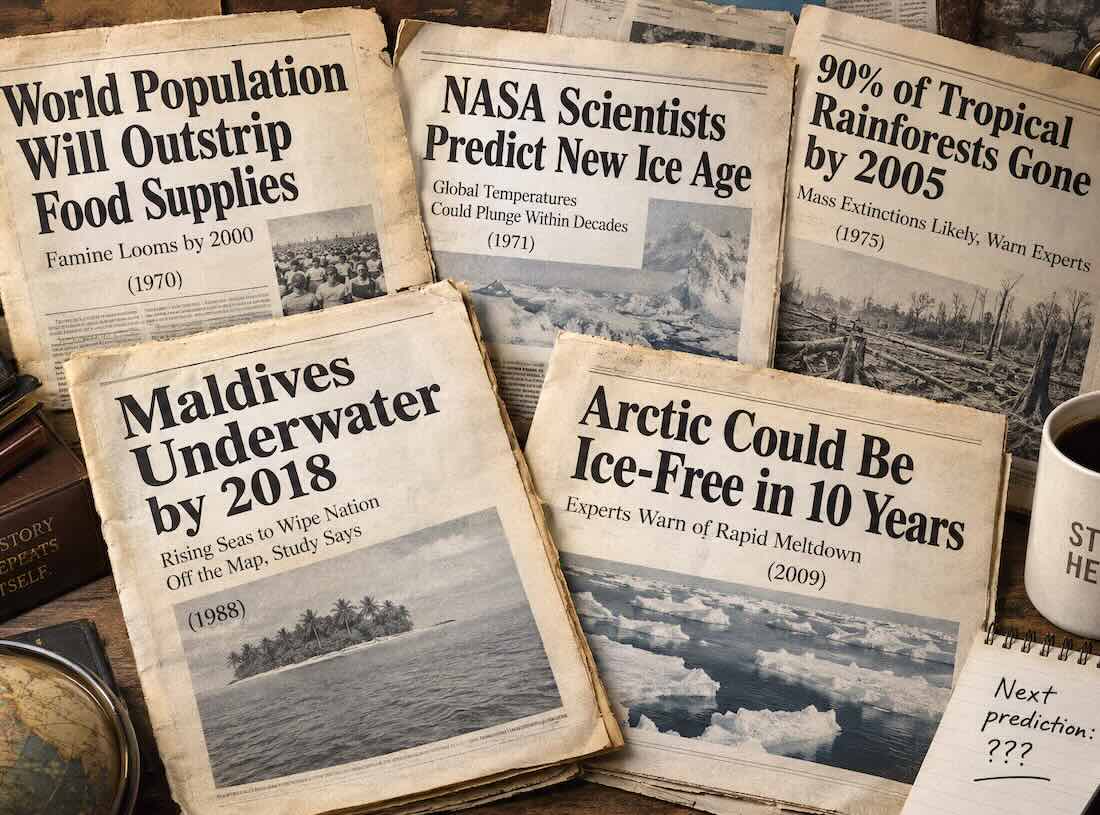
For decades, experts have warned us that humanity was barreling toward environmental catastrophe—running out of resources, exhausting oil supplies, facing mass starvation, or rendering the planet increasingly unlivable. The details change, but one thing has remained remarkably consistent: the predicted apocalypse never seems to arrive. –CCD ed.
As I note in my upcoming Broadside/HarperCollins book Confidently Wrong, one defining feature of upper-middle-class life over the past 50–60 years has been scientists, activists, and public intellectuals making the most horrifying kind of doomsday predictions — which invariably fail to come true.
Remember the Club of Rome and the Limits to Growth report?
Back in 1972, a group of top academics used then-advanced regression analysis to argue that the planet at some point must run out of key resources. [They provided] quite specific dates for this global near-apocalypse. And then none of the predictions came true.
As the American Enterprise Institute’s Mark Perry noted 40 years later in his teasingly titled “Time Has Not Been Kind to the Limits to Growth,” the report “got it so wrong because its authors overlooked the greatest resource of all: our own resourcefulness.”
Because of the so-called Green Revolution in agriculture and horticulture, humanity’s food supplies have not collapsed. In fact, Perry reports, “malnourishment has dropped by more than half,” from well over 30 percent of the world population to about 15 percent.
“Nor are we choking on pollution,” as electric, hybrid, and even hydrogen vehicles have replaced many of the high-dollar gas hogs of the past. In fact, the annual risk of pollution-caused death has shrunk from one in 500 to one in many thousands since 1900.
Perhaps unsurprisingly, given their think tank’s focus, the AEI boys argue that the real solution to environmental problems is innovation, driven by “economic growth.”
This same lesson — that resources are obviously not infinite but new supplies can be found or even grown if we turn to human ingenuity — applies to “peak oil,” perhaps the ultimate recurring boondoggle prediction.
As every commodities investor knows, Very Serious People have predicted on a dozen occasions that the Earth will run dry of key fossil fuels in the near future. As Forbes notes, peak oil is at some level “grounded in reality.”
Oil is “a finite natural resource, produced over a geological timespan, whereas demand continues to climb.” However, given different computer models and continuing exploration by the oil companies, “nobody can quite agree on when we will reach the point of Peak Oil or even what will cause it.” …snip…
A piece of this kind could go on almost forever, documenting similar blooper projections, huge and small.
Read full post at National Review