

Another human-caused global warming modeling failure emerges in observed tropical cyclone data. [some emphasis, links added]
According to climate modeling (Knutson et al., 2015 and 2020), everyday human activities such as driving cars and using cell phones (AGW) should lead to increases in tropical cyclone (TC) landfall frequency and intensity (i.e., accumulated cyclone energy [ACE] or maximum wind speeds).
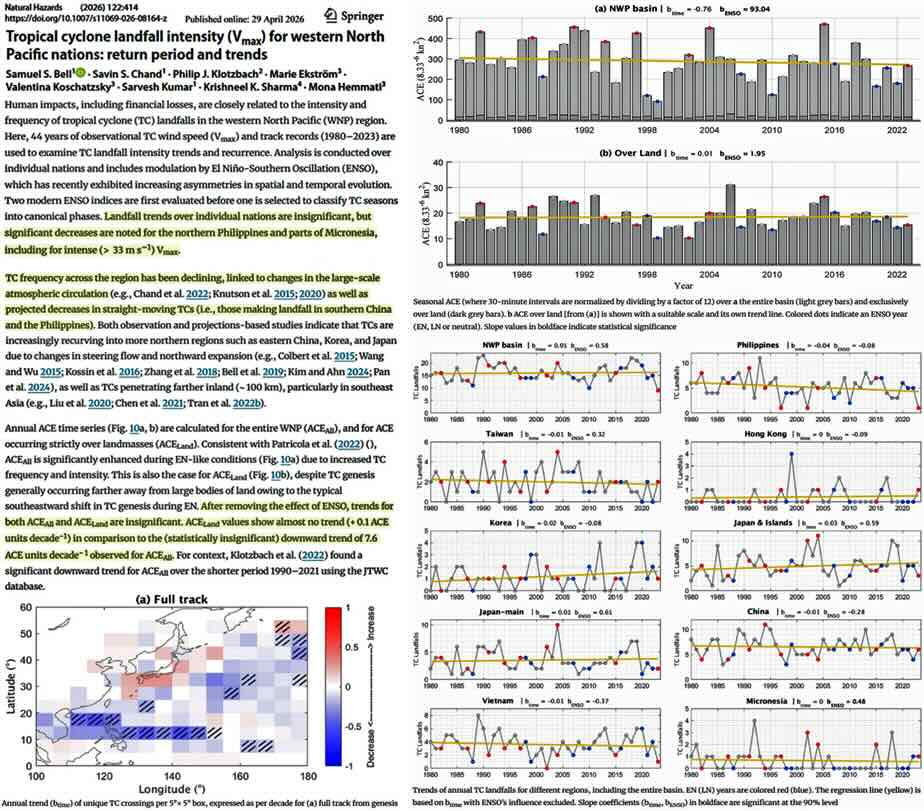
Instead, 45 years of satellite observations (Bell et al., 2026) indicate declining TC frequency trends over the Western North Pacific (WNP), which includes the Philippines, Hong Kong, China, Taiwan, Japan, Korea, Vietnam, Micronesia, as well as a weak decline (-7.6 ACE units per decade) in TC intensity for the WNP.
“Landfall trends over individual nations are insignificant, but significant decreases are noted for the northern Philippines and parts of Micronesia, including for intense (> 33 m s-¹).”
“TC frequency across the region has been declining, linked to changes in the large-scale atmospheric circulation…as well as projected decreases in straight-moving TCs (i.e., those making landfall in southern China and the Philippines.”
“After removing the effect of ENSO [natural variability]…downward trend of 7.6 ACE units per decade-¹ for [the entire WNP].”
Read more at No Tricks Zone





Over the last few decades, lifetime typhoon peak intensity has increased by roughly 10% compared to the 1970s, which translates to a 33% increase in their instantaneous destructiveness.
climate research indicates the global frequency of cyclones
has been declining since the mid 1950s in the pacific ocean
(and since the late 1800s in the atlantic ocean, when counting
strong storms that made landfall)
climate models do not directly predict the number of cyclones
or their intensity
of typhoons have declined since the mid‑20th century
scientists project a decrease or no change in the overall global frequency of tropical cyclones (hurricanes, typhoons, and cyclones), alongside an increase in the proportion of highly intense storms (Categories 4 and 5) by the end of the century.
Prediction in the Fourth Assessment Report (AR4), published in 2007.
18 years later, in 2025, is MUCH too soon to know if this prediction for 2100 is correct or wrong
No claims in this article are true,
typical of studies that KR publicizes
NoTtrickZone website
will never publish any of my comments