

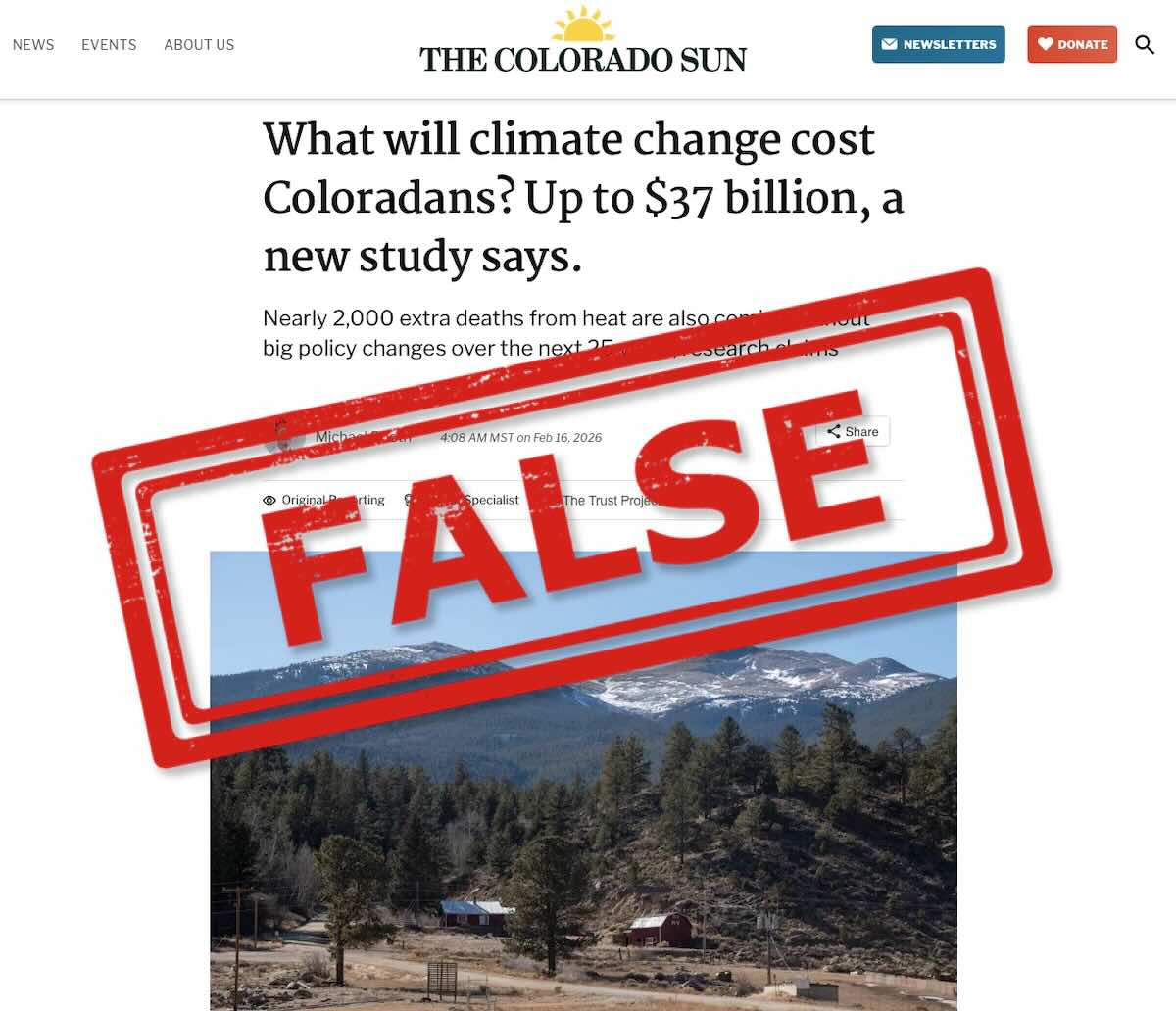
A recent Colorado Sun article claims that climate change could cost the state up to $37 billion due to high temperature extremes and drought. [some emphasis, links added]
This is false, built almost entirely on speculative claims about future weather, and ignores the fact that reductions in extreme cold will positively influence health-related costs.
The Colorado Sun’s (TCS) post, titled “What will climate change cost Coloradans? Up to $37 billion, a new study says,” discusses a study put out by a group called the Colorado Fiscal Institute (CFI), “which uses research to promote equitable economic policies.”
In other words, this is a left-wing activist advocacy group, not a firm that performs straightforward economic analysis.
TCS says that the study “largely avoids scare scenarios about climate vortexes and unlivable homelands,” which is a refreshing change from studies that rely heavily on model scenarios like RCP8.5 and other extremely unlikely scenarios.
However, the study still focuses on “predictable costs of higher heat and more frequent drought from now to 2050.”
The $37 billion figure is called a “conservative estimate of real costs” for the state. It primarily comes from the costs of projected increases in extreme heat, from needing to build out cooling infrastructure, wildfire-related costs, and human deaths, which CFI says will increase due to extreme heat over the next 25 years.
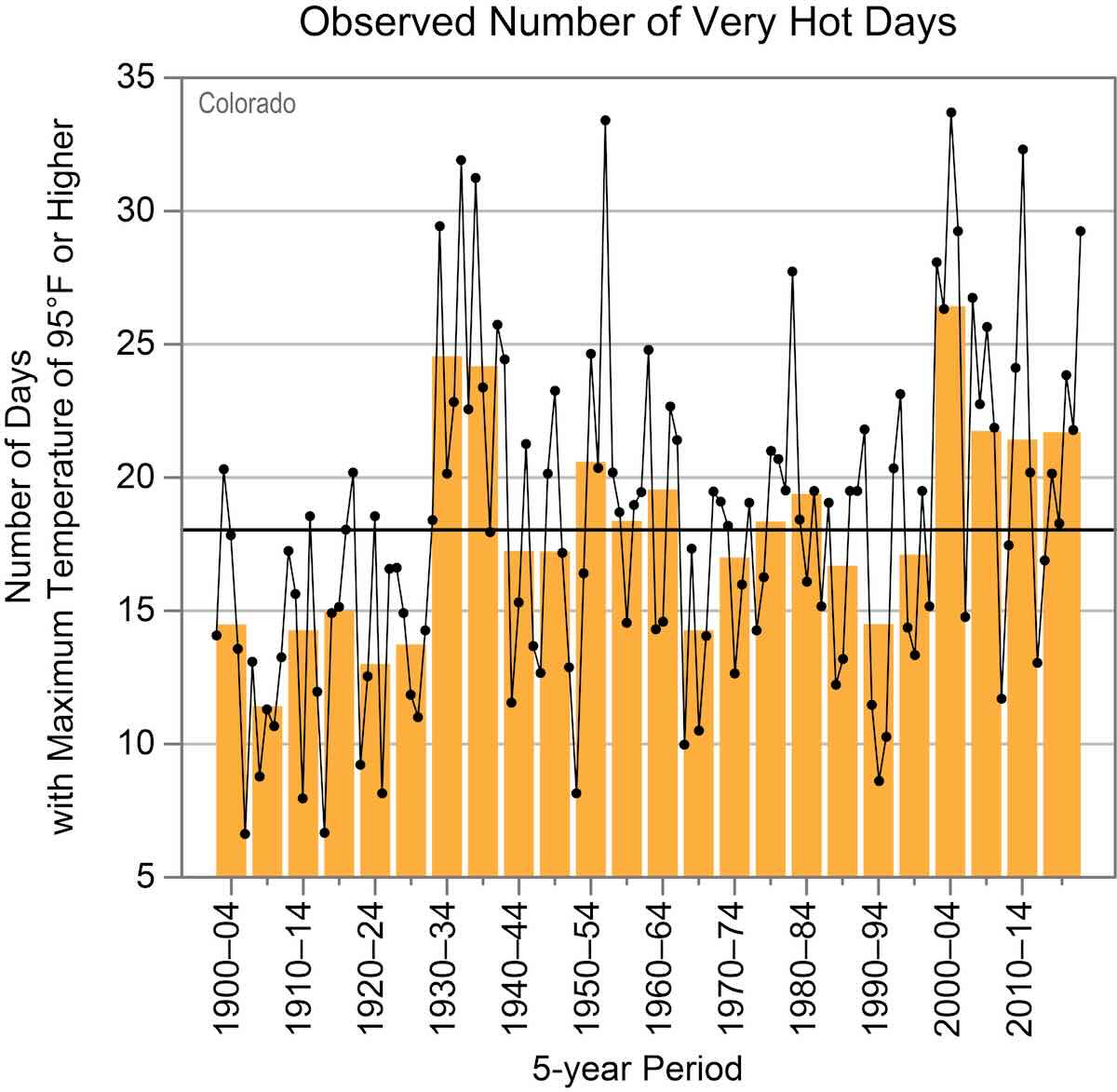
Colorado is one of the few states where the number of very hot days (days with temperatures over 95°F) has increased in recent years; however, it’s no worse than it was during the 1930s and 1940s, according to data on Colorado’s weather history from the National Oceanic and Atmospheric Administration (NOAA). (See figure below)
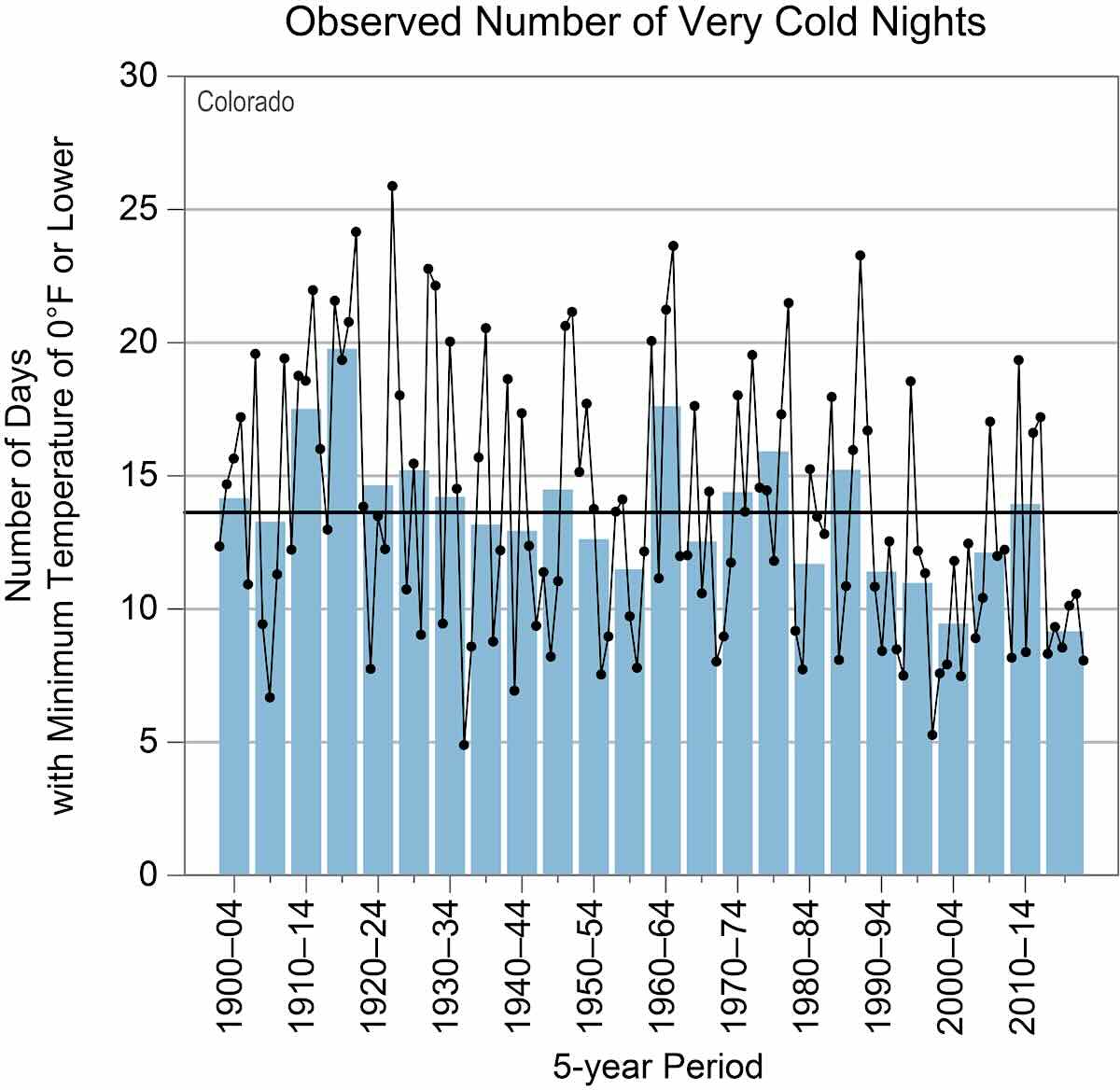
Nowhere in the article is extreme cold mentioned, which is notable because deaths due to extreme cold are declining as the planet has slightly warmed over the past hundred-plus years.
In fact, data on heat-and-cold-related mortality show that the number of deaths due to extreme cold has declined at a faster rate than deaths due to heat over the same time period.
Estimates say that as many as 20 times more people die of cold than heat.
This means that global warming has actually been a net lifesaver, rather than a killer. And indeed, extreme cold instances have declined in Colorado over the years even more consistently than highs have increased. (See figure below)
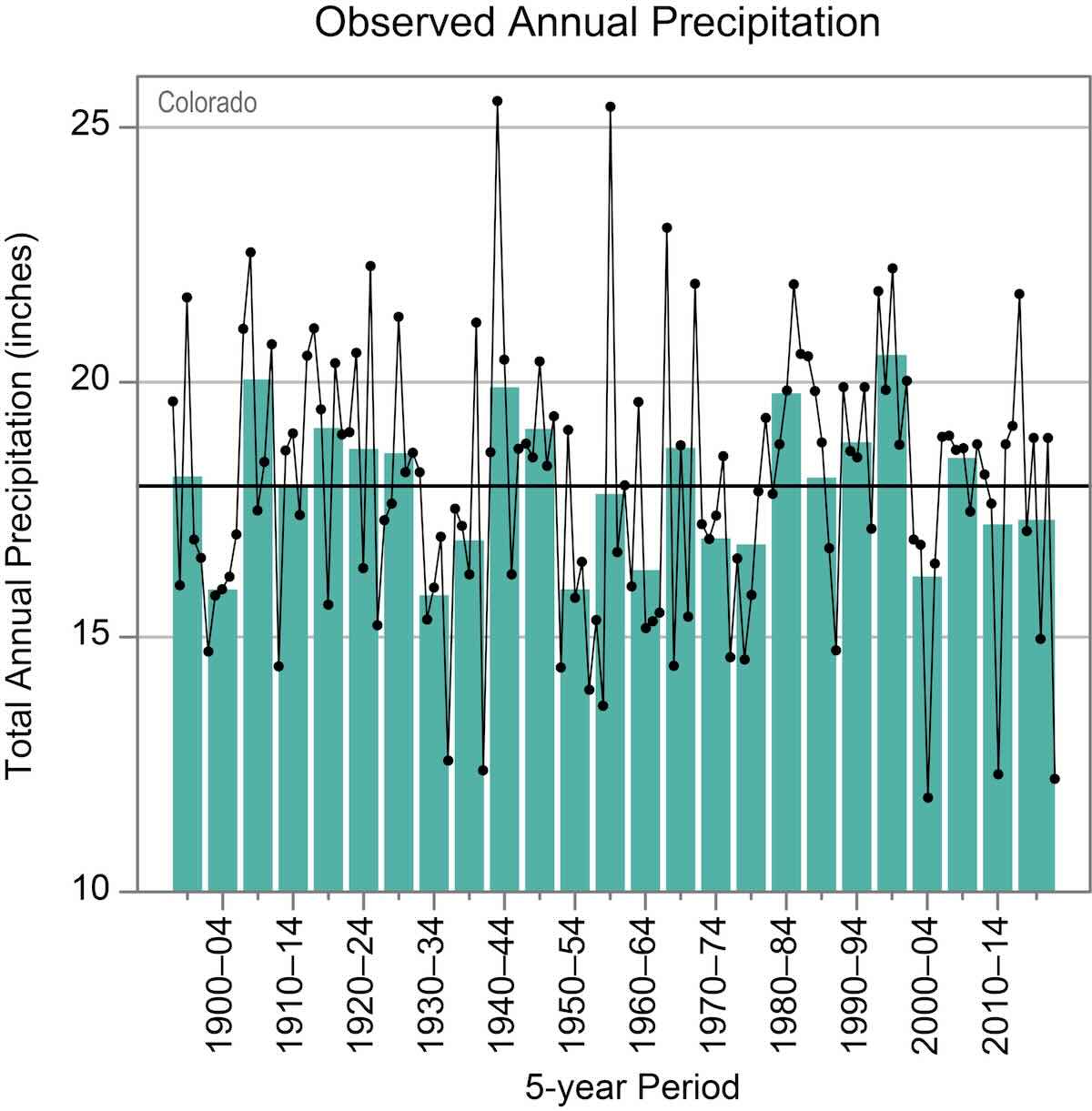
Regarding TCS’s claims about drought, there is little to no evidence that rainfall-related drought is striking Colorado more frequently than usual in recent years, or that recent droughts have been more severe than in the past.
Data show no consistent decline in precipitation over time. (See figure below)
What is true is that what water exists is under more pressure than in the past, as population growth and agricultural development come with rising water demands in an otherwise fairly arid part of the country.
Climate Realism has covered the fact that Colorado’s water problems are not a function of changes in rainfall patterns or amounts but rather increased development and demand, here, here, and here, for example.
This also brings us to the wildfire question: Is climate change making wildfires more intense or widespread in Colorado?
Again, the answer is no.
Data from the National Interagency Fire Center (NIFC) show that the acreage burned from wildfires in recent years is actually much less than what fires burned in the early 1900s.
As discussed in the first of the Climate Realism posts linked above, much of the Western United States’ woes, when it comes to fire, has to do with poor forest management and an increase in the number of people moving into areas historically prone to wildfires.
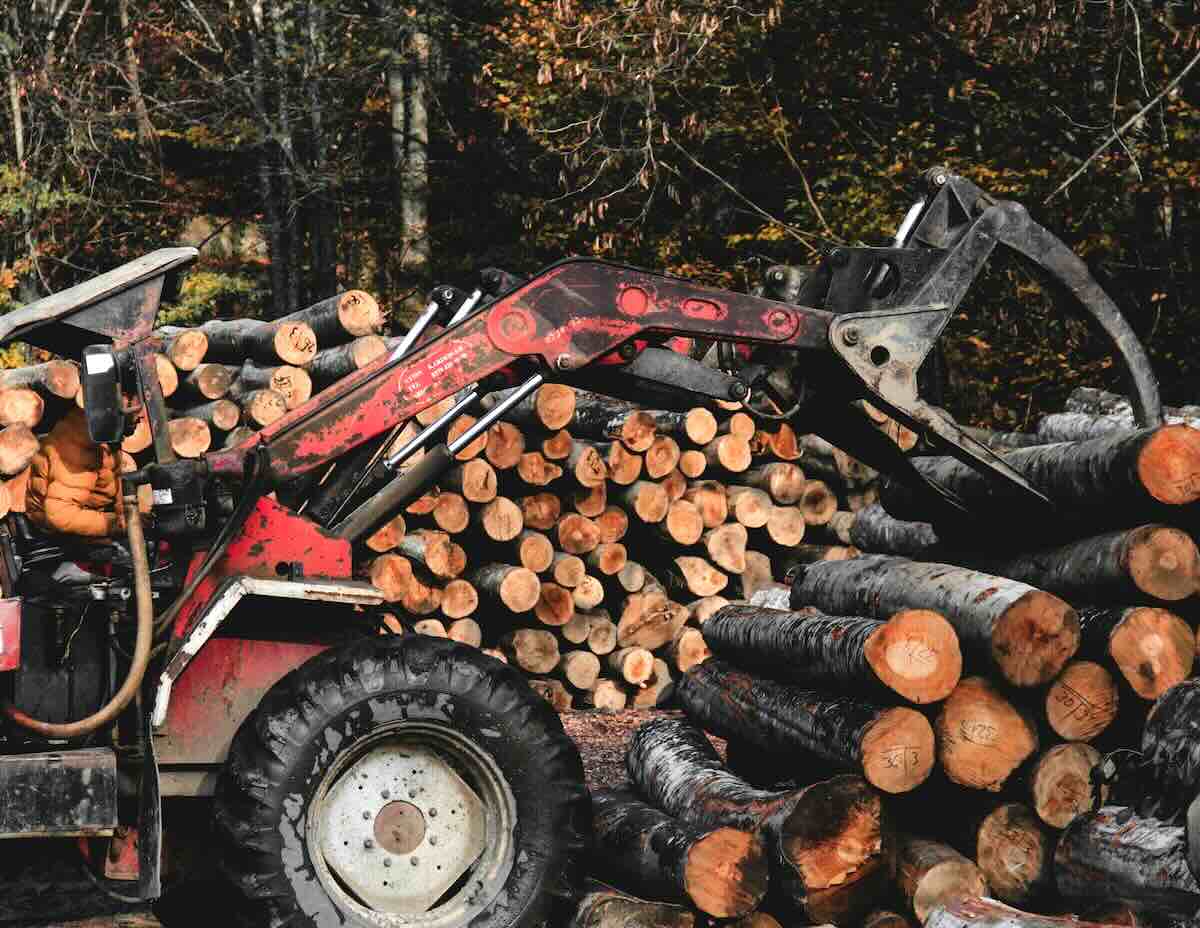
Not to mention the decline of the timber industry, which has led to less clearing of fuel for fires, and fewer maintained forest access roads that used to serve as fire breaks and critical paths for firefighters to reach isolated fires before they destroyed developed areas.
The study referenced by TCS is yet another in a long line of fearmongering economic studies on climate impacts, which rely heavily on fallible climate models while eschewing real-world data that would otherwise show that there is no looming emergency.
Trying to appeal to the public’s pocketbook probably doesn’t mean as much as the study authors would like, when enacted climate policies like restrictions on energy use and sources are always so expensive themselves.
TCS should stick to the facts and not promote speculative scare stories uninformed by real-world data.
Read more at Climate Realism


Billions of Dollars blown on preventing a disaster that’s never going to happen
Livestock is a major pillar of Colorado’s agriculture, especially beef cattle, which are raised on large ranches in the eastern plains and western slope. The state also produces significant amounts of dairy cattle, hogs, and sheep and lambs
scientists say at the tipping point of plus 1.5° C., animals will tip over and die
ha ha
very few deaths are actually caused by very hot or very cold weather
the seasonal trend of deaths from heart disease in the winter makes it appear that there are more deaths due to cold weather but that is deceptive. the deaths are caused by heart disease and they should not be blamed on the cold weather. CO2 emissions do cause warmer winters and that should extend the life of heart patients but they’re still gonna die from heart disease.
the bottom line is out of three million us deaths per year, ~one percent are caused by extremely cold or extremely hot weather. Approximately 0.5% to 1.7% of annual U.S. deaths are directly or partially attributable to extreme cold or heat, with roughly 65% of these being cold-related and 35% heat-related, according to studies analyzing data over the last 25 years. While cold-related deaths are higher, heat-related fatalities are rising rapidly.
A significant number of so-called ‘cold related’ deaths, especially among older folks, comes down to:
I’m having some chest pain, and my left arm doesn’t feel good at all. I should get to a doctor real soon, but it’s bloody cold, wet and windy outside. Maybe tomorrow will be better…
Even Brisbane, Australia, in winter conditions can be nasty. Subtropical, east coast – think Florida. A study of summer V’S winter deaths showed a measurable difference. The westerly winds in winter – really miserable.
Wow, who are these ignorant “scientists” who say these animals will tip over and die? There are cattle that are raised across the south in much hotter weather than here in Colorado (I actually live here in this climate where these animals are all going to die!) BTW, what’s the difference between sheep and lamb? It’s the same animal. But I guess you are not only a climate expert but are also a zoologist so you kwon that. Not bad for a guy with only an MBA.
i wrote “ha ha” after that comment because it was sarcasm and you obviously missed that
the actual meaning of tipping point is when a person drinks too much and falls off his bar stool
the $37 billion claim would have been more believable if it was published as
$36.574.783 billion +/- 50 cents. real science requires at least three decimal places and a margin of error. that’s what i learned in getting my BS degree before i got my MBA degree
and my climate and energy website which often recommends articles from this website is approaching 1.4 million lifetime page views
my wife often compares me to einstein
she always says: “You’re no einstein”
ha ha