The Trump administration has declared the “Green New Scam”—as President Trump terms it—finished. The United States will no longer hobble its industrial base with unrealistic renewable-energy mandates while China and India burn coal without restraint, the White House has announced. [some emphasis, links added]
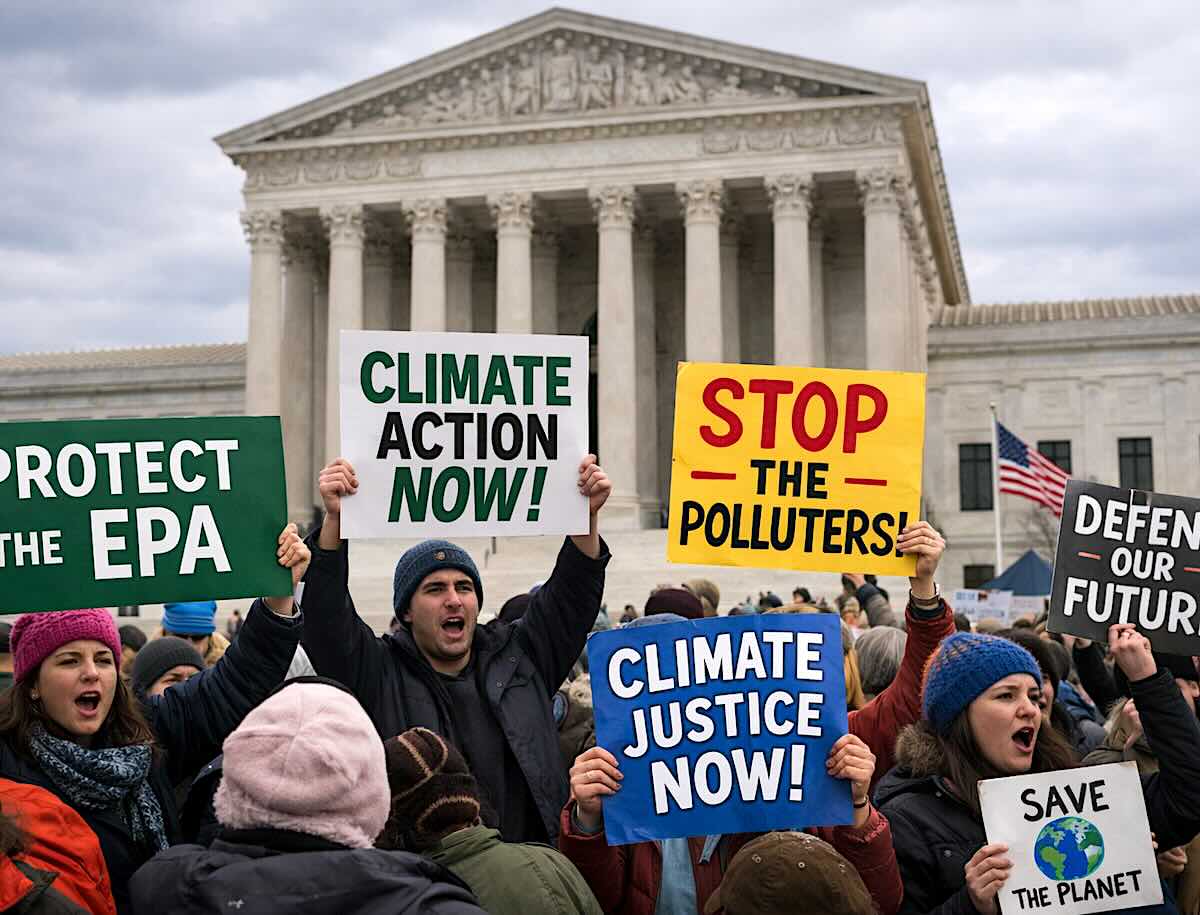
Yet while the federal regulatory war on traditional energy has paused, a litigation war has quietly gathered force. Cities and states are now suing American fossil-fuel companies for the alleged climate harms those jurisdictions claim to suffer.
The pace of these suits is quickening. The first multibillion-dollar judgment against the industry could unleash a cascade of similar rulings. Leading climate litigator Benjamin Franta estimates that the potential liability runs into the trillions of dollars.
The effect on the American economy would be dire. But equally catastrophic, from a philosophical standpoint, would be the damage to rationality itself.
The causal claims behind the climate-change lawsuits insult reason, repudiating the hard-won gains of the Western empirical tradition. In this respect, the suits embody several signal traits of the contemporary West.
The plaintiffs in the more than three dozen climate suits filed in the United States read like an honor roll of progressive localities: San Francisco, Marin County, Oakland, Washington, D.C., Chicago, Maine, Minnesota, and Massachusetts, among others.
Their targets include some of the great industrial concerns of the modern age—ExxonMobil, Chevron, BP, and Shell.
So far, the cases have turned on questions of jurisdiction. After years of strategizing by climate activists, their foundation funders, and state attorneys general, the first major climate change action was filed in 2004 in the Southern District of New York.
New York City, New York State, and seven other states alleged that CO2 emissions from five electric-power producers, including Cinergy and the Tennessee Valley Authority, constituted a federal public nuisance by contributing to global warming. (“Public nuisance” is defined as an unreasonable interference with a public right, such as the use of a waterway free from obstruction or pollution.)
Following seven years of procedural wrangling, the U.S. Supreme Court in 2011 dismissed the suit, American Electric Power Company v. Connecticut.
The Court held that the federal Clean Air Act displaced any right to sue for climate-related harms under what is known as federal common law. (“Common law,” which can be state or federal, refers to that body of law created incrementally by judges on a case-by-case basis, in contrast to statutory law, enacted in one stroke by legislatures.)
The Clean Air Act, the Court ruled, had vested exclusive federal authority to regulate greenhouse gas emissions in the Environmental Protection Agency, and regulating such emissions was precisely what the plaintiffs, despite their protestations to the contrary, were trying to do.
“No problem!” responded the burgeoning climate bar. “If we can’t sue in federal court under federal common law, we’ll bring our cases in state court under state law.”
A decade and a half of further jurisdictional skirmishing followed. Climate crusaders filed dozens of state public nuisance suits in state courts, seeking billions in damages.
The energy companies sought to remove those cases to federal court, widely viewed as less inclined than state courts to engage in sweeping economic redistribution.
The defendants argued that the state-law trappings of the climate suits were a fiction. In substance, the cases were an attempt by cities and states to dictate national climate policy, reaching conduct and parties far beyond their borders.
The Constitution forbids such extraterritorial ambition, contended the energy providers; it permits states to regulate activities only within their own jurisdiction. Moreover, regulating greenhouse gases entails complex economic and environmental trade-offs.
Weighing those trade-offs lies beyond the institutional competence of any judge or jury, the companies maintained. Only Congress and the executive branch have the authority to determine how the nation should meet its energy needs.
For a time, this argument worked. State and federal judges in Delaware, Pennsylvania, South Carolina, and elsewhere threw climate change suits out of court on the grounds of federal preemption.
But then the defensive wall was breached. Several federal appeals courts and the state supreme courts of Colorado and Hawaii ruled that global warming suits could continue under state law. To the energy firms’ dismay, the Supreme Court repeatedly denied their requests to review adverse rulings against them.
In late February 2026, however, the Court agreed to hear Suncor Energy and ExxonMobil’s appeal of a Colorado Supreme Court decision allowing a suit brought by Boulder, Colorado, to proceed to trial. The appeal will be argued in the Supreme Court term that begins this fall, with a decision likely in 2027.
For now, the country’s biggest energy providers are looking down the barrel of a bazooka.
The possibility looms that state judges and juries will try to reclaim what they view as the ill-gotten profits of corporate malfeasors who are destroying the possibility of life on earth.
Once the trials begin, the lawsuits’ central fallacy will come to the fore.
Read rest at City Journal