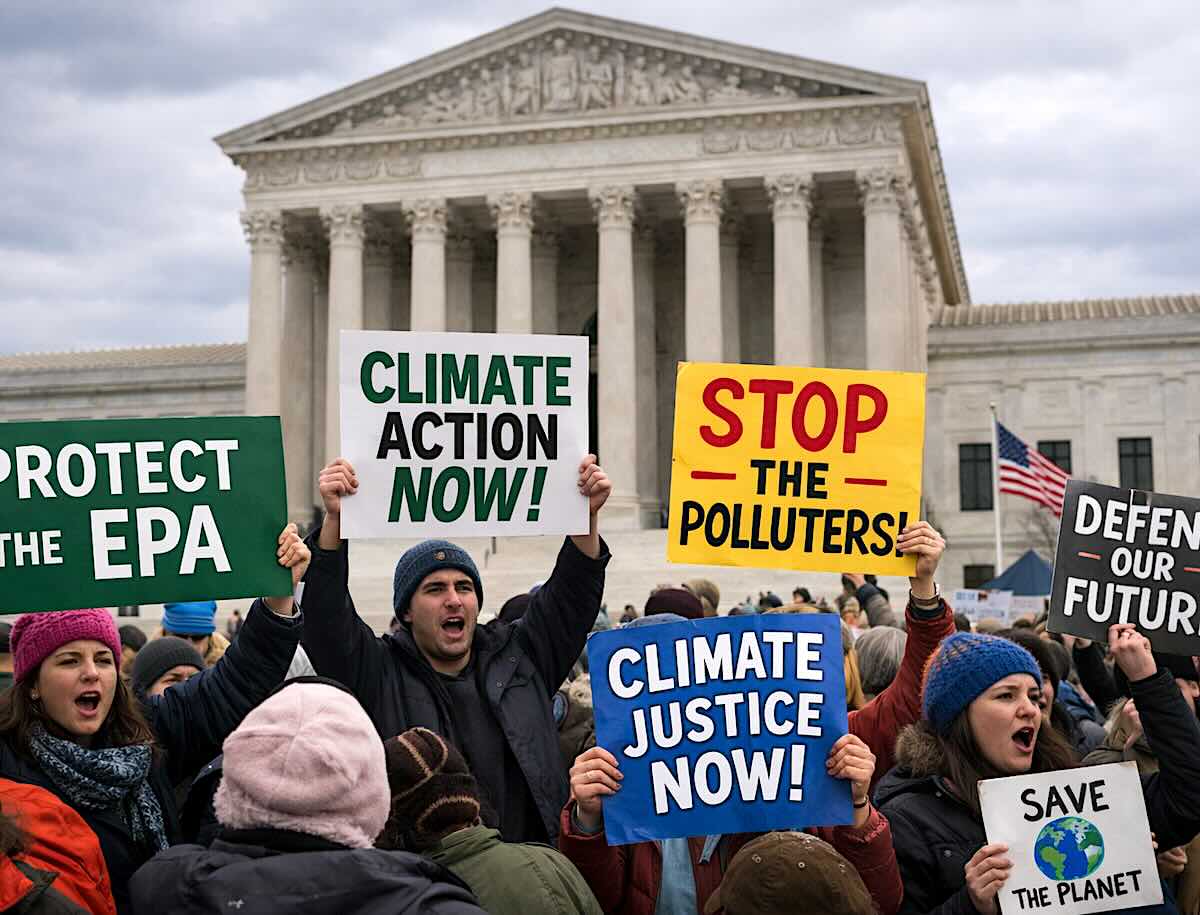
Climate litigation advocates laid out a legal strategy Thursday for states to pursue oil and gas companies over alleged climate deception even if the Supreme Court limits such lawsuits. [some emphasis, links added]
The Center for Progressive Reform, a left-leaning environmental advocacy group, hosted a Thursday webinar in which panelists outlined a strategy beyond the Supreme Court, arguing that states can use consumer protection and tort law to hold fossil fuel companies accountable.
“The case provides an important opportunity for the courts to provide a mechanism by which local governments forced to spend public money on climate adaptation measures will have the opportunity to hold companies that extract and market fossil fuels accountable for their contributions to the problem,” Robert Glicksman, a George Washington University Law School professor and one of the panelists at the Center for Progressive Reform webinar, told the Daily Caller News Foundation.
The Supreme Court is scheduled to hear oral arguments in Suncor Energy v. County Commissioners of Boulder County on Oct. 5, a landmark climate case examining whether federal law preempts state-law claims seeking damages over interstate and international greenhouse gas emissions.
Boulder County, the city of Boulder, and San Miguel County sued Suncor and ExxonMobil in 2018, alleging the companies knowingly promoted fossil fuels while concealing or misrepresenting their climate risks.
The companies dispute the allegations, arguing the claims are preempted by federal law.
Portraying Suncor as a consumer protection case gives Colorado a stronger claim to state authority than if the lawsuit were simply an attempt to regulate greenhouse gas emissions, Tulane University Law School professor Rebecca Bratspies said on the webinar.
“Boulder may now want to argue a consumer-fraud angle, but that isn’t the lawsuit it filed or pursued,” Amy Cooke, director of the Energy and Environmental Policy Center at the Independence Institute, told the DCNF.
“Boulder brought a climate change lawsuit seeking damages from Suncor and Exxon for alleged local effects of global emissions, effectively using the courts to impose a carbon tax it couldn’t get legislatively.”
“If Boulder believes Colorado consumers were defrauded, bring that case. Identify the deception, the consumers harmed, and the damages caused. But that’s a different lawsuit,” Cooke added.
Our 9/3 webinar will examine why accountability for the oil & gas industry is so important, the main legal issues being raised in the Suncor v. Boulder SCOTUS case, and more. Join us, with @rbratspies.bsky.social, @b-dunning.bsky.social, Robert Glicksman, & Lemir Teron! bit.ly/cprsuncorweb…
— Center for Progressive Reform (@progressivereform.bsky.social) August 7, 2026 at 11:25 AM
That distinction fed into another part of the panelists’ strategy: challenging the argument that federal authority displaces Colorado’s ability to hear the case.
“In Suncor, the Court has a chance to end the activist lawfare campaign that seeks to use public nuisance climate cases to impose mandatory Progressive Lifestyle Choices on the American people and reshape the nation’s economy without a single vote in Congress,” O.H. Skinner, executive director of Alliance For Consumers, previously told the DCNF.
Congress can use its Commerce Clause authority to preempt state law in areas where federal and state authority overlap, but Congress has not done so with the state tort and consumer protection claims at issue in Suncor, Bratspies said.
“Without the Court stepping in, progressive activists and their trial lawyer allies will continue to advance their woke lawfare campaign across the country,” Skinner previously said. “Lawmakers in every state should rein in public nuisance law and ensure our nation’s economy is not controlled by court orders and ideologically-driven litigation.”
The Clean Air Act undermines the industry’s position because it gives states a role in implementing federal air pollution laws, contains provisions preserving state authority, and does not expressly preempt state common-law tort claims, Bratspies argued.
Congress enacted the Clean Air Act in 1970 and substantially amended it in 1977 and 1990, creating the federal framework for regulating air pollution while preserving certain state authority.
“The issue before the Supreme Court is whether a Colorado court can hear these allegations that the company’s violations of Colorado Consumer Protection Law cause harms in Colorado,” said Bratspies.
But the panelists’ discussion of fossil fuel accountability did not stop with state courts.
When asked about what options communities would have if the Supreme Court blocks “climate deception” lawsuits such as Suncor, Howard University professor Lemir Teron argued advocates should think about climate change not simply as an environmental issue, but as a human rights issue.
Read rest at Daily Caller