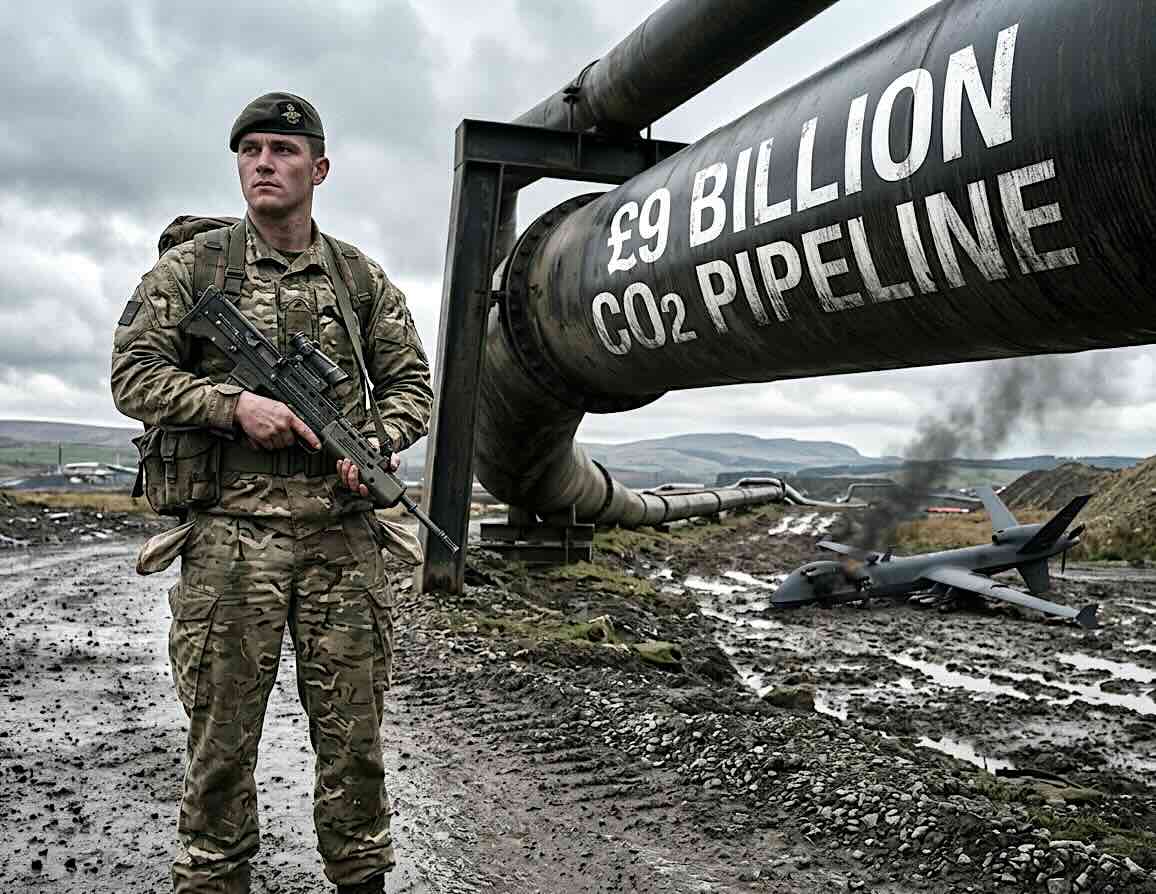
At a moment when Britain is searching down the back of the sofa for money to rebuild its defences, why is the ridiculous £9B (US$12B) carbon capture and storage (“CCS”) budget being protected? [some emphasis, links added]
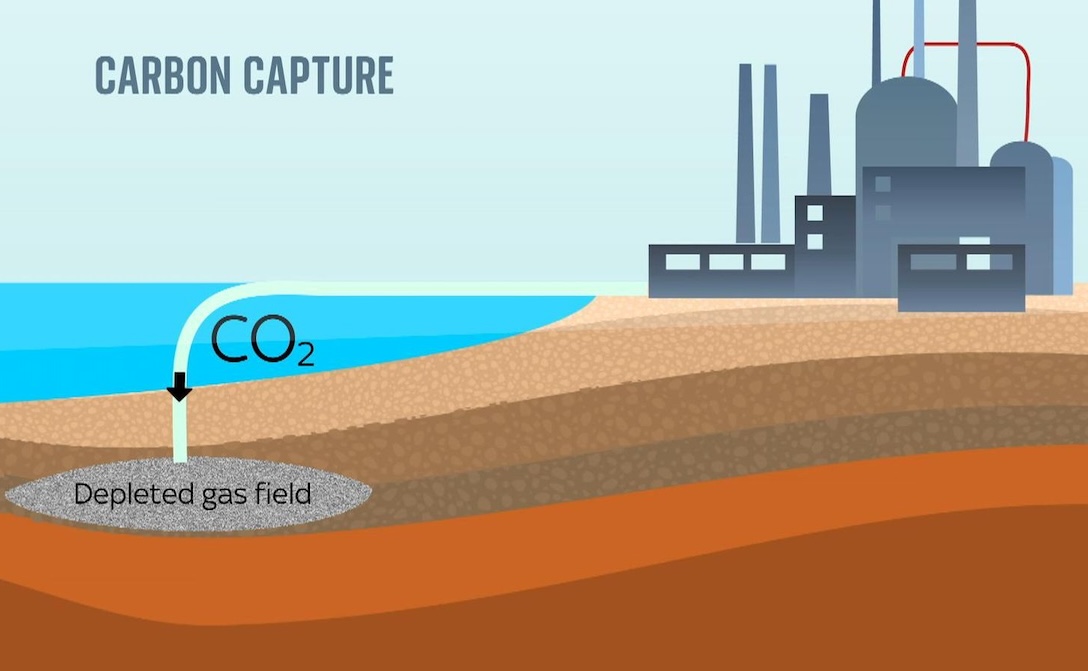
Carbon capture and storage means capturing carbon dioxide (CO2) emissions, usually from power stations or industrial plants such as cement, steel, or chemical facilities, and transporting the CO2 by pipeline or ship to be stored underground in geological formations, often depleted oil and gas reservoirs or saline aquifers.
CCUS is similar, but the U represents “usage” (Carbon capture, usage, and storage) – rather than simply storing the captured CO2, it is “used” in some way, for example in industrial processes, synthetic fuels, building materials, or enhanced oil recovery before being stored or released later.
The UK is focused on storage, leveraging depleted fields and associated pipeline infrastructure in the North Sea.
CCS is not a modest research line.
Energy Secretary Ed Miliband told the Commons that the Government had agreed £21.7bn over 25 years for five projects in HyNet and the East Coast Cluster, intended to create two transport and storage networks, support a gas-with-CCUS plant, an energy-from-waste plant and a blue-hydrogen project, and remove 8.5 million tons of emissions a year.
The Public Accounts Committee has since described the program as a high-risk bet on first-of-a-kind, unproven technologies, noting that there are no examples of CCUS operating at commercial scale in the UK and that liabilities could reach £34bn.
Indeed, the International Energy Agency’s carbon capture database tells us that the majority of CCS projects currently in operation rely on hydrocarbon production or processing for their economics, and despite the billions of dollars spent globally on these projects in the past few decades, relatively little CO2 is being captured and stored.
In the power sector, the results are particularly dire. Of the handful of coal power stations adapted for CCS, the costs were higher and capture rates lower than expected.
Only two – Boundary Dam in Canada and Petra Nova in the US – remain open, although the latter was mothballed for years, with the CO2 being used for enhanced oil recovery from nearby fields.
It’s abundantly clear that CCS is not intrinsically commercial, absent a link with hydrocarbons, a model that will not survive in a net-zero world.
The Global CCS Institute’s 2025 summary reports 77 commercial CCS projects in operation, with 64 million tons per year of capture capacity.
That sounds impressive until one remembers that, after decades of promotion, the industry itself says it will still not meet gigaton-scale goals even if all pipeline projects become operational.
One analysis estimates that governments have spent nearly US$30bn on carbon capture and hydrogen over 40 years, with far more pledged.
We are being asked to subsidise a technology that remains tiny and expensive relative to the claims made for it.
Read rest at The Telegraph