An article at Climate Central, “Climate Change Is Driving More Warm Summer Nights in U.S. Cities,” claims that human-caused climate change is driving more warm summer nights in nearly every major U.S. city, making overnight temperatures increasingly dangerous. [some emphasis, links added]
This is highly misleading if not outright false.
The analysis focuses almost exclusively on cities, ignoring rural temperature changes. It also ignores the well-documented urban heat island (UHI) effect, the single biggest non-climatic influence on nighttime temperatures in urban areas.
Climate Central’s report sounds authoritative because it relies on NOAA weather station records and its own proprietary Climate Shift Index. But there is a glaring flaw in this dataset as an indicator of “climate change.”
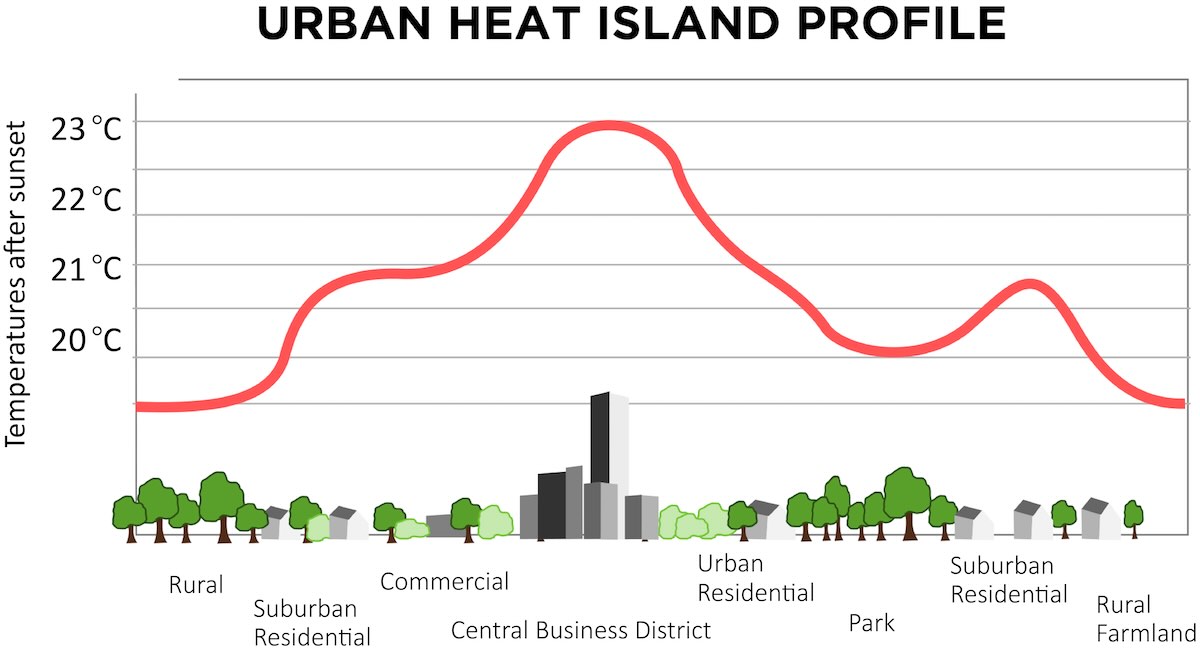
Cities and their surrounding suburbs are urban environments, and measured temperatures in urban environments, especially nighttime temperatures, are those most impacted by the UHI effect. See Figure 1 below.
This is not a controversial point. In fact, Climate Central quietly acknowledges it. Buried deep in the report, it notes that heat-related risks can be greater “in urban heat islands” and even discusses unequal exposure to urban heat among city residents.
Yet after acknowledging that UHIs exist, the organization never attempts to determine how much of the observed nighttime warming is attributed to urbanization versus climate change.
Instead, it attributes the increase in nighttime temperatures almost entirely to greenhouse gas emissions as measured by its Climate Shift Index. This is an assumption masquerading as analysis.
The UHI effect is especially pronounced at night because concrete, asphalt, rooftops, parking lots, and buildings absorb heat during the day and slowly release it after sunset.
Rural locations cool efficiently after dark because vegetation loses heat rapidly through radiation and evapotranspiration. Cities do not.
Anyone who has walked from a downtown parking garage into a nearby park after sunset has experienced the difference firsthand. That park is noticeably cooler because grass and trees act as heat sinks, storing the solar warming produced during the day.
Nighttime minimum temperatures are therefore among the measurements most susceptible to urbanization bias.
Climate Central’s own methodology makes this problem worse. The report relies on weather stations located in or near major cities and compares nighttime minimum temperatures dating back to 1970. Yet, Climate Central overlooks the tremendous physical transformation of American cities since 1970.
Urban populations have expanded. Impervious surfaces have multiplied. Vegetation has declined. Artificial lighting, vehicles, buildings, and waste heat have all increased.
Every one of those factors preferentially warms cities at night.
In addition, many of the temperature stations in these cities no longer sit in the same environment they occupied decades ago.
Over the last half-century, cities have expanded dramatically. Airports have grown larger. New highways, parking lots, warehouses, commercial developments, and residential neighborhoods have surrounded weather stations that were once located in relatively open areas.
As documented in Corrupted Climate Stations: The Official U.S. Temperature Record Remains Fatally Flawed, many NOAA weather stations fail basic siting standards because they are located near buildings, pavement, air-conditioning exhaust, jet blast areas, and other artificial heat sources.
One of the clearest examples is Reno, Nevada.
Climate Central highlights Reno as having experienced the largest increase in unusually warm summer nights since 1970, claiming 79 additional warm nights annually.
But Climate Central fails to disclose to readers that Reno’s long-term temperature record comes largely from a weather station located between runways at the Reno-Tahoe International Airport, seen below in Figure 2.

Recent field testing at that airport demonstrated that the official weather station consistently reads warmer than nearby locations due to its immediate surroundings.
In other words, one of the report’s showcase examples is also one of the most powerful examples of siting bias that the report never discusses.
That omission matters; it turns out that siting bias is stronger than the climate signal.
If a thermometer is increasingly surrounded by heat-retaining pavement, buildings, jet traffic, and expanding urban infrastructure, its nighttime temperatures will naturally rise even if the broader regional climate changes very little.
Instead of investigating whether station exposure has changed over time, Climate Central merely feeds the observations into its Climate Shift Index, raising another important issue.
The Climate Shift Index is not an independent measurement or a source of measured data. It is a model-based attribution tool designed to estimate how much more likely an event became because of human-caused climate change.
The methodology combines observational data with climate model output to conclude that warm nights were “made at least twice as likely due to climate change.”
But if the underlying observations already contain UHI contamination, then the model will faithfully attribute that contamination to greenhouse gases; the result is “Garbage in, garbage out.”
Ignoring those influences while attributing nearly every increase to climate change is like measuring temperatures next to a backyard barbecue and concluding the entire neighborhood has warmed.
Scientific studies should first eliminate or control for confounding variables when attempting to attribute an effect to a specific cause, in this case warmer urban nighttime temperatures to human greenhouse gas emissions.
Yet in an effort to keep the “climate change causes everything bad, narrative going, Climate Central ignores or downplays the most obvious variable: urban expansion and compromised temperature stations, leading to data biased by a significant UHI effect.
Good science asks whether the thermometer itself has become warmer because its surroundings have changed. Good journalism asks that question before publishing alarming headlines. Climate Central did neither.
The result is another misleading climate headline that sounds alarming, but rests on an assumption that has never been properly tested and seriously compromised data sources.
Read more at Climate Realism