Climate Central’s latest report, Warming U.S. Cities Face Higher Cooling Demand and Energy Bills, argues that climate change is driving increased cooling demand and higher electricity costs across America. [some emphasis, links added]
The report is mistaken, overlooking several important factors that explain the increased use of cooling better, factors endemic to growing cities.
Climate Central describes “cooling degree days as a temperature-based metric used to estimate the demand for energy to cool buildings.”
Climate Central has calculated that cooling degree days have increased in 97 percent of the 241 U.S. cities it analyzed since 1970, resulting in an average 37 percent increase in cooling demand. It further suggests that household cooling costs will continue to climb as the climate warms.
Perhaps the most obvious omission is that the analysis focuses exclusively on cities. Climate Central’s own methodology states that it calculated cooling degree day trends using temperature records from 241 urban locations between 1970 and 2025.
Cities are well known to experience the urban heat island (UHI) effect. As vegetation is replaced by asphalt, concrete, buildings, parking lots, highways, and other infrastructure, urban areas naturally become warmer than surrounding rural regions.
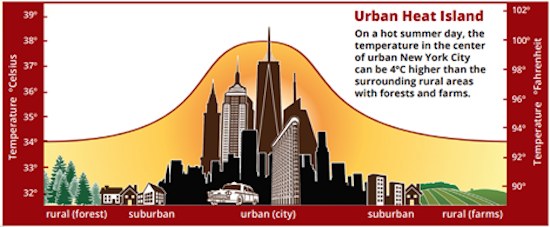
A definitive test case performed in Reno, NV, illustrated how a one-mile difference could dramatically alter temperature measurements used in the climate record.
Pavement absorbs solar energy throughout the day, buildings trap heat overnight, and millions of air conditioners discharge waste heat directly into the surrounding environment.
In fact, Climate Central acknowledges this phenomenon in its own report, noting that air conditioners release waste heat outdoors and that, in cities with millions of units operating simultaneously, this process can increase the UHI effect.
Despite recognizing that cities generate their own localized warming, the report makes no serious attempt to determine how much of the increase in cooling degree days is due to expanding urban development rather than some general warming trend.
The report also assumes that the National Oceanic and Atmospheric Administration’s (NOAA) temperature records accurately reflect long-term climatic changes.
NOAA does not adequately account for the many weather stations that have become compromised, closed, or relocated over time, generating false continuous readings.
As documented in The Heartland Institute report Corrupted Climate Stations: The Official U.S. Temperature Record Remains Fatally Flawed, numerous official weather stations that once sat in relatively open environments are now surrounded by parking lots, airports, buildings, industrial development, air-conditioning exhaust systems, and other artificial heat sources.
Other stations have been affected by nearby irrigation or landscaping that can influence local temperature measurements.
These changes matter because the purpose of a local weather station is to measure changes in the immediate surroundings of the station’s thermometer, and any associated instruments which measure precipitation, air pressure, and wind speeds; data needed for accurate local weather reports.
Unfortunately, many weather stations’ data have been used for a purpose they were never intended for or well suited to looking for a long-term climate signal.
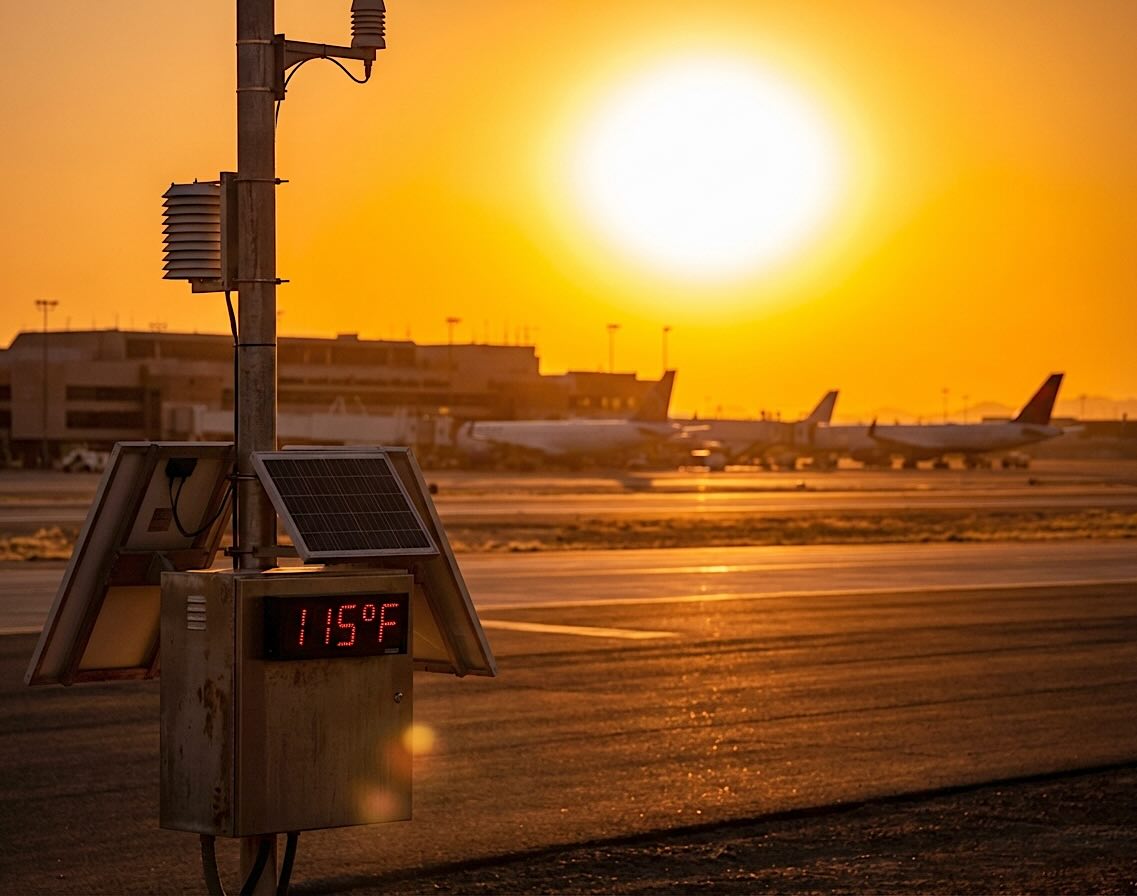
If a weather station becomes increasingly surrounded by urban development over several decades, it should not be surprising if the recorded temperatures increase or wind speeds shift, even if the broader regional climate changes far less.
Climate Central’s analysis never meaningfully addresses this fact.
The growth of American cities over the past half-century is a confounding factor compromising Climate Central’s conclusions. Since 1970, most major metropolitan areas have expanded dramatically.
Population growth, new highways, larger airports, commercial development, denser housing, and widespread air-conditioning all contribute additional heat to the local environment.
Treating all of this warming as evidence of greenhouse-gas-driven climate change risks confusing the effects of urbanization with changes in the atmosphere itself.
The clearest illustration of how city temperatures do not reflect the actual overall climate for an area comes from the work of Roy Spencer, Ph.D., of the University of Alabama Huntsville, who mapped temperature differences versus population density in the United States, seen in Figure 2 below.
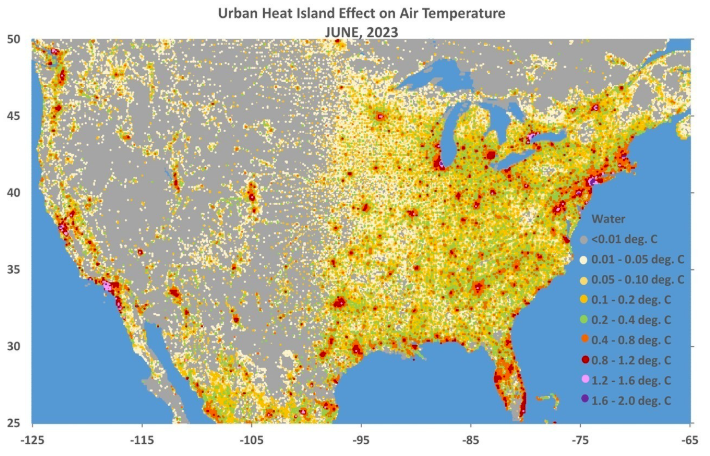
Based on Spencer’s map, it is clear that cities themselves concentrate the warming, and that many cities studied by Climate Central are on his map.
If climate was unilaterally warming the United States, there would not be areas in grey where no warming has been measured.
In fact, one study calculated the effect of heating of the urban environment due to air conditioning and found heating values that exceeded expectations of warming supposedly caused by greenhouse gas emissions and concluded that “Waste heat release from AC systems was maximum during the day, but the mean effect was negligible near the surface.
However, during the night, heat emitted from AC systems increased the mean two-meter air temperature by more than 1°C for some urban locations.”
Climate Central’s attribution of rising household cooling bills to a warming climate is equally flawed. Electricity prices depend on much more than outdoor temperatures.
The report acknowledges that residential electricity prices increased by 31 percent between 2020 and 2025 while noting that growing demand from data centers contributed to higher prices. It does not, however, examine another major factor: energy policy.
Across much of the United States, aggressive renewable energy mandates have required utilities to retire reliable, relatively inexpensive, conventional generation while investing billions of dollars in wind farms, solar facilities, battery storage, and extensive new transmission infrastructure.
Because wind and solar generation are intermittent, utilities must also maintain backup generation to preserve grid reliability. These shifts in the makeup of the electric power grid are responsible for ratepayers’ rising electricity costs.
In short, it is the supposed cure for climate change, “emission-free” renewable power, not climate change itself, that is causing higher power prices.
Climate Central says their methodology, the statistical model they use, controls for factors such as home size and air-conditioning prevalence. But it does not evaluate how state energy policies, renewable energy mandates, transmission investments, or changes in generation mix affect electricity prices.
As a result, the report cannot separate higher cooling costs caused by warmer weather from higher costs caused by more expensive electricity.

Perhaps the greatest weakness in the report is its reliance on cooling degree days as though they establish causation. Cooling degree days simply measure how often temperatures exceed 65 degrees Fahrenheit. They do not reveal why those temperatures occur.
The metric cannot distinguish between warming caused by regional climate trends, urban heat islands, expanding development, deteriorating weather-station siting, airport expansion, or localized waste heat.
Nevertheless, Climate Central repeatedly presents increasing cooling degree days as evidence that greenhouse gas emissions are responsible for rising cooling demand.
By focusing almost exclusively on urban locations, ignoring cooling degree days in rural areas, overlooking the documented deterioration of many weather station sites, failing to account for the UHI effect, and failing to control for the role that energy policy plays in electricity prices, Climate Central presents an incomplete picture of why Americans are paying more to cool their homes.
Until those factors are fully addressed, Climate Central’s analysis should receive a failing grade, or more charitably, an incomplete.
Claims that greenhouse gases alone are causing increased cooling demand and household electricity bills are unpersuasive when so many other, more direct factors impacting households’ cooling costs are not controlled for.
Read more at Climate Realism