

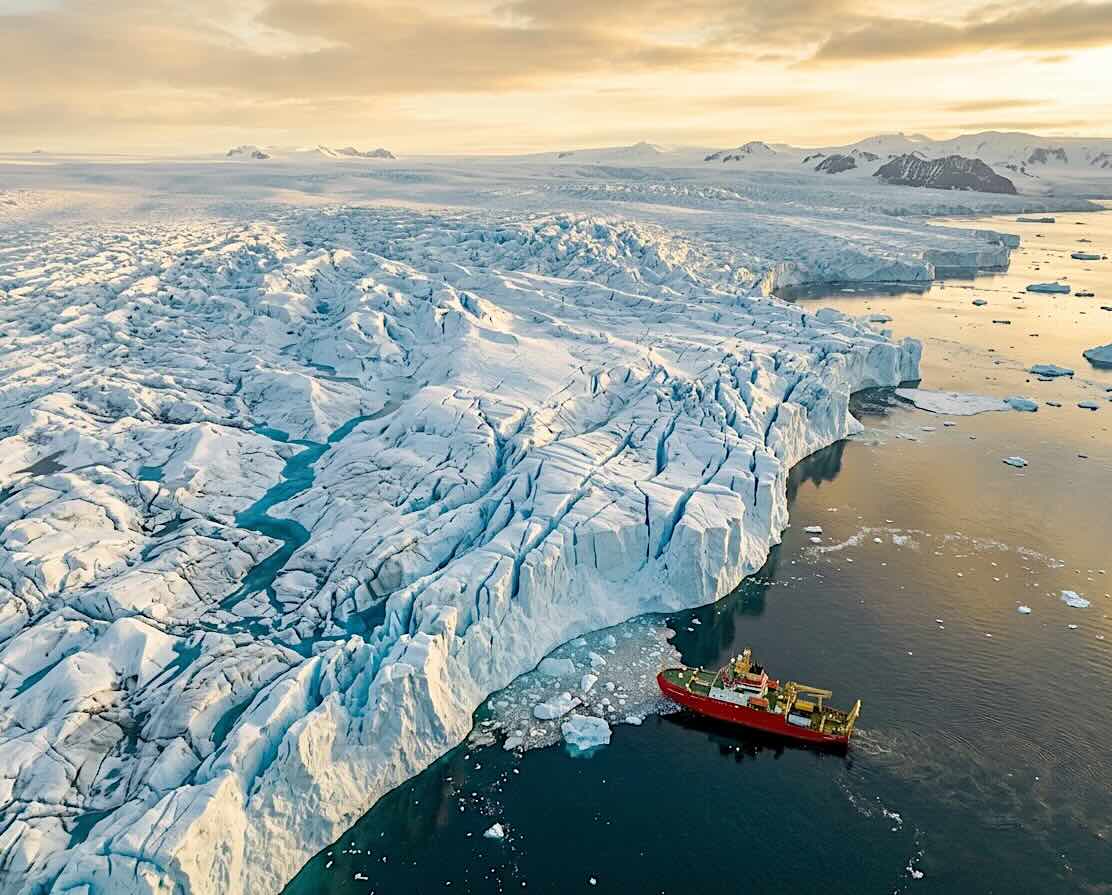
The Daily Mail (DM) claims in “Is Antarctica’s Doomsday Glacier about to COLLAPSE?” that the Thwaites Glacier could lose its ice shelf “this year” with “devastating consequences” for global sea levels. [some emphasis, links added]
This is false. The article’s claims rely on worst-case modeling scenarios while ignoring measured data, physical scale, and the substantial uncertainty surrounding projections.
The DM article warns that Thwaites could “trigger catastrophic sea-level rise” and suggests its ice shelf is on the verge of imminent failure. That framing creates the impression of a sudden, unstoppable chain reaction.
But the researchers actually studying Thwaites distinguish between ongoing retreat and irreversible collapse. Measured basal melting and grounding line retreat are real phenomena.
However, projecting full structural collapse on a specific timeline is solely a model forecast built on unverified assumptions and limited observations.
Scale matters.
Thwaites Glacier contains on the order of 600,000 gigatons of ice. Even if one accepts the article’s cited figure of roughly 200 gigatons of potential ice loss in the coming decades, that is a tiny fraction of the total mass.
As shown in the graph (right) in the figure below, each year’s total ice loss is a nearly undetectable three ten-thousandths of one percent (0.0003 percent) of the Antarctic ice mass.
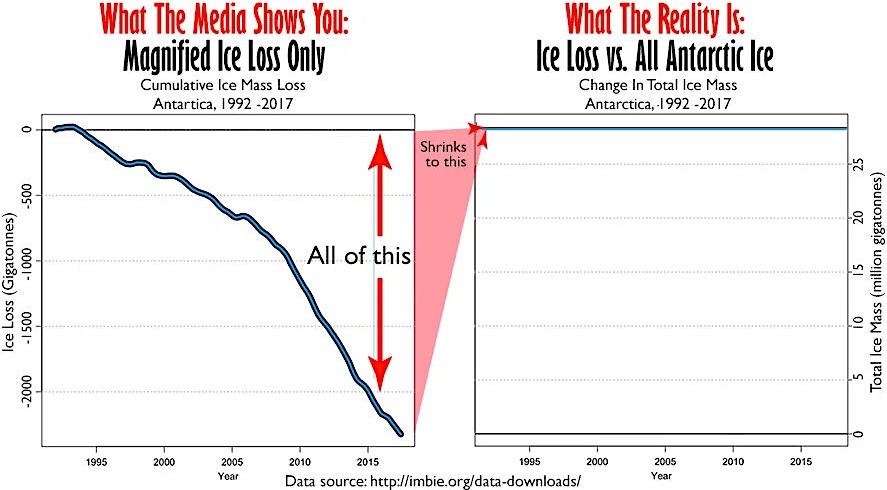
As Climate at a Glance documents in its review of Antarctic ice trends, Antarctic ice mass variability is complex and regionally heterogeneous. Short-term losses do not automatically translate into runaway collapse or multi-meter sea-level rise.
The mechanism of melting is also misrepresented in popular coverage. The International Thwaites Glacier Collaboration deployed instruments beneath the ice shelf and directly measured Circumpolar Deep Water intruding beneath the glacier.
This relatively warm ocean water, about 1°C above freezing, melts the ice from below. That is an ocean circulation issue, not an atmospheric temperature issue.
Ocean currents that bring subsurface warm water into contact with the ice shelf are a key driver. Blaming “climate change” misleads about the physical mechanism behind the ongoing decline.
The DM’s tone implies the inevitability of collapse. But measurements show ongoing retreat and thinning consistent with instability in certain sectors. The distinction is crucial.
Observations document present behavior. Models extrapolate future behavior under assumed forcings. The leap from measured thinning to “collapse this year” is undermined by empirical evidence.
The media has made similar alarming assertions over the years, and Climate Realism has refuted them, for instance, here, here, and here.
Climate Realism has repeatedly noted that Antarctic ice projections have swung widely over the past decade, with studies alternately warning of imminent collapse, then revising timelines, then highlighting stabilizing feedbacks.
A Washington Times analysis of recent Thwaites data emphasized that while retreat is measurable, the data do not demonstrate a sudden, irreversible tipping point in the near term.
Ice-sheet dynamics unfold over decades to centuries, not news headline cycles.
There is also the matter of the broader Antarctic context. Satellite observations show that while parts of West Antarctica have lost mass, other regions, including portions of East Antarctica, have gained mass.
Net Antarctic trends vary depending on the time window selected. Short baselines can exaggerate perceived acceleration. The mechanism is primarily oceanographic. It involves shifting ocean currents transporting subsurface heat beneath the ice shelf. That distinction is important.
The dominant process here is not surface air temperature melting the glacier from above. It is warm seawater interacting with the glacier’s underside.
The Intergovernmental Panel on Climate Change (IPCC) Sixth Assessment Report concluded that Antarctic ice loss could contribute significantly to long-term sea-level rise under high-emissions scenarios, yet the same IPCC recently admitted that such scenarios are implausible; in fact, impossible.
Warnings of collapse shouldn’t be taken seriously when they are based on impossible physical emissions scenarios. There is deep uncertainty in ice-sheet modeling, particularly regarding marine ice-cliff instability and hydrofracturing assumptions.
Extreme assumptions drive the projections of near-term collapse. Climate models are not measurements.
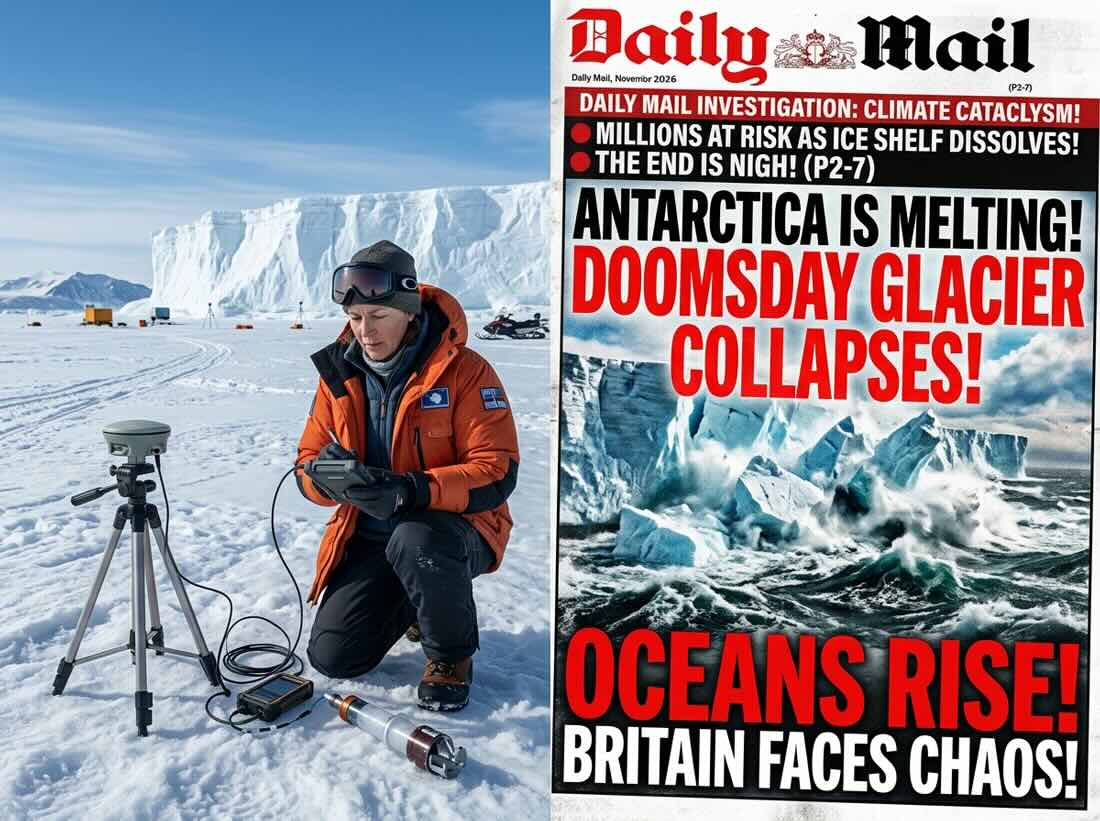
The DM has a long record of using capitalized words like “COLLAPSE” and “DOOMSDAY” to generate clicks. That is not scientific communication. The difference between a long-term ice retreat and sudden disintegration matters.
Over the long term, ice shelves can thin and retreat, but this is not equal to, nor will it trigger, an instantaneous sea-level catastrophe. Ocean-driven melt processes are measurable and ongoing, but they are part of a dynamic system influenced by ocean circulation patterns that predate modern industrial emissions.
Presenting a complex, multidecadal glaciological process as an imminent apocalypse does not inform readers.
The DM’s story does not represent a sober, accurate analysis of trends in Antarctica, grounded in measured data and testable science. It is climate doomsday clickbait, using dramatic typography.
Read more at Climate Realism







“Antarctic ice loss could contribute significantly
to long-term sea-level rise under high-emissions scenarios,”
most of its arctic the permanent temperature inversion
and a negative greenhouse effect
therefore more CO2 in the atmosphere
makes it colder not warmer
The Thwaites Glacier is situated directly over the West Antarctic Rift System, which is one of the largest volcanic provinces on Earth. While these geological features sit under the bedrock beneath the ice rather than being open “undersea” volcanoes in the open ocean, their activity directly impacts the underside of the glacier.