

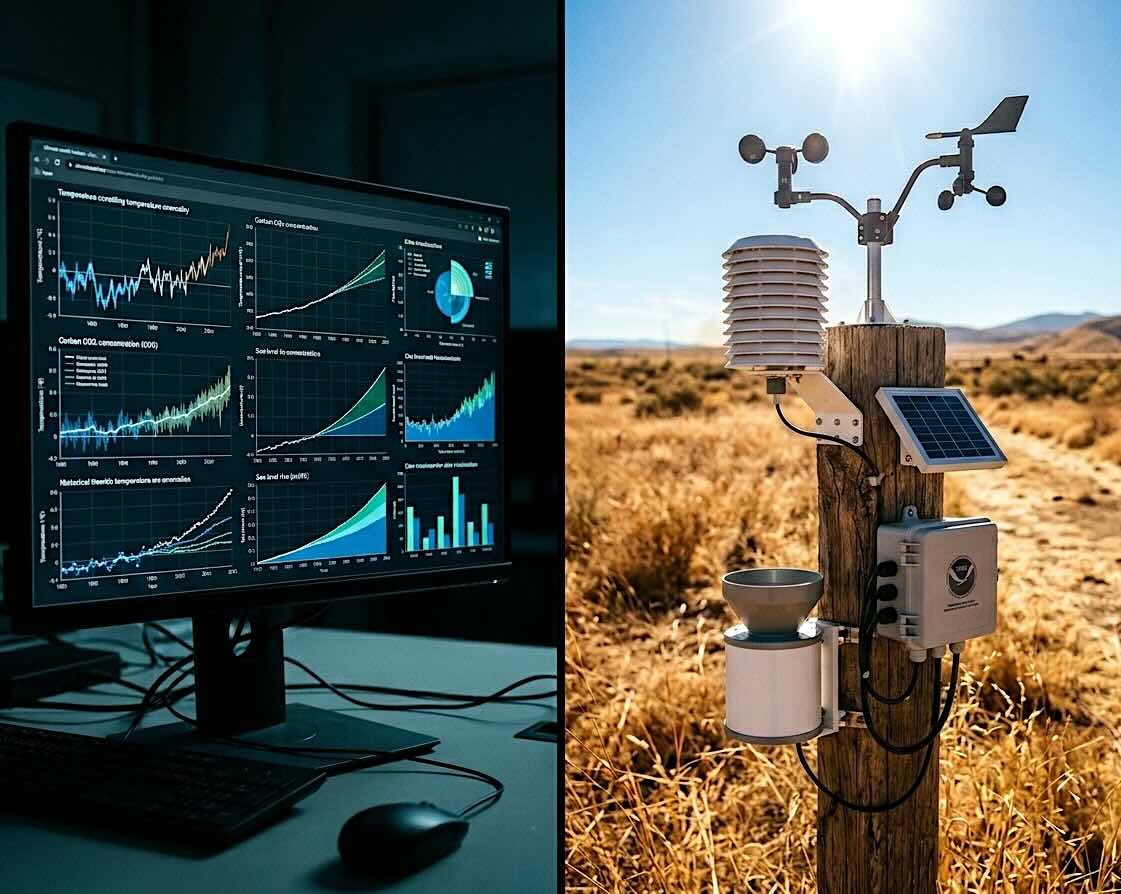
The Associated Press (AP) claims in “Think it’s hot now? The next five years will smash records, UN says” that Earth is “overwhelmingly likely” to repeatedly surge past the 1.5°C threshold and experience escalating heatwaves and extreme weather from 2026 to 2030. [some emphasis, links added]
This is highly misleading if not outright false. The story is built almost entirely on computer model projections, not observed data, and it treats speculative model simulations as though they reflect measured trends.
The AP admits that its claims are “based on the averaging of about 200 runs of computer simulations using 13 different climate models.” That is the core of the story.
Not thermometers. Not weather station records. Not satellite observations. Computer simulations. Climate model outputs are not data.
Climate models are tools, consisting of assumptions about greenhouse gas forcing, feedbacks, ocean heat uptake, and cloud behavior, all fed into computers. They are useful for exploring scenarios. But they provide no real evidence that specific outcomes will occur.
As documented in Climate at a Glance’s analysis of climate models versus measured temperature data, model ensembles have historically projected more warming than satellite and balloon observations show.

The divergence between model runs and measured lower troposphere temperatures is not trivial. It is persistent.
The AP story warns of “limit-smashing global warming” and ties that to more extreme heatwaves. But heatwaves are not new, nor are they unprecedented in the historical record.
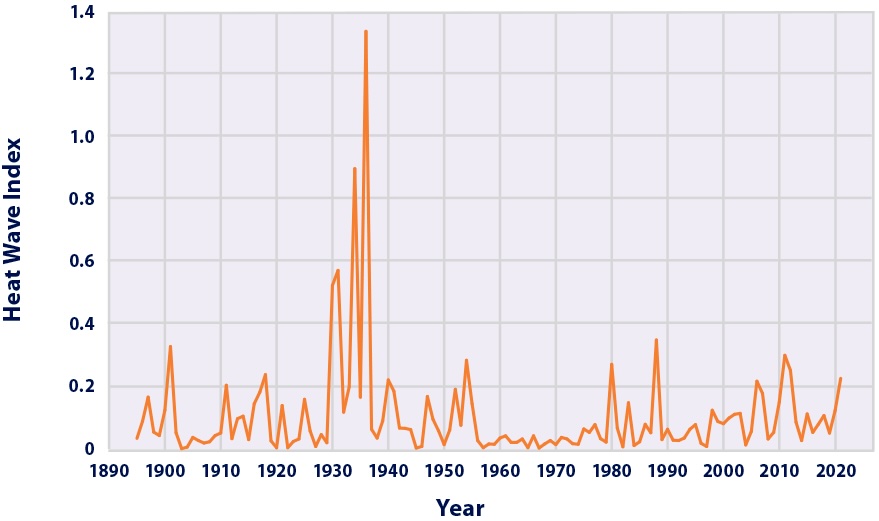
The United States experienced severe, prolonged heatwaves in the 1930s during the Dust Bowl era, long before modern emissions levels were reached.
Climate at a Glance’s review of U.S. heatwaves explains that the frequency of extreme heatwaves in the United States was higher in the 1930s than in recent decades. That is based on NOAA historical data, not projections.
If heatwaves were strictly “driven” by rising CO2 concentrations, we would expect a clear, monotonic increase in frequency and intensity corresponding to emissions growth. The observational record does not show that.
Instead, it shows strong variability influenced by natural factors such as ocean cycles, soil moisture patterns, atmospheric blocking highs, and El Niño events.
The AP article itself acknowledges that “nearly all the shorter-term forecasts call for a strong El Niño.” El Niño is a natural ocean-atmosphere oscillation that temporarily boosts global average temperatures. It has nothing to do with fossil fuels.
If 2027 turns out hotter due to a strong El Niño, that would reflect a cyclical Pacific warming phase, not proof of accelerating man-made climate forcing.
AP also emphasizes that there is a “75% chance” that the five-year average will exceed 1.5°C above preindustrial levels. But that 1.5°C threshold was a politically chosen “threshold,” not one identified by science as bringing catastrophe.
The 1.5℃ temperature was a 20-year average benchmark established under the Paris Agreement. Even the report’s coauthor admits it is “not kind of a cliff edge that we’re going to fall off.” Yet the headline language suggests imminent planetary destabilization.
Short-term variability is a defining feature of Earth’s climate system. Volcanic eruptions, solar cycles, ENSO phases, and ocean circulation shifts can all nudge global averages up or down by tenths of a degree.
The planet does not warm in a straight line. The idea that five years of elevated readings would constitute some irreversible tipping point is not supported by historical climate behavior.
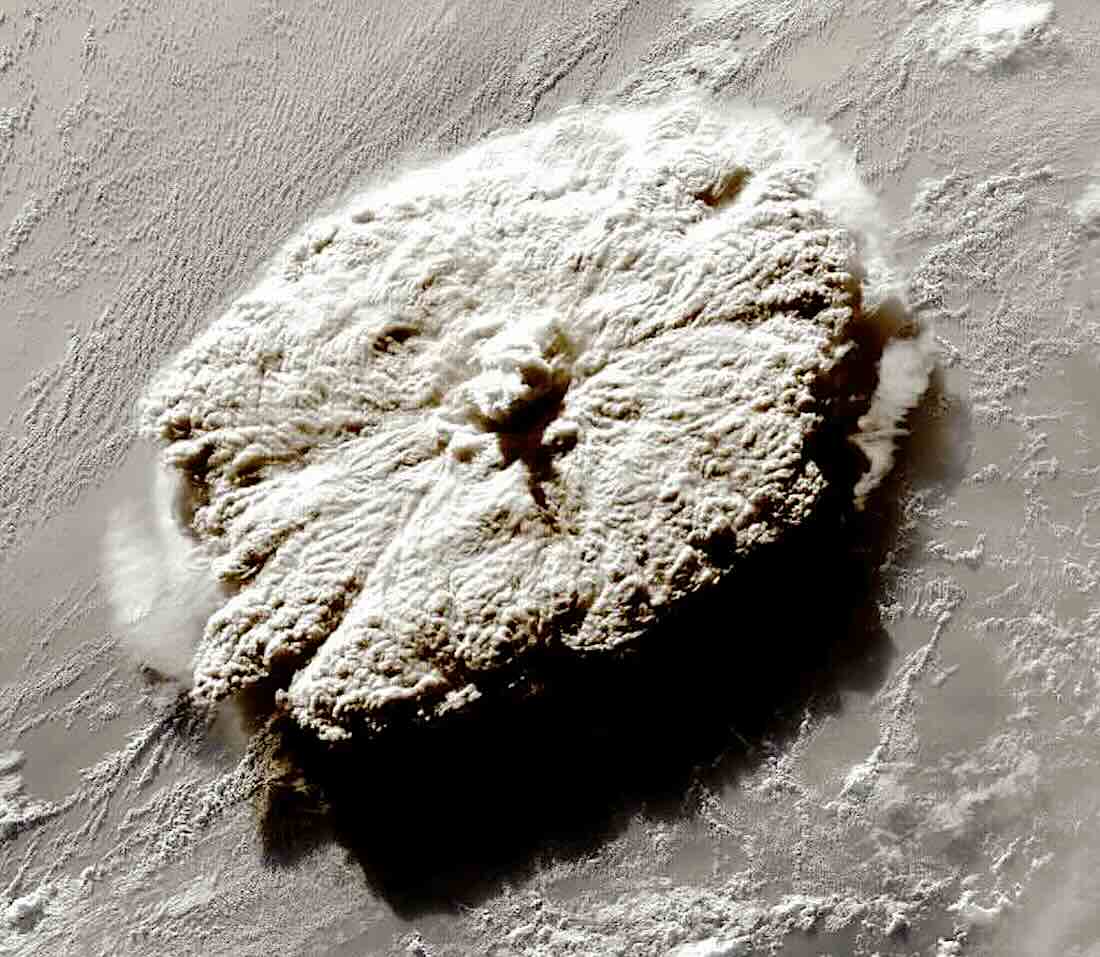
In point of fact, much of the warming of the past few years was likely driven by the Hunga Tonga near-sea-surface volcanic eruption, which injected enough water vapor into the atmosphere – water vapor being the dominant greenhouse gas – to, in the words of the National Oceanic and Atmospheric Administration (NOAA), “cause a rapid change in chemistry.”
The water vapor added by Hunga Tonga is only slowly diminishing, meaning its lingering effects will add to the expected El Niño. Meaning if the politically determined 1.5℃ threshold is breached, it will be a combination of natural factors, not human-caused climate change, to blame.
In either case, there is no real reason to believe dangerous tipping points will flow from it.
Climate at a Glance’s discussion of model fallibility documents multiple instances where model projections overstated warming trends or extreme event changes relative to observations. This fact means confidence in precise five-year forecasts should be restrained.
The broader problem is attribution inflation. When a heatwave occurs, it is immediately cited by an overzealous press (such as AP) as evidence of climate change.
But weather is not climate. Heatwaves occurred before the Industrial Revolution. They occurred during the Medieval Warm Period. They occurred during the 1930s Dust Bowl, as seen in the figure below.
Specific events are influenced by immediate meteorological dynamics, not by abstract multi-decade averages alone.
Climate change is a long-term statistical trend. It does not dictate the formation of a particular blocking heat dome over North America in June 2027. It does not create or prevent El Niño. It does not eliminate natural variability.
The AP story closes with sweeping claims that “every nation is already paying a huge price” from a “global climate crisis.” That alarmist rhetoric goes far beyond what five-year model ensembles can justify and, based on mortality, agricultural, and economic data, is flat false.
Forecasts based on 200 model runs are not measurements. They are scenario outputs, outputs only as good as the assumptions, data, and the accuracy of the modeled interconnections between disparate physical, chemical, and biological phenomena built into the models.
In fact, most of the factors that impact global and regional climates are only poorly understood and accounted for in models, as even the IPCC has admitted. (See the graphic below.)
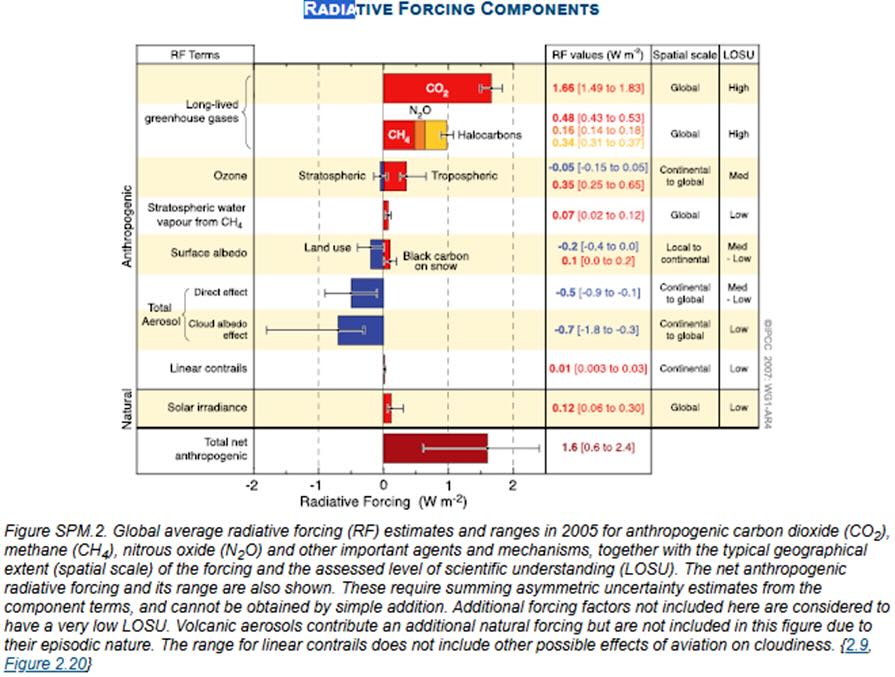
The models used by the IPCC have a low Level of Scientific Understanding (LOSU) concerning the impact of clouds, solar irradiance (that is, the impact of the sun), and aerosols on climate change.
Note that the models don’t even attempt to account for volcanic impacts or the impacts of changes to large-scale ocean currents, changes in vegetation, or the Earth’s wobble and shifts in its tilt.
Yet all of these impact the climate on a regional or global scale.
Thus, treating inadequate model forecasts as inevitabilities is unjustified as a matter of science and science reporting. The AP is choosing to promote an alarming climate narrative over the deep uncertainty that is the fact of the causes and present and future consequences of climate change.
Read more at Climate Realism



“much of the warming of the past few years
was likely driven by the Hunga Tonga
near-sea-surface volcanic eruption”
,none of the warming made by the global average temperature
was caused by hunga tonga
there is no evidence it caused even 0.1° C of warming
climate forecasts and predictions are never based on data
because there are no data for the future climate
whether they are based on climate models
or written on the back of an envelope
by a scientist doesn’t matter
there is never data for the future
“…there is never data for the future.” Spot on. {On the other hand – “The science is settled…”}
(Which is why I don’t listen to horse-racing touts.)