

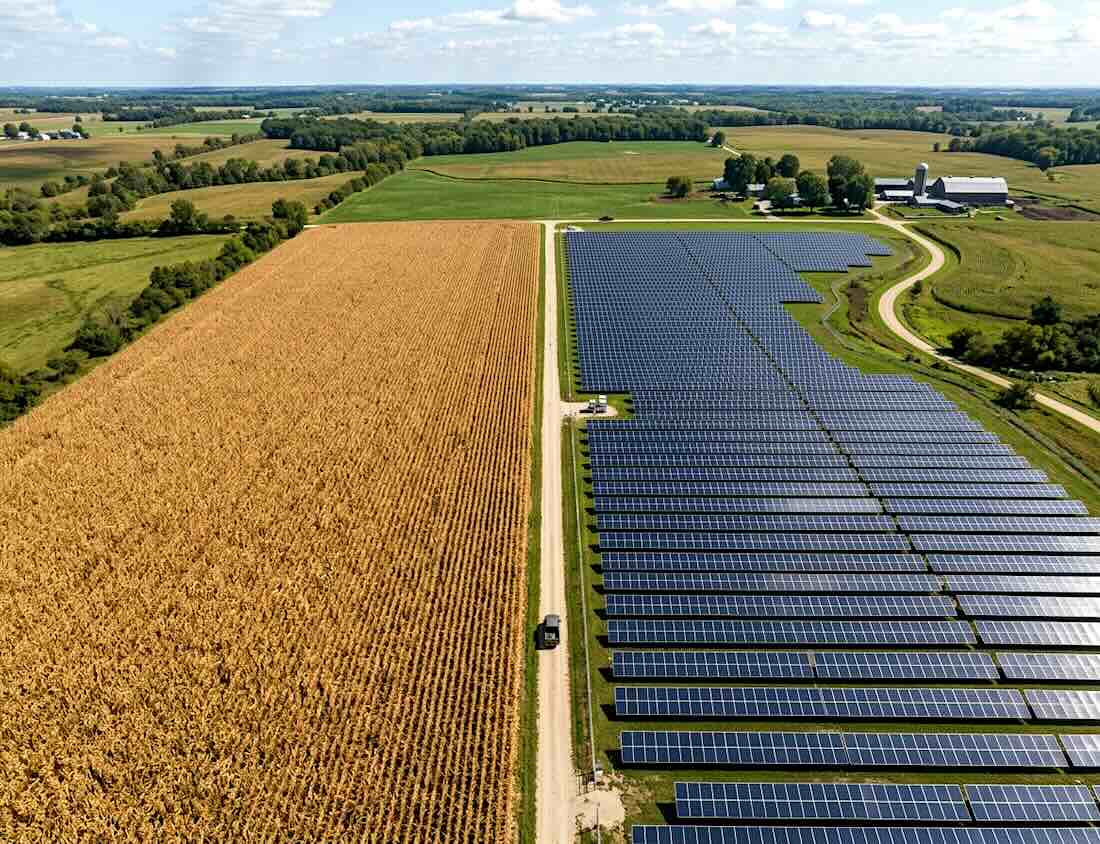
I have to admit that I laughed out loud – almost spewing coffee on my keyboard – Friday morning when I read this headline from a competing platform’s energy-related newsletter: “SOLAR DOESN’T USE MUCH FARMLAND: Solar occupies less than 1% of farmland in the U.S., according to the Solar Energy Industries Association.” [some emphasis, links added]
To paraphrase from former President Bill Clinton’s grand jury testimony, that depends on what the meaning of “much” is. Curious about the subject, I decided to research the question, accessing a wealth of public information easily available to anyone, including those in the solar industry.
The answer I found might surprise the folks at the Solar Energy Industries Association. Or maybe it wouldn’t, which might explain why they chose to couch the answer in such a misleading way.
The salient question: How many acres make up 1% of U.S. farmlands?
The easily discovered answer: Approximately 8.74 million acres (using the latest 2025 figure of ~874 million acres total), according to the U.S. Department of Agriculture.
According to the USDA’s most recent data, the 2025 total land in farms is 873.95 million acres (down slightly from prior years). Earlier years were a bit higher (e.g., ~900 million in 2017), but the total has been gradually declining. One percent of 873.95 million acres = 8.74 million acres.
Farmland here generally refers to “land in farms” per USDA definitions (including cropland, pasture, woodland, etc.). Figures can vary slightly by source or definition (e.g., cropland-only vs. all agricultural land), but the ~874 million-acre range is the standard benchmark from official USDA reports.
Now, for some context. The King Ranch in South Texas is arguably the largest and most celebrated big farming and ranching operation in U.S. history. Established in 1854 by pioneering rancher Richard King, the ranch at its peak consisted of 1.2 million acres.
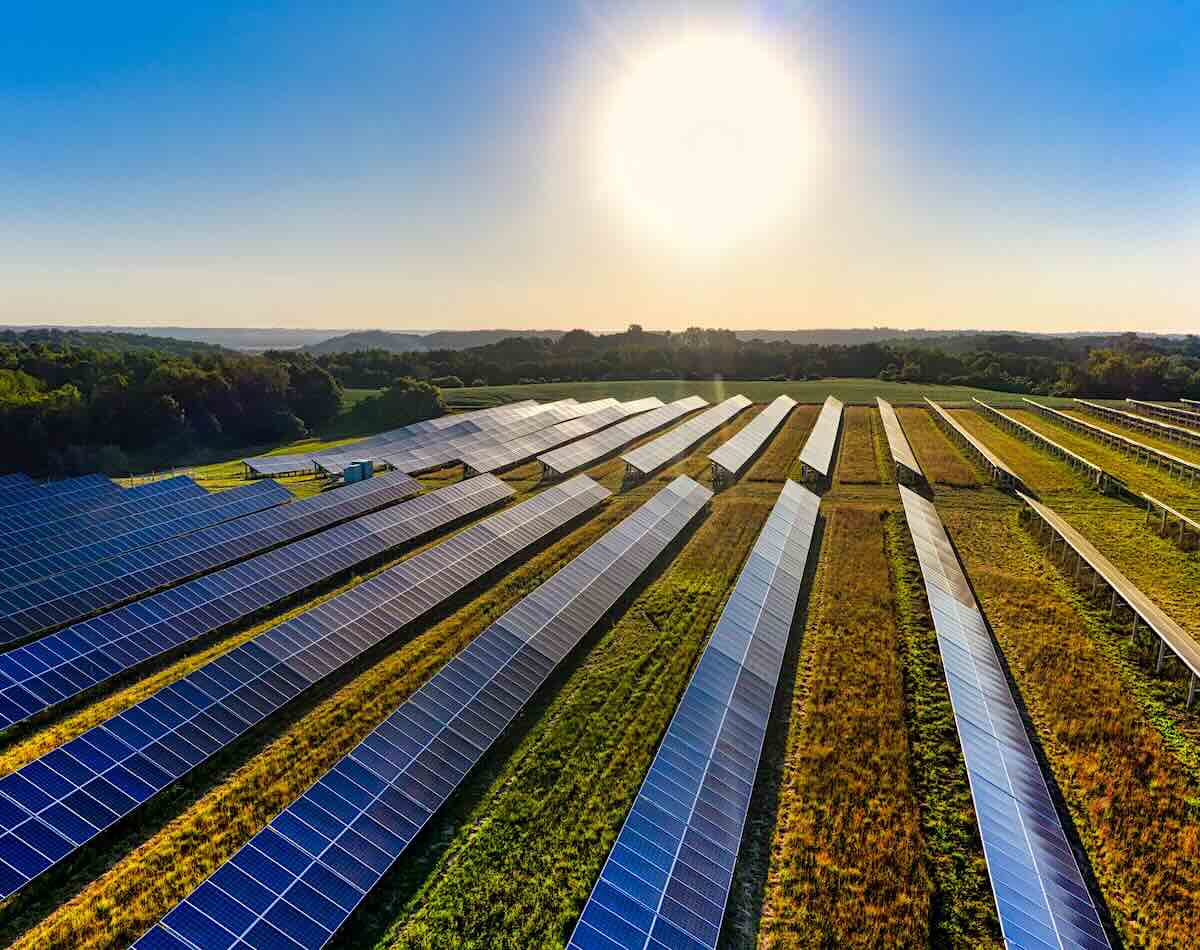
Thus, the solar power industry itself admits that its wind arrays currently occupy an area of fertile farmlands that is roughly eight times the size of the biggest farming and ranching operation in United States history.
That is a stunning number, yet the authors of that referenced newsletter characterize it as being “not much.”
Being a guy who grew up in a farming and ranching family, that sure seems like “much” to me. It also most likely seems like “much” to experts whose own studies find that placing solar arrays atop farmlands robs the land of crucial nutrients and renders it more vulnerable to erosion.
Disturbingly, unless radical changes are quickly made, the industry plans to cover up many more King Ranch-sized swaths of fertile land in the coming years.
A 2024 report by the Institute for Energy Research finds that, despite these warnings by experts in the field, the vast majority of new solar projects are targeting farmland to house their industrial projects in the coming years.
“The target for solar operations is increasingly in the Midwest, where government handouts to solar allow them to pay more to rent land than the farmers providing food for the nation,” the report says, adding: “Farmland preservation groups believe 83 percent of new solar installations will come from farm and ranch lands, with half of these installations on the richest land for food and crops.”
Fortunately, the big federal subsidies that drove the recent huge solar expansion are scheduled to begin expiring in July.
But with hundreds of new solar projects already in the queue, millions more acres of fertile farmlands will be removed from the food system in the years to come, even as a fertilizer shortage threatens to disrupt global food supplies.
All to create unreliable, unpredictable, intermittent electricity for a few hours a day that could be provided by an array of more reliable power sources, which occupy a fraction of the land, none of which intentionally target farmlands as their homes.
It’s a completely irrational misallocation of hundreds of billions of dollars in capital brought to us directly by the Biden autopen presidency and its Orwellian Inflation Reduction Act. You could never make this stuff up if it weren’t already happening before your very eyes. Watch it and weep.
Read more at Daily Caller



“studies find that placing solar arrays atop farmlands robs the land of crucial nutrients and renders it more vulnerable to erosion.”
Ah, that may be true but the author is leaving out a lot of other negative aspects of solar panels. Do not forget that these solar arrays, with their ancillary and large scale infrastructure, need constant cleaning of dust and debris, and are subject to wind storms and tornadoes (it’s the Midwest, aka Tornado Alley), snow and ice (Alberta Clippers) which block and/or destroy their function, hail which destroys them, and cold and heat which decrease their function as well.
This is not to mention that the heavy metals from these short-lived (decreasing a percentage every year as they age, thus a 12-year half-life) solar panels will destroy the land and that adjacent to it for decades or more. Oh, and they are not recyclable.
Solar farms are simply a good example of crony capitalism and handing out money to friends and family. Do not forget that such grifters and government ALWAYS pursue new things, such as biofuels and corn-based ethanol rather than nuclear, because such companies already exist and cannot demand the huge start up funding from which billions tend to disappear—they want all the funding under their control. Think Solyndra and the extensive funding and eventual failure while the money found new unexplainable pockets.
Solar panels at large scale are the worst not-green energy source on the planet. They are only good for small end-user installations, such on small islands off the Maine coast, where cost-wise they are expensive but cheaper and more independent than putting in underwater transmission lines and shore power.
Here in Aurora, Colorado there was a new installation of a “solar farm” of about 200 acres. It’s a mile long and something just over a 1/4 mile wide. This land and a neighboring plot was alternating growing winter wheat. I had wondered why last year either was planted with winter wheat (you have to alternate plantings to let the soil regenerate). So now one planted with expensive toxic waste and the other has gone fallow for two years. And we live in an area where hail storms are not rare at all. Last year another smaller solar installation a few miles away was totally destroyed by hail. We’ll see if this investment by Xcel Energy was smart but their dependence on “green energy” is anything but smart which we will soon be paying for.