


The ScienceAlert article “Sea Level Rise Is Accelerating, And We Now Know The Biggest Reason Why” claims that sea-level rise is not only accelerating but that scientists have now “closed the budget” and identified ocean thermal expansion as the dominant driver. [some emphasis, links added]
This is false. Direct, long-term tide gauge measurements around the world do not show the dramatic acceleration implied in the satellite-based narrative.
The distinction between satellite altimetry and tide gauges is critical. Satellite measurements of global mean sea level began in 1993. That record spans about 30 years and involves multiple satellite missions stitched together over time.
Each transition between satellites requires calibration adjustments. Even small offsets can introduce artificial curvature into the record, creating the appearance of acceleration.
By contrast, tide gauges measure sea level directly at specific coastal locations, and in many cases for more than a century.
For example, in Figure 1 below, the Battery tide gauge in New York City has operated since 1856. It shows a steady rise of about 2.8 to 3.0 millimeters per year, with no statistically significant acceleration over more than 160 years.
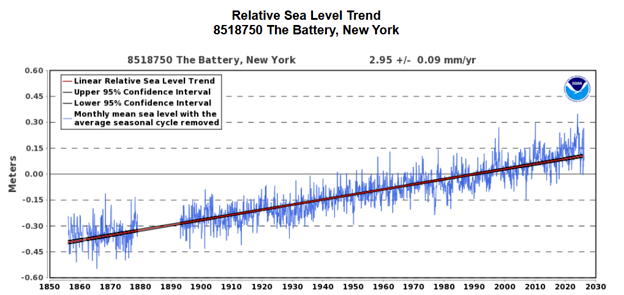
Many other long-term gauges around the world display similarly linear trends.
This matters because tide gauges measure what actually affects people: sea level at the coast. Satellite altimetry measures global averages across the open ocean.
When the two datasets diverge in character, the longer, directly observed tide gauge record deserves greater weight.
The pattern in the Pacific Ocean known as El Niño causes sea level rise by changes in prevailing winds piling up water in the eastern Pacific Ocean, as shown in Figure 2 below.
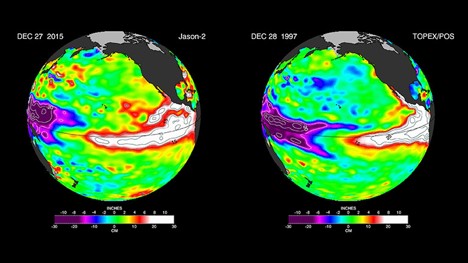
That bulge of water makes it into the global satellite sea level record but does not reflect what happens on coastlines.
The article leans heavily on the “global mean sea level budget” concept and emphasizes acceleration from 2005 to 2023. It should be pointed out that “budgets” are a human creation and that nature pays no attention to such things.
But this budget conclusion depends primarily on the satellite era, which is short and subject to calibration uncertainties. When evaluating acceleration, the window of time chosen can dramatically influence the result.
Starting in 1993, near the beginning of a strong El Niño cycle, naturally increases the likelihood of seeing curvature in the trend.
The Climate at a Glance sea level analysis shows that sea-level rise has been ongoing since the end of the Little Ice Age in the 1800s and remains modest and largely linear in long-term observational records. The rate today is not unprecedented compared to earlier 20th-century values.
The article also asserts that thermal expansion accounts for roughly 43 percent of the recent rise. That may be true within the assumptions of their model budget closure.
But again, this depends on reconciling satellite altimetry with Argo float temperature data and other modeled components. Budget closure is not the same thing as independent measurement confirmation. It is an internal accounting exercise constrained by the datasets selected.
Thermal expansion is a well-understood physical process. Warmer water occupies more volume. However, ocean heat content measurements before the early 2000s are sparse.
The global Argo float network, which provides the most reliable subsurface temperature coverage, only became operational around 2005. That means the supposed acceleration tied to thermal expansion relies heavily on a short, modern dataset.
When you examine tide gauges in stable tectonic regions around the world, where the tide gauge is not affected by land rise or subsidence, you do not see a sudden doubling of the rate since 2005. What you see is continuity. Slow, steady rise.
The broader implication of the article is that accelerating sea-level rise will inevitably threaten millions of people in the coming decades. That claim is entirely climate model-driven.

Projections are sensitive to assumptions about future warming, ice sheet dynamics, and feedbacks. Yet the historical record shows resilience and adaptability.
Coastal engineering, improved drainage, land elevation adjustments, and infrastructure planning have long been part of managing coastal risk.
Sea level has been rising for more than a century. Cities such as Boston, Amsterdam, and Tokyo have adapted. The narrative that acceleration is newly discovered and unprecedented does not align with the long-term observational record.
If acceleration were truly dramatic and recent, we would expect clear, unmistakable signals across century-long tide gauges. That signal is simply not there.
The difference between a stitched-together satellite record and continuous measurements should not be glossed over. Satellite data are valuable, but they are short, indirect measurements and heavily calibration dependent. Tide gauges are long, direct measurements.
In the end, this article presents a technically sophisticated but selectively framed argument. It emphasizes acceleration derived from a short satellite era while underweighting the longer coastal measurement record.
The public deserves to know that the evidence for dramatic new acceleration is far weaker in the observational data than the headlines suggest.
Sea level is rising; it has been for generations. The key question is whether it is accelerating in a way that justifies claims of a looming crisis. The longest, most reliable measurements say no.
ScienceAlert failed to look at all the science available and, in the process, created a biased and false article.
Read more at Climate Realism







The believers of “global warming” are desperate to prove something is happening… Anything will do for them… Here on the east coast of Australia, the ocean level hasn’t changed in the 77 years I’ve been on this beautiful planet. And I know this personnally because I was born and raised on the coast at Newcastle NSW, directly behind the harbour, where I fished for years when I was a child.
It should be pointed out that only the upper ocean warms with temperature changes, making the water expansion minimal due to any ocean warming. Pretending that it is full column warming was a mistake they assumed years ago.