

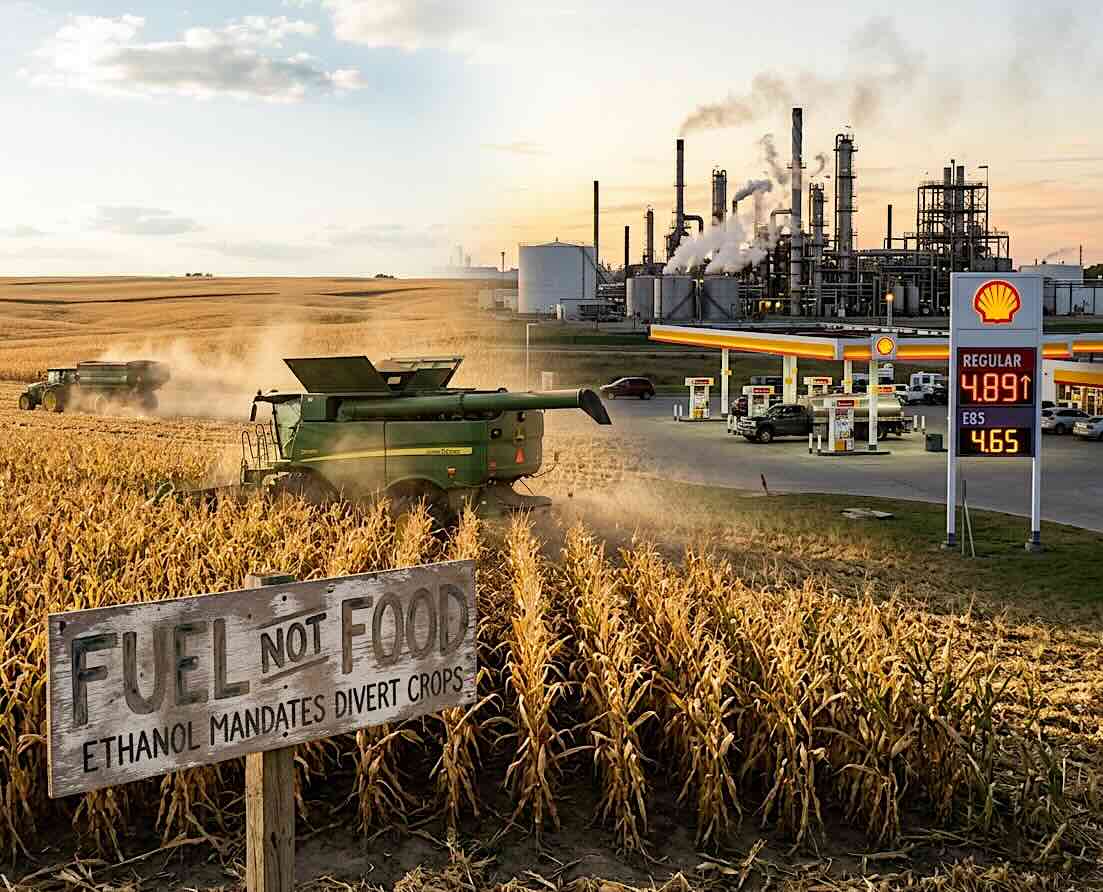
A coalition of conservative and free-market groups urged Congress to reject a bill that would permanently allow year-round sales of E15 gasoline nationwide. [some emphasis, links added]
The coalition sent a letter to House Speaker Mike Johnson and House Minority Leader Hakeem Jeffries opposing H.R. 1346, the Nationwide Consumer and Fuel Retailer Choice Act.
The groups argued that the bill would expand federal intervention in energy markets rather than increase consumer choice.
The letter says the legislation would “further entrench a federally managed fuel mandate regime that has distorted energy markets, burdened consumers, harmed independent refiners, and expanded corporate welfare for politically connected ethanol interests.”
The groups also wrote that Congress “should not mistake an expansion of ethanol mandates for genuine free-market energy reform.”
The coalition targeted the federal Renewable Fuel Standard in the letter.
The groups argued the ethanol industry still relies on “federal mandates, subsidies, waivers, tax preferences, and regulatory favoritism” after two decades of government support.
The letter says the Renewable Fuel Standard acts as a hidden tax on Americans because refiners must purchase Renewable Identification Number compliance credits through what the groups called a “volatile and opaque regulatory system.”
The coalition also raised concerns about E15 fuel.
“Ethanol contains significantly less energy per gallon than conventional gasoline, resulting in lower fuel economy for consumers,” the groups wrote.
“Higher ethanol blends are also incompatible with many older vehicles, boats, motorcycles, and small engines, creating risks of misfueling, equipment damage, and additional consumer costs.”
The letter argues the Renewable Fuel Standard contributes to higher grocery prices and agricultural market distortion because it diverts corn and other crops away from food and feed markets.
The coalition urged Congress to reject the bill and instead pursue reforms that would “phase down and ultimately repeal the Renewable Fuel Standard.”
Jason Isaac, president of the American Energy Association, criticized the proposal.
“Year-round E15 is another welfare program that benefits politically connected ethanol interests at the expense of consumers and independent refiners,” Isaac said in a separate statement. “Americans deserve affordable, reliable fuel options driven by market demand, not federal mandates, subsidies, and regulatory carveouts.”
Read more at The Center Square






If they stopped wasting corn on gasohol, food prices would drop, particularly the grains, as driven up by corn being sidetracked. The alcohol-corn farmers would lose their subsidies and all farmers would make less profit. The only adult response has to be “so what?” Nothing says that stupid schemes that make you money have to last forever. Life is tough—adapt or find another vocation.
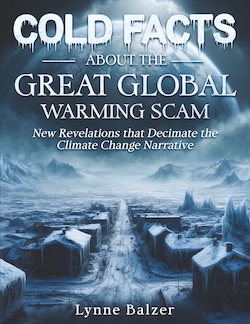
The half-lives of CO2 and methane in the atmosphere are about 5 years, which is fairly rapid turnover. The alarmists would like to claim it is 100s to a 1000 years, just to lie and alarm the public. Furthermore, they claim methane is 20 times the greenhouse gas that CO2 is. But, at about one 400th of the concentration, compared to CO2, methane is 1/20th in its effect.
The bottomline is that there is no such thing as a greenhouse gas or greenhouse effect and the IR radiation absorption/emission bands of these two gases are few and, for blocking IR, it like using a one-foot-spaced picket fence to corral mice.
Almost certainly the production of ethanol is huge emitter of the alleged pollutant CO2.
The fertiliser used to grow the crop (corn, soya) then the gas heating of the “wash” to convert starch to sugar. Then the actual fermentation, producing huge amounts of CO2 which is collected and piped to be injected into oil wells to increase yields. Finally the actual distillation boiling the “wort” using natural gas.
Methanol is made from corn grown for meat animal feed, not corn sold for human consumption. The spent mash from extracting methanol is a high quality feed that’s more easily digested and thus more nutritious. The corn side-streamed for methanol is not wasted nor stealing food from starving people, as some articles want you to believe.
Methanol is the best fuel additive to prevent engine damaging pre-detonation or ‘knocking’ so lower octane fuel can be used in modern engines.
Don’t be fooled by methanol misinformation.
Mike, you are mixing up methanol with ethanol:
Toxicity: Ethanol is consumable (alcoholic beverages). Methanol is highly toxic, causing blindness or death if ingested, inhaled, or absorbed through the skin.
Production: Ethanol is typically produced via fermentation of crops (e.g., corn, wheat). Methanol is produced via synthetic processes (e.g., natural gas).
Usage: Ethanol is used in beverages, as a bio-fuel, and a disinfectant. Methanol is a fuel additive, used for manufacturing formaldehyde, and in industrial solvent applications.
Energy Density: Ethanol has a higher energy density, making it more efficient as a fuel compared to methanol.
None of that changes the fact that taking a large portion of corn production and burning it in automobiles reducing both fuel mileage and engine life is ludicrous. Unfortunately the corn-belt senators have a huge ability to keep this subsidy to farmers growing this corn.
Ethanol belongs in whiskey not in our fuel tanks.
My feelings exactly, you beat me to it.
I guess you could say that great minds think alike!