


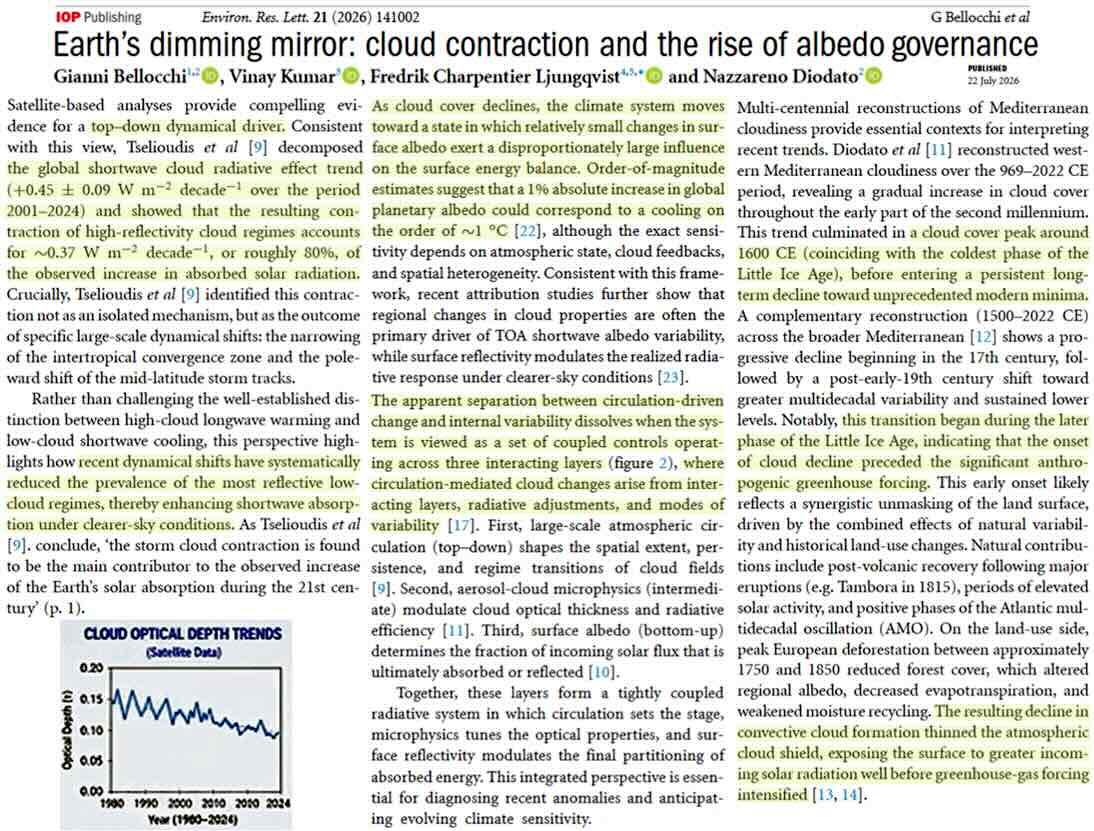
A July 2026 Environmental Research Letters paper by Bellocchi et al. attributes ~80% of the rise in Earth’s absorbed solar radiation since 2000 to a decline in highly reflective cloud cover, largely due to circulation-driven contraction of storm-cloud zones. [some emphasis, links added]
The study highlights the climate’s “albedo governance,” suggesting that a 1% shift in Earth’s albedo corresponds to a 1°C change in surface temperature.
With more cloud cover, more solar radiation is reflected, and the surface cools. With declining cloud albedo observed since 1980, less solar radiation is reflected and the surface warms.
Natural atmospheric circulation modes and internal variability drive changes in cloud cover.
This is supported by reconstruction data showing cloud cover decline has occurred independently of “greenhouse-gas forcing” for centuries.
Read more at No Tricks Zone









a reduction in cloudiness would cause warmer days and cooler nights because clouds are part of the greenhouse effect
in fact nights are warming faster than days
Your first point is correct: reduced cloud cover generally increases daytime solar heating while allowing greater radiative cooling at night.
But your second point doesn’t contradict it. Faster nighttime warming was characteristic of much of the historical record and has itself been associated with increased cloud cover.
A 2023 Nature Communications study found that this pattern has reversed over land in recent decades, with maximum daytime temperatures warming faster. It credited much of that change to reduced cloud cover and increased solar radiation. So you’re actually describing one of the mechanisms supporting the argument you’re trying to rebut.
A for effort. You’ll get there.