

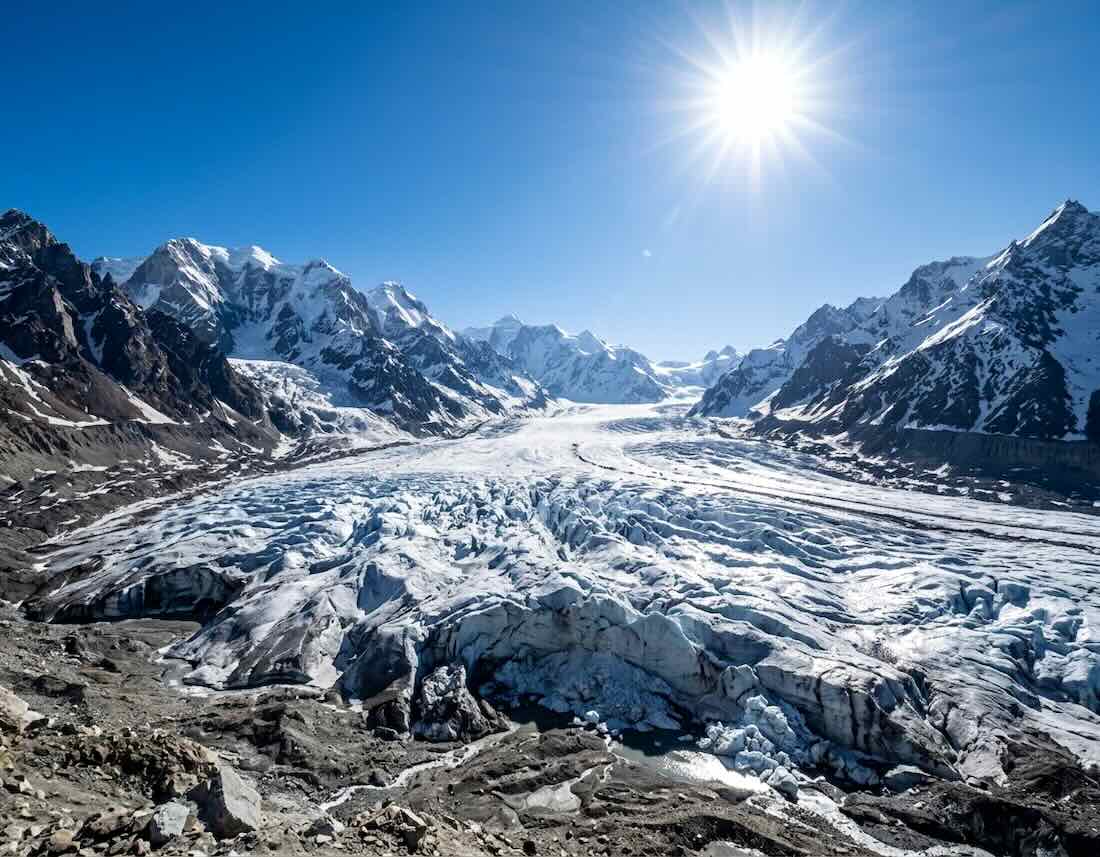
We constantly hear panic stories about melting glaciers, accompanied by hysterical voices calling out that retreating glaciers are a clear sign of human-induced global warming. [some emphasis, links added]
Much of this hysteria is driven by green activists and politicians who know just enough to be dangerous but not enough to be sensible.
Scientifically, you can’t reach a conclusion based on a principle. You have to look at the real science and carry out accurate measurements.
This is a complex subject, but let us have a quick look at the issue. What about atmospheric warming? Well, for starters, we need some physics. For a gram of cold glacial ice to warm up by 1°C, say from -4°C to -3°C, it takes about two Joules of heat. It needs this amount of heat for each degree Celsius that the ice warms.
Inside a glacier, it can be as cold as -50°C, but let us consider the top part and, being generous, call it -10°C. In other words, to raise the temperature of a gram of ice from -10°C to 0°C, we will need about 20 Joules.
So far, so good. So where would this heat come from? Well, the global warming enthusiasts say, ‘from the atmosphere.’ So, we take 20 Joules from the atmosphere. That is reasonable.
But now for a bit more physics.
When you melt ice into water, it needs a huge amount of heat to separate the frozen molecules. In fact, it takes just over 300 Joules per gram.
Remember that it takes 20 Joules to raise the temperature of a gram of ice by 10°C, but 300 Joules to turn that one gram of ice into water. So where do the 300 Joules of heat come from?
‘Well, the atmosphere,’ say the warmists. If that much heat is being pulled out of the atmosphere, why do we not see the air above a glacier cooling off? After all, the warmists are worrying about the atmosphere warming by only 1 or 2°C.
So if an entire glacier is melting faster than before, where on earth (excuse the pun) is all that melting heat coming from? Remember, millions of grams of ice each need 300 Joules to melt. That is a vast amount of energy.
What about an alternative mechanism? There is another option, i.e., direct sunlight falling on the glacier surface.
What is known to happen is that sunlight warms the top couple of millimeters of the ice, which melts quite easily. So an obvious question is: Where does that water go?
The simple answer is that it percolates downward through the fissures in the glacier. The water works its way to the bottom, where the ice lies on the bedrock. There, it acts as a lubricant, reducing the friction between the ice and the rock, so the ice slides faster.
Therefore, the entire glacier becomes more mobile, allowing larger chunks to break off the glacier’s end.
The amount of sunlight falling on the glacier’s surface has nothing to do with the temperature of the atmosphere.
In contrast, it has to do with the amount of cloud cover, which in turn is linked to the amount of cosmic radiation coming in from outer space. That, in turn, is linked to the Sun’s magnetic activity, as the Sun influences the magnetic barrier protecting the Earth.
Where this magnetic barrier ‘leaks’ is visible at the North and South poles, where one can see the spectacular Aurorae that form curtains of waving light sheets in the night sky.
So we clearly have a perfectly reasonable mechanism for retreating glaciers, which has nothing to do with atmospheric warming.
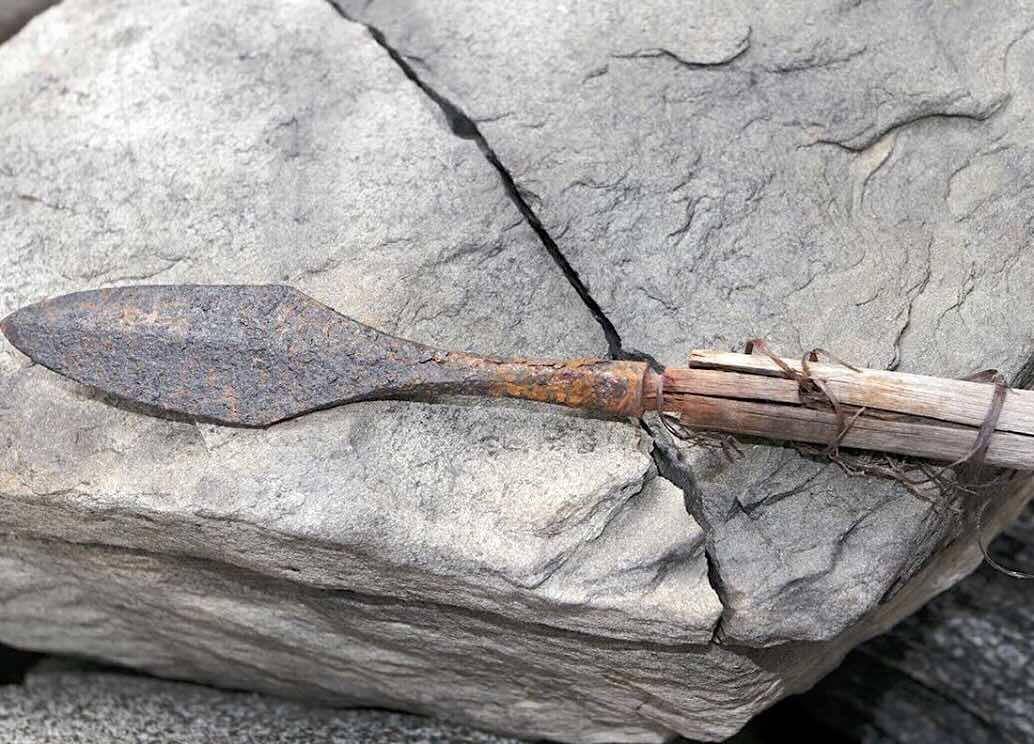
But there is yet more! There has been a significant archaeological benefit from the retreat of some glaciers and melting ice sheets.
What has happened is that melting ice has revealed thousands of ancient artifacts, a bonanza for historians and archaeologists.
For example, 10,000-year-old Atlatl spear-throwing hunting darts have been found in the Rocky Mountains and the Canadian Yukon. Intact arrows have been found in a Norwegian mountain pass dating to 3,000 to 4,000 years ago. They have quartzite arrowheads secured by animal sinew and Birch-bark glue.
A 1,700-year-old Roman-style shoe was also found in Norway. In the Schnidejoch pass in the Swiss Alps, leather trousers, shoes, and birch-bark arrows were found, dating back to 3,000 to 4,000 BCE.
The list goes on, [but it shows that there was no thick ice cover there in the past, such as 1,700, 3,000, and 10,000 years ago].
This indicates that ice cover and glaciers have come and gone regularly in the past, which had nothing to do with industrially produced carbon dioxide.
But they can be linked to the Sun’s magnetic activity.
CCD Editor’s Note: The geothermal and volcanic activity that bottom-melts glaciers from below — well documented in West Antarctica and elsewhere — is another natural mechanism the atmosphere-first narrative conveniently ignores.
Read more at CFACT





Top 10 Dumbest Things About “Ancient Artifacts Prove Glaciers Come And Go Naturally”
#10. “Glaciers changed naturally before, therefore they can’t be changing because of CO₂ now.”
Forests burned before humans invented matches. That doesn’t mean arson doesn’t exist.
#9. Confusing “the Sun melts ice” with “the Sun explains recent glacier retreat.”
Nobody disputes that sunlight melts ice. The question is why the Earth system is retaining more energy than it emits. That’s the greenhouse effect.
#8. “If glaciers absorb heat from the atmosphere, why doesn’t the air cool?”
Because the atmosphere isn’t a finite battery sitting over one glacier. Heat is continuously replenished by solar input and transported by winds and oceans. This is basically asking why your kitchen doesn’t freeze when you put ice cubes in a drink.
#7. Treating latent heat like some mysterious missing energy source.
The author discovers that melting ice takes ~334 J/g and then acts like climate scientists never heard of it. The Earth’s energy budget explicitly includes latent heat.
#6. The archaeology argument.
Finding a 3,000-year-old arrow under retreating ice means that location was once exposed. Congratulations—you’ve rediscovered that glaciers advance and retreat. That’s been known since the 19th century.
#5. Ignoring the obvious implication of his own Greenland example.
A WWII airplane landed on a Greenland glacier and is now buried under hundreds of feet of ice. So glaciers can both grow and shrink depending on location and time? Exactly. That’s why scientists study global trends, not anecdotes.
#4. “Clouds → cosmic rays → Sun’s magnetism → glacier retreat.”
This is basically the Svensmark hypothesis, which has struggled for decades because measurements show cosmic rays and cloud cover simply don’t track modern warming very well.
#3. Pretending greenhouse warming means the atmosphere directly melts every gram of ice.
Much glacier loss occurs because warmer oceans melt glacier fronts and ice shelves from below, while warmer air lengthens melt seasons and reduces snow accumulation. It’s an entire energy budget problem, not “hot air touches ice.”
#2. “No CO₂ required.”
This is like saying, “You don’t need gasoline to make a car move—gravity can roll one downhill.” Multiple mechanisms can exist. The existence of natural causes does not eliminate anthropogenic forcing.
And the #1 dumbest thing…
“Scientifically, you can’t reach a conclusion based on a principle. You have to look at the real science and carry out accurate measurements.”
…followed immediately by an article that ignores:
in favor of a hand-wavy back-of-the-envelope calculation and some old shoes found in Norway.
That’s not “the real science.”
That’s a Facebook meme with arithmetic.
Not sure what your point is but most of them are dumber than what you say the author stated. But perhaps you can explain how those artifacts had been buried under ice for centuries appeared except that there were warm times when the area they were found was not covered by meters of ice but that ice somehow melted. It wasn’t caused by CO2 levels changing as the idiots claim today. I live in Colorado where there were glaciers filling many valleys of the Rockies but only a couple remain. And they all disappeared way before we burned fossil fuels. Or the mile-high glaciers covering much of the midwest and eastern US which gouged out Minnesota’s 10,00 lakes or NY’s Finger Lakes. There were no SUVs back then.
So your long list of complaints don’t make sense. Perhaps try again before hitting the bottle.
“For example, 10,000 year old Atlati spear-throwing hunting darts have been found in the Rocky Mountains and the Canadian Yukon”.
The 10,000-year-old atlatl hunting darts ended up in the high altitudes of the Rocky Mountains and the Canadian Yukon because ancient Indigenous hunters intentionally traveled to alpine ice patches to hunt caribou and bighorn sheep. When hunters missed a shot, their long wooden darts shot past the animals, plunged deep into the snowbanks, and became permanently frozen and preserved in the ice for millennia.
during world war two some us planes emergency landed on a glacier in greenland … and now they are under two hundred feet of ice
Can you cite one historical records or anything else that said the indigenous hunters were up there in the winter. That’s not what I have seen in anything I’ve read.
antarctica is too cold for the sun to melt more than a small amount of the ice directly, and then only in some local areas:
(1) sections with exposed rock experience direct, sun-driven melting every year.
(2) The Antarctic Peninsula stretches further north than the rest of the continent. During the summer months, temperatures here regularly climb above freezing—frequently hitting 40°F to 50°F—causing widespread surface snow and ice to melt directly under the sun
The sun does not directly melt ice in Antarctica primarily because the continent’s bright white snow reflects up to 90% of the sun’s heat back into space. This phenomenon is known as the albedo effect
oceans get warmer over time for the same reason that land gets warmer over time: greenhouse gases, reduced air pollution and reduced cloud cover
the system pulling heat from low-latitude tropical regions down toward Antarctica is called the Southern Ocean Overturning Circulation (or Southern Meridional Overturning Circulation)
heat from the Southern Meridional Overturning Circulation & and heat from nearby underseas volcanoes, cause the small amount of melting on the edges of antarctica and the peninsula