

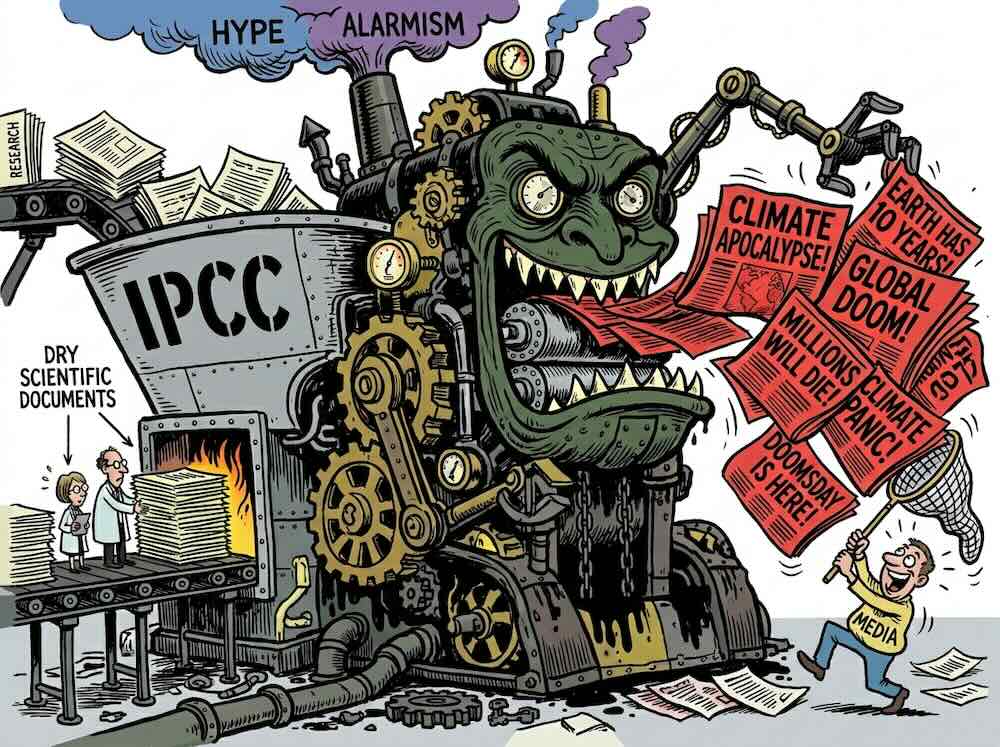
A potentially very significant new preprint by Galiani et al. documents how the IPCC (Intergovernmental Panel on Climate Change) and the media introduce bias into assessment and reporting on climate change — a bias toward more extreme claims. [some emphasis, links added]
The paper is a preprint, and its data files are not yet available, so the findings should be considered preliminary.
Specifically, the paper claims that the IPCC Summary for Policymakers (SPM) is biased toward making claims more extreme than the underlying science represented elsewhere in the IPCC reports.
Critics of the IPCC have often made this assertion, but this is the first analysis that I am aware of that seeks to systematically evaluate the claim with data.
Today’s post shares my interpretation of the new analysis.
What Galiani et al. Did
Scientific findings of the IPCC — especially those projecting climate futures — can be thought of as the result of a linear process, shown in the figure below.
The process begins with the selection and prioritization of scenarios used in projective climate research. Researchers then apply those scenarios in further modeling, ultimately publishing results in the peer-reviewed literature.1
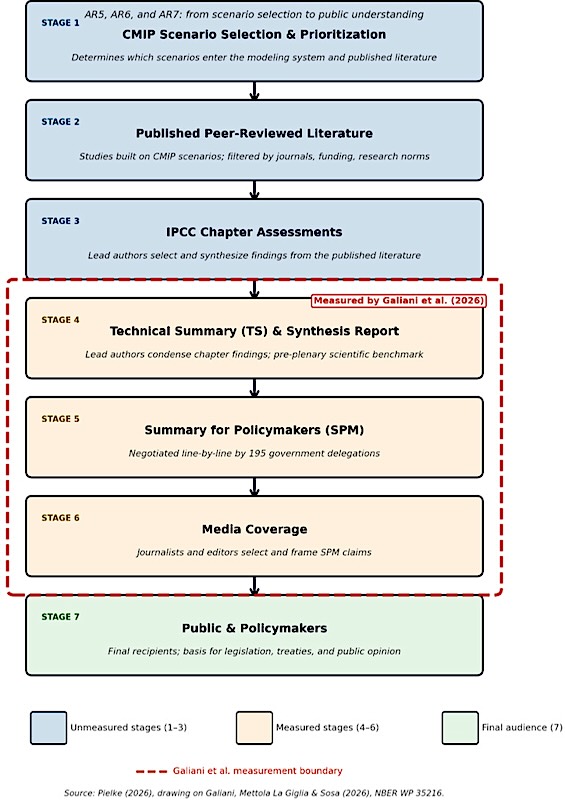
Then the IPCC, which is organized into more or less independent chapter teams, assesses the published literature and produces a chapter (which goes through multiple drafts and comment stages).
The IPCC Chapters form the basis of the IPCC Technical Summary and Synthesis Report, which then feed into a Summary for Policymakers (SPM). The SPM is typically what drives media coverage and policy.2
The figure above also shows, with the red dashed line, the focus of Galiani et al., which represents a subset of this communication chain. The paper focuses on three dimensions of potential bias: severity shift, uncertainty compression, and scenario salience.
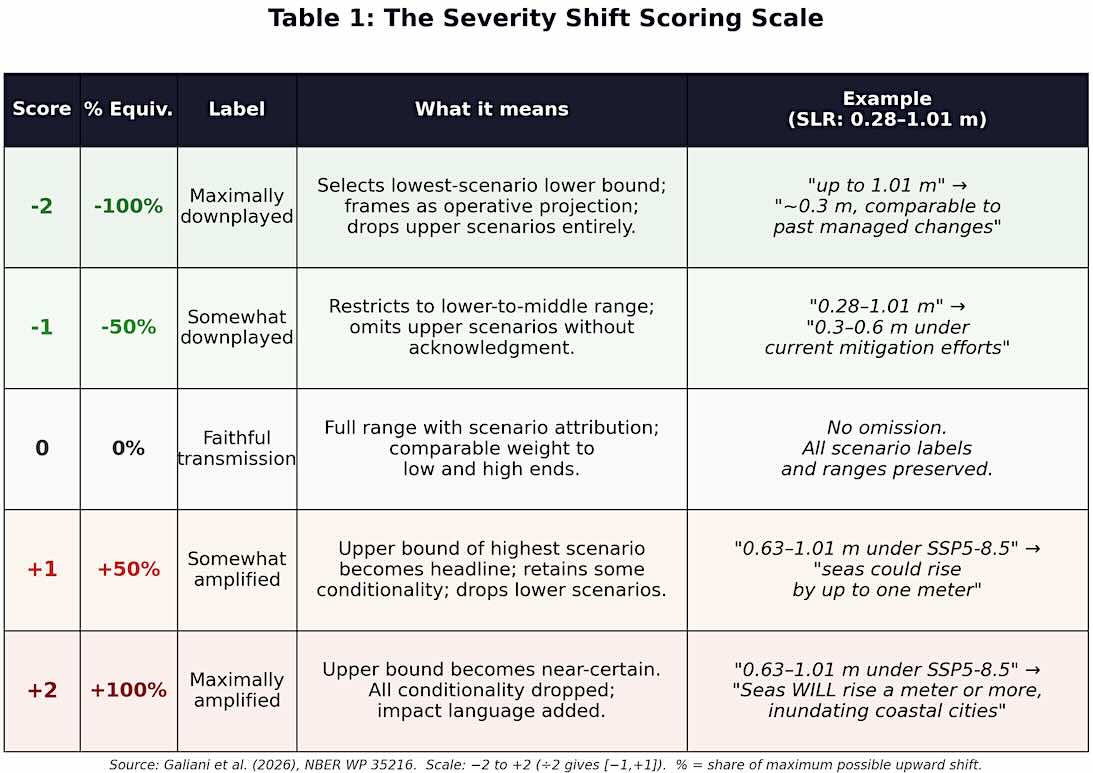
- Severity shift measures whether emphasis is given to the most extreme end of a source document’s reported quantitative range. The paper scores severity shift on a five-point ordinal scale: −2, −1, 0, +1, +2. Percentages in aggregate results — such as +13% — are averages across many scored pairs.
Table 1 illustrates each level with a sea-level-rise example.
- Uncertainty compression measures whether summaries strip out the IPCC’s formal probabilistic vocabulary — such as virtually certain (99–100%), very likely(>90%), likely (>66%).
- Scenario salience measures selective citation of individual scenario results.
The range of outcomes for any variable across scenarios — such as 0.28 m to 1.01 m of sea level rise by 2100 in AR6, or 1.4°C to 4.4°C of warming — is not a probabilistic distribution of real-world outcomes.
The exercise reveals a design flaw in the IPCC; while some specialists may understand that projected ranges across scenarios for any variable are neither forecasts nor probabilistic ranges, most others will not.
What Galiani et al. Found
Galiani et al. scored ~114,000 matched claim pairs drawn from all six IPCC Assessment Reports (1990–2023) and 116,000 newspaper articles from ten major US and UK outlets, using three independent large language models — GPT-5-mini, Claude Haiku 4.5, and Gemini 2.5 Flash — to evaluate each pair on the three dimensions: severity shift, uncertainty compression, and scenario salience.
The headline result is unambiguous: at every measured stage, in every Assessment Report, claims shift systematically toward the more severe end of the scientific ranges presented by the IPCC in its Technical Summary.
The dominant effect is severity shift — the tendency to emphasize the upper end of reported quantitative ranges while backgrounding or ignoring the lower end.
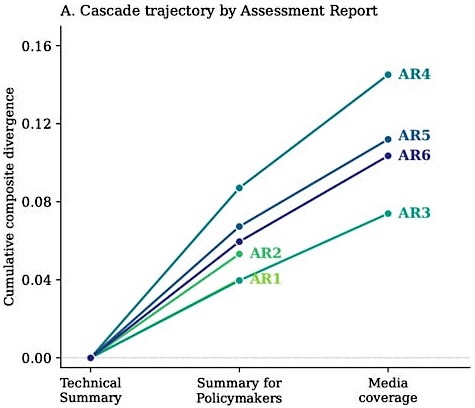
At the TS-to-SPM stage, severity shift ranges from +4% to +13% of the maximum possible upward distortion under their unitless ordinal scale (across the six Assessment Reports, peaking in AR4 (2007). Media coverage adds a further +5% to +9% bias on top of what the SPM already contains.
Uncertainty compression — the stripping of calibrated IPCC confidence qualifiers — is a secondary but consistent effect. Scenario salience is the smallest channel, which the authors interpret as evidence that the cascade does not depend on scenario cherry-picking.
However, the analysis fails to recognize that the largest scenario-bias effect is already baked into the severity shift.
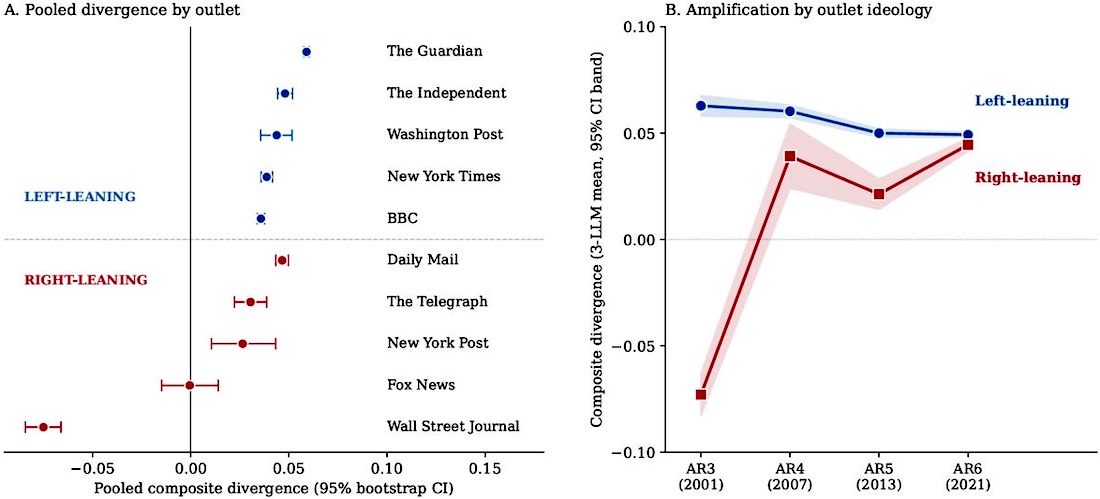
The figure below from the paper shows that the “amplification cascade” is documented across all IPCC assessment cycles, with the most recent three assessments showing greater bias in the SPMs towards amplifying scientific claims than the first three IPCC assessments.
Three further findings stand out.
- First, in the AR6 cycle, left- and right-leaning media outlets show virtually identical amplification patterns after diverging over the three previous cycles.
- Second, the media results are robust across five alternative sample restrictions, including removing The Guardian (most amplification), removing the Wall Street Journal (most deamplification), and equalizing outlet weights — none of which changes the direction or qualitative magnitude of the findings.
Interestingly, the media outlet judged to have played things the most straight? Fox News!
- Third, the pattern reproduces independently across all three LLMs, with Gemini scoring systematically lower than GPT and Claude but all three showing the same directional cascade.
The fact that the media has a bias toward amplifying climate science will come as a surprise to absolutely nobody. However, the finding that the IPCC SPMs also reflect the same bias is a very significant finding.
Why Galiani et al. Matters
Galiani et al. offer the first evidence that the IPCC process amplifies climate science [toward] more extreme conclusions, beyond those reported in the Technical Summaries, and by extension, beyond what’s found in the peer-reviewed literature.
Because Galiani et al. look at only a subset of the climate science communication chain, their results should be interpreted as just a floor of possible amplification bias.
As I’ve documented at THB at length, the overreliance on extreme climate scenarios in research and policy represents an enormous source of bias, beyond that documented in this new preprint.
It is important to note that while the amplification cascade may serve some political interests, the dynamics at play here require no misconduct or even intent.
Each actor might behave rationally within their institutional context, and the amplification cascade results even so:
- CMIP scenario developers included SSP5-8.5 as a high-end emissions scenario, not because it was plausible, but because it served the interests of climate modelers.
- Researchers publishing in the literature used the scenarios CMIP made available, and often had good scientific reasons for choosing the most extreme scenarios, regardless of their actual plausibility.
- IPCC chapter authors synthesized the published literature — that is their job. The IPCC’s choice to represent scenarios as probabilistic distributions of real-world futures was an error of understanding and judgment.
- IPCC Lead Authors writing the TS carried forward this framing, dropping much of the detail that sits inside the scenario and projection black boxes. Choosing to simplify the SPM for policymakers is rational, but in this case, context was lost, and extreme projections were amplified.
- Journalists apply standard news-value criteria: novelty, urgency, salience. Severe outcomes are more newsworthy than moderate ones. If it bleeds, it leads.
The cumulative result is representative of climate science by the IPCC, and the media that’s biased toward the extreme end.
With RCP8.5 /SSP5-8.5 sitting at that extreme end — while also being represented as “business as usual” or a reference scenario — the stage was set for climate change to be represented in policy as an “existential risk” even though the IPCC chapters and underlying literature never said anything close to supporting such a claim.
The Honest Broker is written by climate expert Roger Pielke Jr and is reader-supported. If you value what you have read here, please consider subscribing and supporting the work that goes into it.
Read rest at The Honest Broker



There is the basic report made by IPCC scientists. That is taken by politicians to write The Summary for Policymakers. I once read an article from one of the scientists working on the basic report. He said that people came around and badgered the scientists to come to more dire conclusions. This is not science. It is a political movement designed to support various liberal causes.
The Summary for Policymakers has always been biased to the worst cases to help those policymakers to push the worst policy proposals for the citizens (e.g. Green Energy and no new fossil fuel development). And the left-wing media (aka MSM) pushed even more extreme narrative. And it hasn’t ended yet.
this is a very good article about what the IPCC has been doing since the beginning
and the article should have mentioned that the media tend to read the press release of the summary rather than the summary itself
many problems with the climate models do not include the high end CO2 growth rates as pielke keeps claiming. the high end CO2 growth rates assume CO2 growth in the past few decades will continue and net zero will fail
both assumptions make sense
all the other scenarios assume net zero will succeed and CO2 levels stop rising between 2050 and 2100
that doesn’t make sense to me
Then, given that RCP8.5 has been deemed unphysical, even in light of the ever-accelerating utilization of fossil fuels and concomitant emission of CO2, that should have told any sane person that that represents a total repudiation of the warmist alarmist stance.
Because even the IPCC is being forced, reluctantly, to concede that AGW / CAGW is nothing more than a poorly-told, easily-disproved and physically-impossible mathematical scam, predicated upon a false premise (that energy can spontaneously flow up an energy density gradient); upon misuse of the S-B equation to conjure “backradiation” out of thin air; and upon misattribution of cause to effect in their claim that the ~6.5 K km-1 atmospheric temperature gradient is caused by their wholly-fictive “greenhouse gases (due to the greenhouse effect (due to backradiation))”, when it can be proved in a mathematically-precise manner that the atmospheric temperature gradient is 100% caused by the gravitational auto-compression of the Adiabatic Lapse Rate.
https://www.patriotaction.us/forum/science-the-earth-and-enviroment/the-science/724-the-comprehensive-agw-cagw-hypothesis-disproof