

A recent article in The New York Times (NYT) suggests that climate change is increasingly endangering tennis players at the French Open, particularly those less inured to the heat, making them ill and unable to compete. [some emphasis, links added]
This is false.
While it’s true that this year’s French Open at Roland Garros was unseasonably hot, there are many factors contributing to tennis players’ suffering this year, and no evidence of any trend in either hotter temperatures or increasing incidences of heat prostration or stroke over time.
In “Jannik Sinner might have a heat problem, but tennis has a bigger one,” the NYT claims that despite the Roland Garros officials determining that temperatures were not hot enough to suspend play:
“And regardless of what the scientific meter might say, the conditions for the first five days of the tournament have been seriously hot and seriously hard. They have also exposed a lack of preparedness for unseasonably hot conditions on the part of both players and the tournament, at a time when global temperatures are rising and tennis has become more physical than ever.”
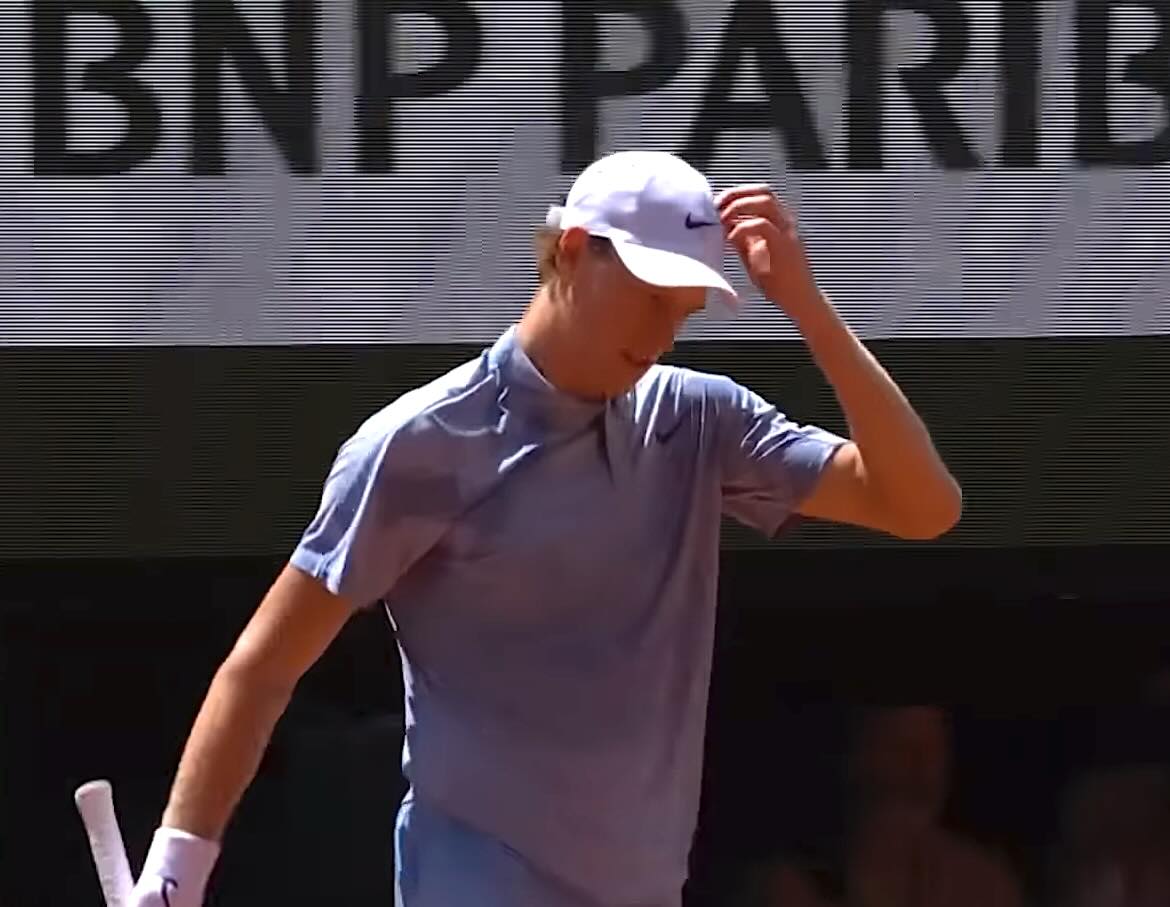
The player highlighted in this article is Jannik Sinner [pictured above], who withdrew due to illness, possibly in part heat-related. The NYT says Sinner has “one major weakness,” which is “[t]he hotter it is, the more vulnerable he becomes.”
One element this story neglects to mention is that once someone is hit with heat-related illness like heat stroke, they become much more vulnerable to heat syncope and general sensitivity to high temperatures, and even recurrent heat stroke, for years to come.
I have had fairly serious heat stress (including nausea, chills in 90+ degree weather, confusion) from playing tennis drills one hot Chicago summer day, and can attest that, despite it not developing into stroke territory, since then I have needed to be much more careful about drinking extra water and taking reasonable breaks during exertion in hot temperatures.
It’s not clear whether Sinner has suffered heat stroke or stress in the past, but it wouldn’t be surprising, as it is a fairly common illness among hardcore tennis players, who push themselves through games even when they begin to feel ill.
What is clear is that once a person has experienced heat stroke or prostration, they are more prone to such health events in the future. At the French Open this year, Sinner admitted he played despite knowing he is sensitive to heat, and “woke up not feeling very well” that day anyway.
Global temperatures may be rising slightly on average, as the NYT asserts, but climate change cannot be immediately blamed for the recent heatwave in France and other parts of Western Europe, which occurred during the French Open.
It is, for Paris at least, a record-breaker as far as temperature stations go. However, a single heat wave is not a climate trend; rather, it is just weather.
Also, the recent heatwave does not cover all of Europe. While parts of Western Europe have been under an extended heat dome, a stagnant, high-pressure weather system that surged up from Northern Africa, trapping hot air underneath it, much of Eastern and Southeastern Europe has been experiencing unseasonably cold temperatures.
Most news outlets are ignoring the unusual cold spell in Eastern Europe, while trying to link the unusual heat in Western Europe to global climate change.
Multiple Climate Realism stories about various heatwaves in Europe over the past few years (here, here, and here, for example) explain that heatwaves need to be clearly defined to be tracked over time.
Only a sustained trend in frequency and severity can imply a causal connection to global climate change. In general, the modest warming of the past century has been driven not by heat spikes or extended days of above-normal temperatures but by making extreme cold less common, driving averages upwards.

This is most prevalent in urban and suburban areas, where the urban heat island (UHI) effect strongly influences local temperatures.
Ironically, the NYT article does unwittingly describe one of the elements of UHI, which is heat radiating off hard surfaces, when it describes the red clay court surface: “radiating heat up and helping to cook players from every direction.”
Tennis tournaments are held all over the world, including some very hot places, like the Australian Open in Melbourne, the U.S. Open in New York, where temperatures are regularly in the 90s, or Atlanta and Miami.
The BNP Paribas Open is held in the middle of the California desert in Palm Springs, where temperatures can easily hit the 90s and low hundreds, even in March.
There is one major difference between Roland Garros and other tennis venues: The former is in an area where it can’t expand and build an enclosed stadium for temperature control.
The NYT article even acknowledges this, admitting that at other venues like the U.S. Open and Australian Open, “there are cold air hoses by the player benches so they can air-condition themselves during changeover” and “players have complained about a lack of ice, about water in the courtside refrigerators not being as cold as they are used to.”
These things make a difference when playing fast-paced sports like tennis for 3+ hours in the sun, and other venues can accommodate players.
It sounds a lot less like climate change is hurting tennis players and more like Roland Garros is somewhat outdated, and the tournament organizers should have been more prepared for heatwaves to keep players safe.
The NYT’s desperation to turn this story about players losing matches due to illness or the intensity of the game in tough conditions into a climate change article shows that climate realists currently hold the advantage point.
Alarmists seem worried that any lost opportunity to mention climate change will result in game, set, match for realists.
Read more at Climate Realism







Jannik Sinner didn’t withdraw from the French Open. He lost in five sets with the last two by 6-1, 6-1. So it seems that his opponent Juan Cerundolo was more able to deal with the weather than he was. I don’t know if Sinner blamed his loss on the temperature (hasn’t he played in the NY Open in August where the temps and humidity sucks?) or did he not properly hydrate before and during the match.