

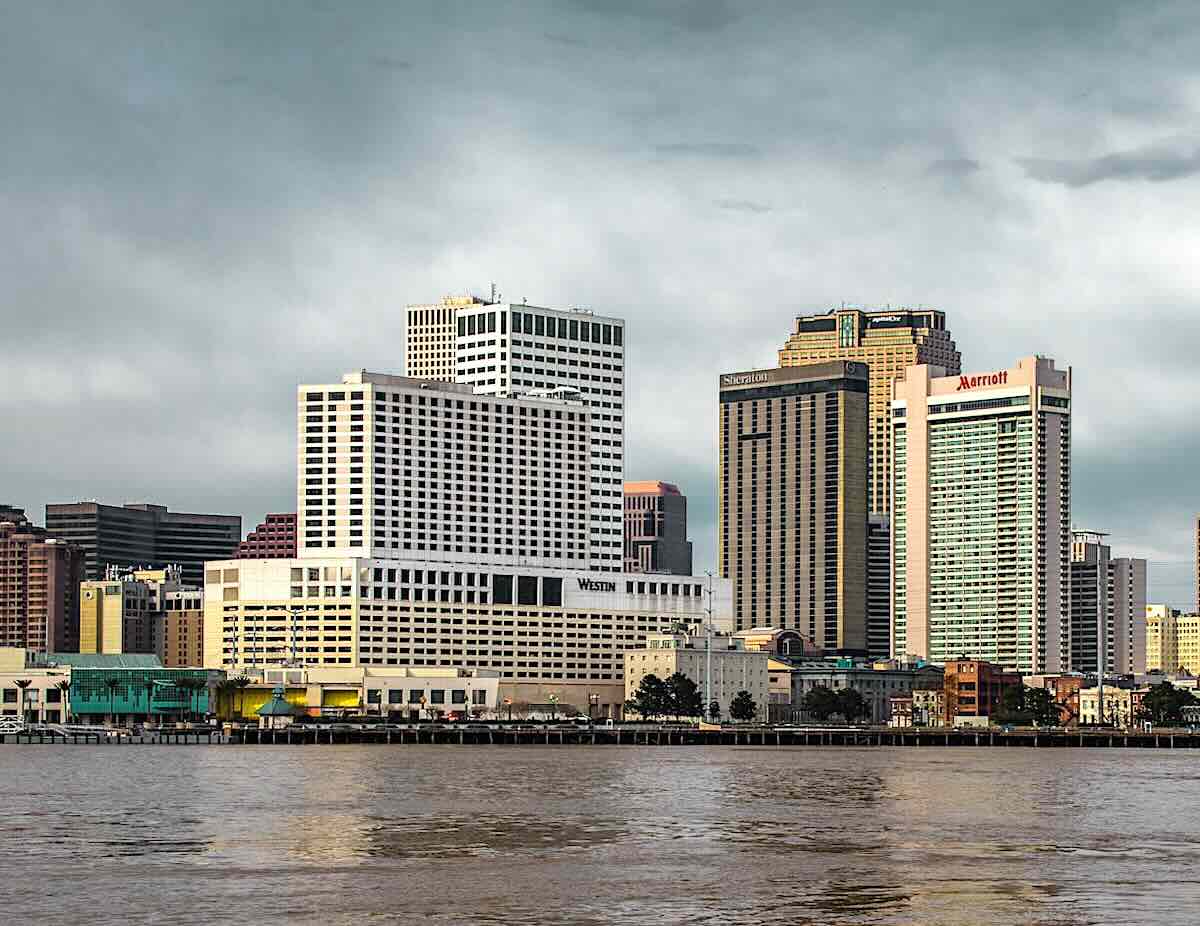
The Guardian claims in “‘Point of no return’: New Orleans relocation must start now due to sea level, study finds” that New Orleans has effectively entered a “terminal condition” and must begin an organized population retreat because sea-level rise will surround the city within decades. [some emphasis, links added]
This is false. The article relies on speculative climate modeling, paleoclimate analogies, and worst-case sea-level projections that are nowhere near what actual tide gauge measurements show today.
The story warns that southern Louisiana faces “3–7 meters of sea-level rise” and shoreline retreat of up to 100 kilometers inland. That claim is extrapolated from comparisons to a warm period 125,000 years ago, when ice sheets were in a very different configuration, not based on observed current data trends.
The result of computer model simulations of ancient paleoclimate conditions has no bearing on the present, nor is it in line with actual sea level trends.
Measured sea-level rise along the Gulf Coast is well documented by long-running tide gauges operated by the National Oceanic and Atmospheric Administration (NOAA).
The observed rate in the region is on the order of millimeters per year, not meters per decade as seen in the sea level-trend graphic from NOAA below.
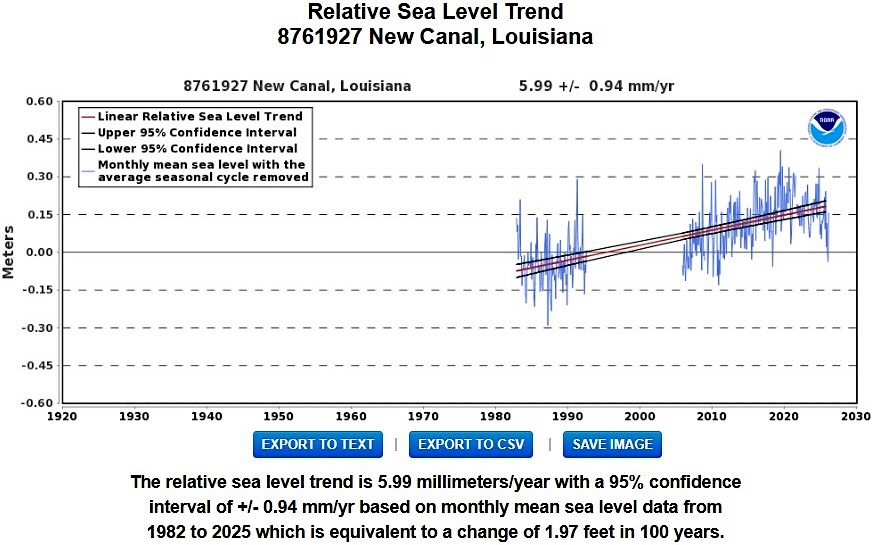
The New Canal, Louisiana, tide gauge is the station closest to New Orleans. Note that based on actual data, NOAA predicts about two feet of rise in 100 years. Even accounting for local subsidence, the data show a gradual rise, not an exponential surge toward three to seven meters (9.8 to 23 feet) this century.
There is no empirical evidence supporting the notion that New Orleans will be “surrounded by the Gulf of Mexico before the end of this century.”
The Guardian also asserts that “strengthening hurricanes” are compounding the threat. Yet the Intergovernmental Panel on Climate Change (IPCC) Sixth Assessment Report (AR6) reports no increase in the number or severity of major hurricanes. Observational records for U.S. landfalling hurricanes show no significant upward trend over the past 50 years, as seen in the graphic below.
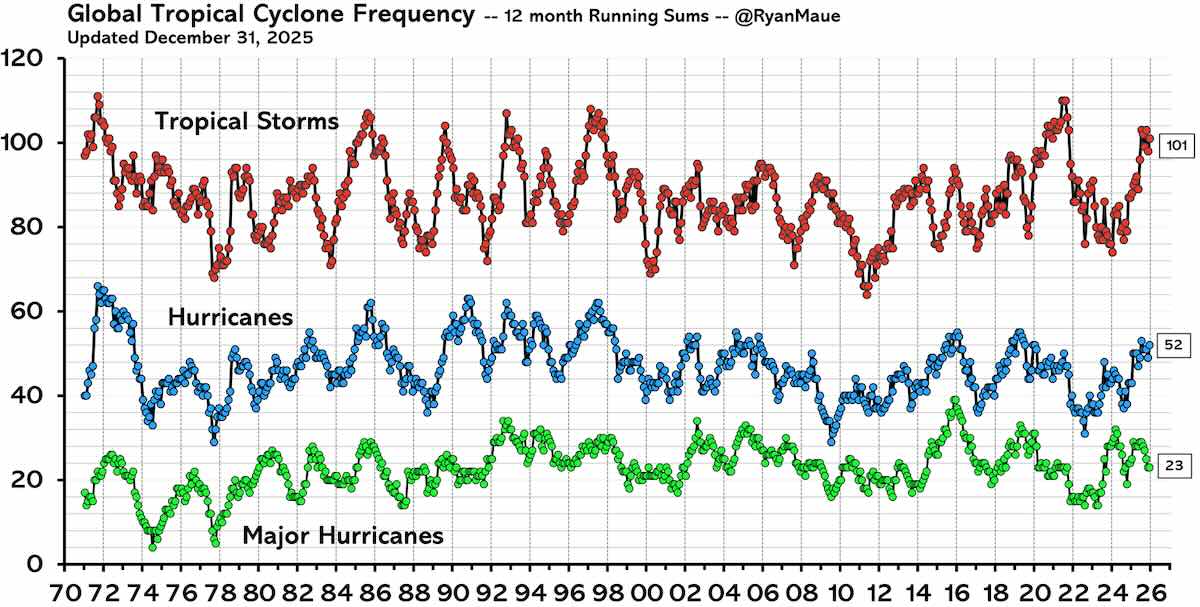
The most destructive hurricane to strike Louisiana, the 1900 Galveston storm, and later the 1915 and 1965 storms, occurred long before modern carbon dioxide (CO2) emissions were elevated.
Hurricane activity in the Gulf of America has always fluctuated due to natural cycles such as the Atlantic Multidecadal Oscillation. Wind shear, sea-surface temperatures, and atmospheric dynamics drive storm intensity. No consistent data demonstrates a climate-driven escalation in Gulf Coast hurricane strength.
To the extent that “sea level rise” is greater on average in New Orleans and some other Gulf Coast areas than for the nation or world as a whole is due to a factor that The Guardian largely ignores: land subsidence.
Southern Louisiana is sinking due to sediment compaction, groundwater withdrawal, oil and gas extraction, and the historical channelization of the Mississippi River. Much of the relative sea-level rise in the region is local land sinking, not accelerating global ocean expansion.
Conflating subsidence with climate change-induced sea level rise is grossly and dangerously misleading.
Even the study at the center of the article is an opinion piece, not a research paper, in a scientific journal projecting improbable future scenarios. It does not present new measurements showing imminent sinking or rapid sea level rise.
The map shown in the article depicts Louisiana under three meters of sea-level rise. That graphic is a model scenario based on SSP5-8.5, a high-emissions climate scenario combining fossil-fuel-intensive development with high-level climate forcing by 2100.
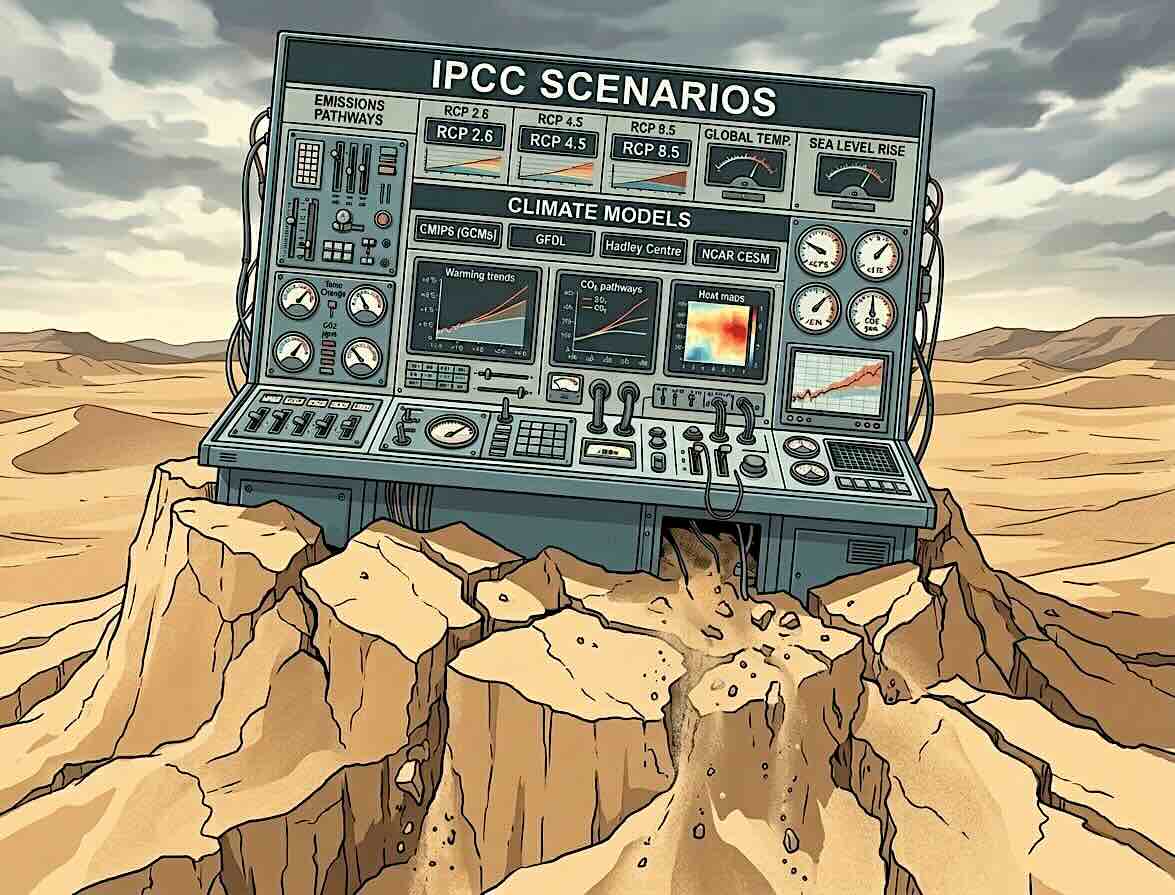
This worst-case scenario has no bearing in reality and was so bad that the IPCC recently removed it from all scientific consideration.
The rhetoric reads more like the trailer for a big-budget disaster film rather than an objective journalistic endeavor. “Terminal condition.” “Point of no return.” “Timebomb.” These alarming trigger words and phrases don’t reflect reality on the ground in New Orleans, nor trends recorded by scientific instruments.
New Orleans has already invested billions of dollars in levees, pumps, and floodgates since Hurricane Katrina. Engineering solutions exist. The Dutch have defended land below sea level for centuries.
To suggest that “there’s no amount of money” that can maintain protective infrastructure ignores modern coastal engineering reality.
The sea level is rising gradually. Wetlands are eroding due to river management and sediment starvation. Subsidence is measurable. These are real challenges. But they are not proof that relocation “must start now.”
Policy should be driven by measurements, not metaphors.
New Orleans faces engineering and land management challenges. It does not face a guaranteed watery extinction within decades based on current observed sea-level rise or hurricane trends. The Guardian’s doomsday story is not sober risk assessment; it is junk journalism at its worst.
Top photo of Algiers Point, New Orleans by Jimmy Woo on Unsplash
Read more at Climate Realism






The climate change agenda requires a significant impact to middle class and national economies. To justify this the movement is dredging every possible justification. Sea level rise is one of their weakest points. The sea level has been rising a only few millimeters a year. There are certain locations where gages will show more. These are mainly where the ground is built of sediment containing organic material. As that material decays, the ground sinks.