In the story, “One of the world’s most important climate threats has an image problem,” The Conversation claims that the Atlantic Meridional Overturning Circulation (AMOC) is a major climate change threat that is misunderstood; it suffers from an “image problem” because the public struggles to visualize a slow-moving ocean current hidden beneath the Atlantic Ocean. [some emphasis, links added]
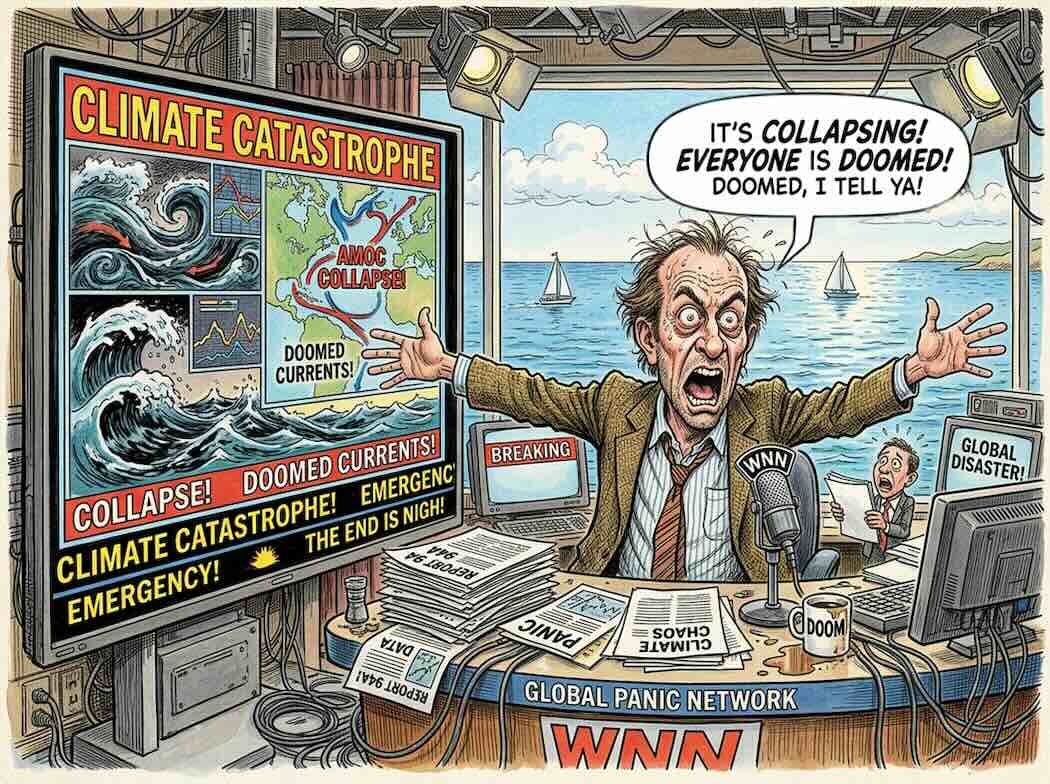
This is simplistic and wrongheaded. The AMOC’s problem is not that people cannot visualize it.
The problem is that after more than two decades of alarming headlines, scientists still cannot agree on whether the current is slowing down, speeding up, or remaining essentially unchanged, and whether human greenhouse gas emissions have any impact on the AMOC.
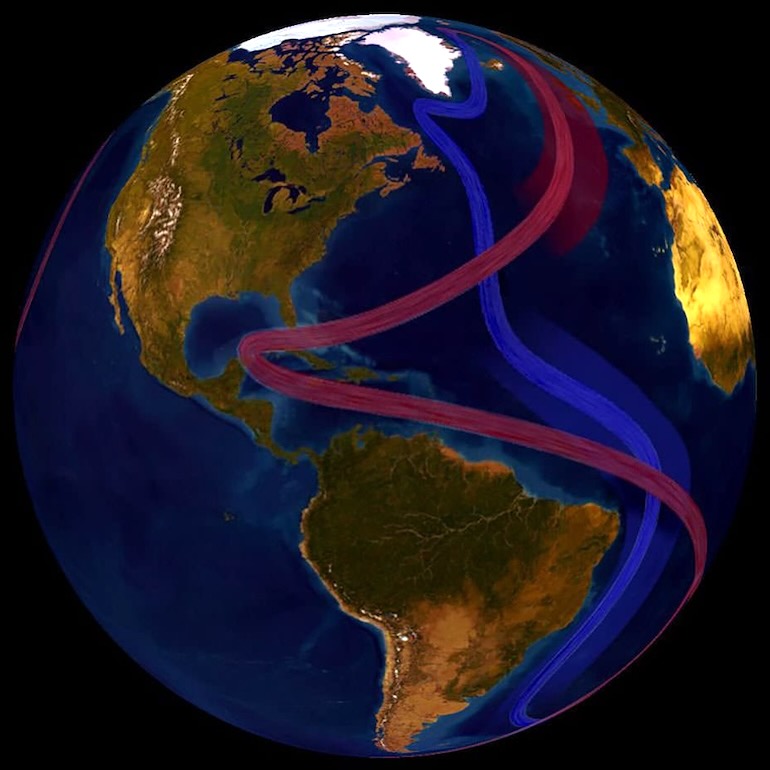
The Conversation argues that AMOC fails to capture public attention because it lacks compelling visuals. Unlike wildfires, hurricanes, glaciers, or polar bears, ocean circulation is difficult to photograph and therefore difficult to communicate.
According to the author, climate journalism needs better images to help the public understand the threat. This completely misses the point.
People do not ignore AMOC because it lacks dramatic imagery. They ignore it because evidence that climate change is affecting it is contradictory, and they rightly recognize there is nothing humans can do about shifts in the AMOC.
Over the past 20 years, scientific papers and media reports have alternately claimed that AMOC is slowing, accelerating, collapsing, stabilizing, or behaving within the range of natural variability. The scientific literature has not produced anything close to a consensus.
As Climate Realism documented in “Climate Activists Flip-Flop on Ocean Currents Yet Again,” studies have repeatedly contradicted one another. In one year, researchers announced alarming evidence of weakening. The next year, another study finds little evidence of long-term change. Then another paper claims acceleration. Then another predicts collapse.
The narrative changes far more often than the ocean current itself.
That uncertainty is acknowledged, though somewhat buried, in The Conversation article. The author admits that “we still don’t know exactly how fast the circulation will change or even its future trajectory” and that “predicted outcomes remain uncertain.”
Exactly. That is not an image problem; it’s a scientific uncertainty problem.
The article cites studies suggesting AMOC is weakening and repeats familiar warnings that Europe could cool dramatically, monsoons could shift, and sea levels could rise along the U.S. East Coast. Yet these warnings have been circulating for decades without materializing.
Climate Realism addressed a similar wave of media panic in 2024 after CNN and numerous other outlets promoted claims that climate change was causing AMOC to collapse.
That analysis showed [that] the observational record remains sparse, direct measurements are relatively recent, and much of the “collapse” narrative depends heavily on computer model simulations rather than direct observations.
That distinction matters because models are not data.
The overwhelming majority of alarming AMOC headlines rely on model projections extending decades or even centuries into the future. Yet as Climate at a Glance notes in its review of ocean currents, direct measurements of AMOC cover only a tiny fraction of the timescales over which ocean circulation naturally varies.
Historical proxy reconstructions often disagree with one another, while models produce widely differing outcomes depending on assumptions.
The result is not a scientific consensus; it is scientific debate in progress.
Ironically, the author comes close to admitting this when discussing the challenge of communicating AMOC to the public. The article notes that researchers often rely on computer models to reconstruct ocean circulation and generate three-dimensional animations.
In other words, much of what the public is presented as future risk is based on simulations of a system that remains incompletely understood.
The article then laments that frozen-Europe imagery may oversimplify the science because “most scientists say such a doomsday scenario is unlikely.” That statement deserves far more attention than the article gives it.
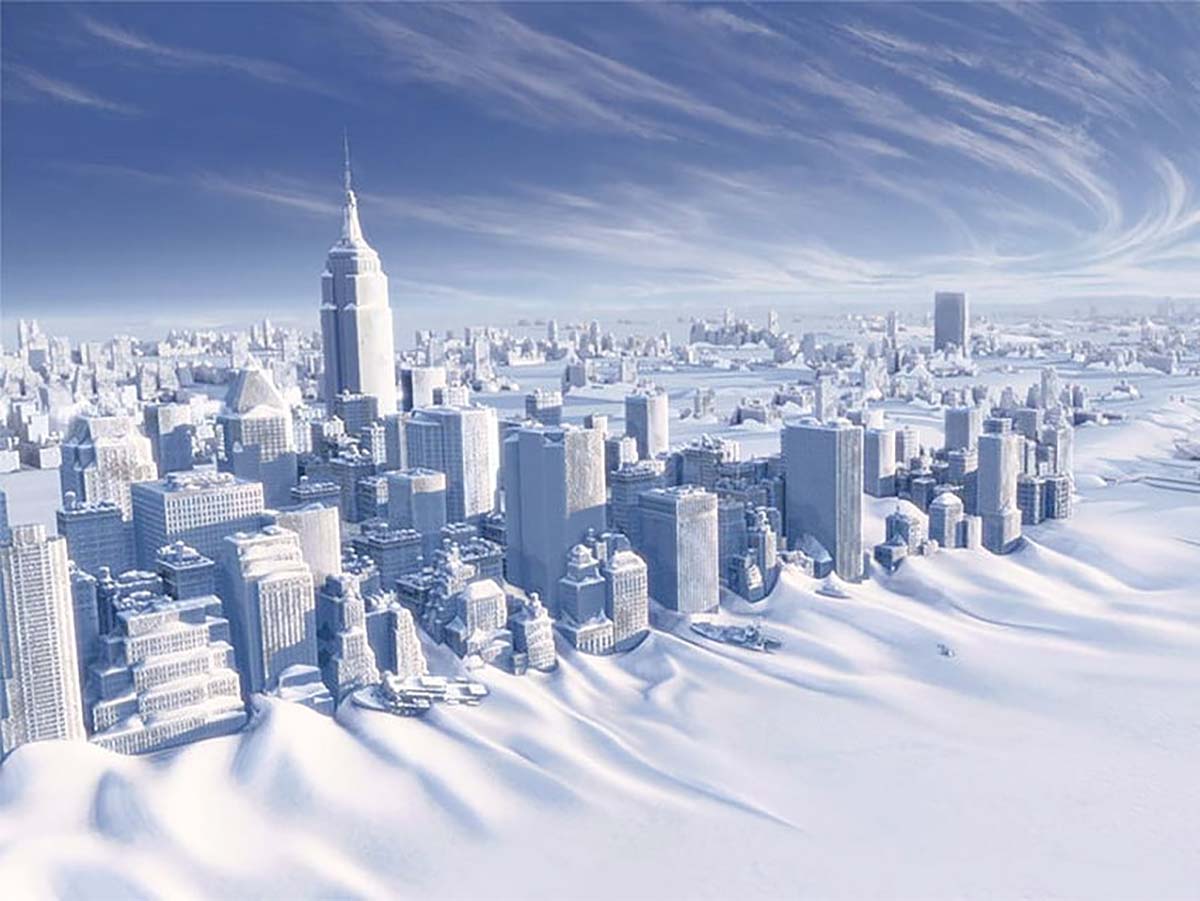
For years, media outlets have invoked imagery reminiscent of the Hollywood disaster movie The Day After Tomorrow, portraying AMOC slowdown as a trigger for sudden climate catastrophe. Yet the article concedes that the dramatic version of the story is highly unlikely.
If the most memorable visual representation of AMOC is scientifically implausible, perhaps the problem is not the public’s inability to understand the issue. Perhaps the problem is that the most alarming claims are not supported by strong evidence.
Most people intuitively understand this.
The average person is concerned about things that directly affect daily life: jobs, energy costs, housing, health care, education, and public safety. A hypothetical change in a deep-ocean current that scientists cannot confidently measure over long timescales and cannot reliably predict decades into the future ranks understandably low on that list.
No amount of improved graphics in the media will change that reality.
The Conversation assumes that if journalists can find better images, the public will finally appreciate the danger. But people are not rejecting AMOC warnings because they lack imagination.
They are skeptical because the scientific story is unsettled; the evidence and predictions are in constant flux.
For more than 20 years, headlines have warned that the AMOC is slowing, collapsing, accelerating, recovering, or behaving unpredictably. The public notices those contradictions.
And, of course, if any of the narratives are actually accurate, slowing, accelerating, or remaining relatively stable, the question of what impact, if any, that human emissions have on the AMOC’s behavior remains an open question.
In short, the evidence that the world faces an AMOC problem is lacking, and there is even less evidence that humans can impact AMOC shifts, whatever direction they may take.
The article concludes that AMOC reveals “the gap between what matters and what becomes visible.” In reality, it reveals something else entirely, the gap between doomsday-laden media narratives and an unsettled, highly uncertain scientific record.
The AMOC issue in the media does not have an image problem; it has a credibility problem.
Read more at Climate Realism