

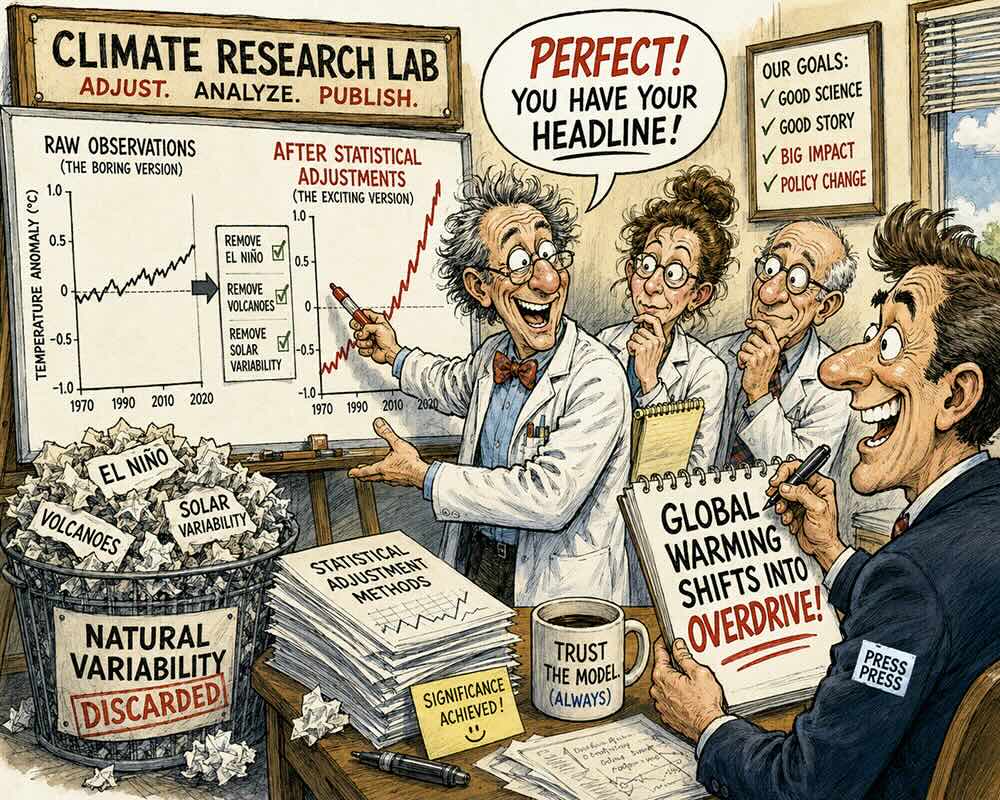
ScienceDaily’s article, “Scientists detect a sharp acceleration in global warming,” promotes a new Geophysical Research Letters paper claiming that global warming has entered “a faster gear” since about 2015. [some emphasis, links added]
This is false.
The authors argue that after statistically removing the effects of El Niño, volcanic eruptions, and solar variability from five global surface temperature datasets, they detect a statistically significant acceleration in warming of about 0.35°C per decade over the past 10 years.
But historical temperature data show a much different picture.
There is no convincing evidence that Earth’s warming has suddenly accelerated. Instead, this appears to be an exercise in statistical manipulation built upon climate modeling assumptions and presented as though it were an observational discovery.
And there’s advocacy behind the paper too, as evidenced by this quote from the paper’s co-author, climate science blogger Stefan Rahmstorf:
If the warming rate of the past 10 years continues, it would lead to a long-term exceedance of the 1.5°C limit of the Paris Agreement before 2030. How quickly the Earth continues to warm ultimately depends on how rapidly we reduce global CO2 emissions from fossil fuels to zero.
Science and advocacy are not a convincing combination.
The paper does not report the discovery of a new measurement. It takes existing surface temperature records, applies a statistical procedure designed to subtract what the authors consider “noise” from El Niño, volcanic aerosols, and solar variability, and then analyzes the adjusted temperatures for an acceleration signal.
In other words, the claimed acceleration appears only after the authors modify the observations. ScienceDaily presents this as though scientists have discovered a new physical phenomenon. They haven’t. They have created a new statistical product.
While that may be a legitimate scientific exercise, it should not be confused with or take precedence over direct observational evidence. In addition, to be a fair statistical comparison, they would have had to run the same analysis, “removing noise,” from past historical temperature data.
The paper acknowledges that the apparent acceleration is not statistically significant in the unadjusted data. Only after removing what the authors characterize as natural variability does the acceleration exceed their chosen confidence threshold.
That raises an obvious question: If the temperature acceleration is so obvious, why must it first be extracted mathematically via statistical methods?
Even more revealing is what the authors admit later in the paper: Their adjustment for El Niño, volcanic eruptions, and solar influences is “empirically based, but approximate and imperfect,” and they acknowledge that the influence of the powerful 2023-2024 El Niño may not have been completely removed.
Those are important caveats, and ScienceDaily barely mentions them.
Instead, readers are told that global warming has “shifted into overdrive” and that warming has accelerated with more than 98 percent statistical certainty.
That makes for a dramatic headline, but statistical confidence in a chosen analytical method is not the same thing as confirmation that the climate system itself has fundamentally changed.

The paper also leans heavily on climate models. ScienceDaily notes that the observed acceleration is considered “consistent” with current climate models. At the same time, the journal paper likewise states that such acceleration is expected under standard global warming scenarios and falls within the range of model predictions.
That should immediately raise skepticism.
Climate models are hypotheses expressed as computer code. They are useful research tools, but they are not measurements. Their value depends on how well they match the real world.
Using model expectations to validate statistical adjustments derived from observations risks becoming a circular exercise, i.e., “junk science.”
Importantly, without adjustment, models consistently fail to represent past and current temperatures accurately. If models don’t get past and present temperatures right, and consistently overstate measured warming, no one should trust their projections of the future or base predictions upon their outputs.
If the question is whether global warming has accelerated, perhaps the first place to look should be the atmosphere itself.
The University of Alabama in Huntsville (UAH) satellite temperature record provides one of the world’s longest continuous measurements of lower-tropospheric temperature using microwave sounding instruments carried aboard satellites.
The UAH team has maintained this record since 1979, producing a globally consistent dataset that measures the bulk atmosphere rather than relying on a patchwork of imperfect and biased surface weather stations.
The latest UAH global temperature time series, seen below, tells a very different story from the one presented by ScienceDaily.
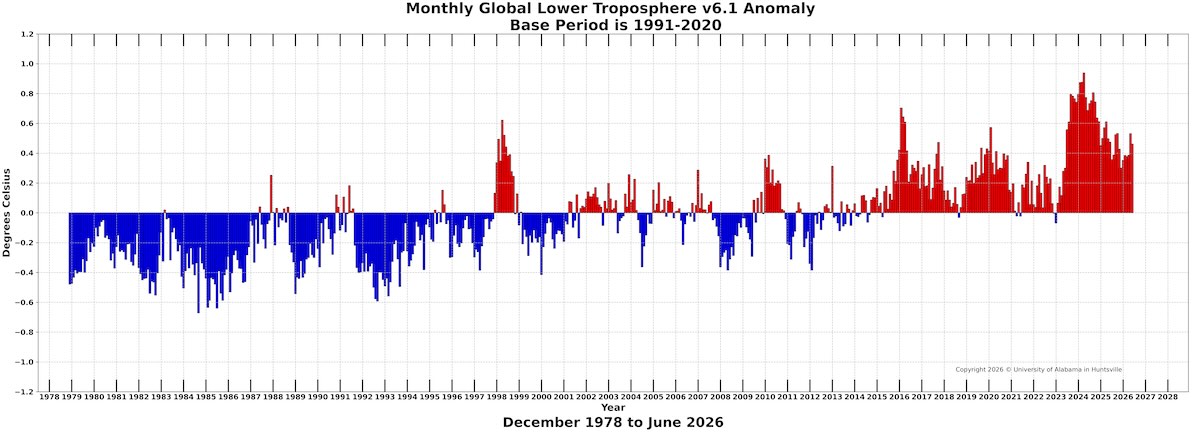
The graph accompanying the July 2026 report shows that lower-troposphere temperatures surged during the recent El Niño, peaked in 2024, and have since declined noticeably.
The current anomaly remains above the long-term average, but the sharp rise that fueled so many alarming headlines has subsided. The short-term trajectory is downward, not upward.
That does not prove that global warming has ended. Neither does it support headlines claiming that warming has suddenly accelerated into a new phase.
Instead, it illustrates something climate scientists have long recognized: global temperatures fluctuate considerably from year to year due to natural variability, particularly from El Niño and La Niña events.
A few unusually warm years following a strong El Niño are not, by themselves, evidence that the long-term warming rate has permanently changed.
Ironically, even the paper cited by ScienceDaily acknowledges this uncertainty.
The authors explicitly state that they are not identifying the physical cause of the claimed acceleration and concede that whether such rapid warming continues “remains to be seen.”
Those are appropriately cautious scientific statements. ScienceDaily’s headline is not, and that is the broader lesson here.
Science advances through observations that can be independently verified, not through increasingly sophisticated methods of massaging existing datasets until they reveal the desired statistical signal.
When a claimed acceleration appears only after extensive adjustments to multiple variables and is then celebrated for aligning with climate model expectations, skepticism is not only appropriate but also essential.
Also, the article presents no evidence whatsoever that reducing fossil fuel use will change temperature trends in the near or long term, despite statistical filtering and manipulation that might project a favorable decline as called for by advocates and/or researchers if the data is massaged enough.
The climate is changing, as it always has. The question is how fast, why, and with what degree of confidence we can measure those changes.
Those questions are answered by observations, not by admittedly imperfect statistical filters designed to tease out an “acceleration” that isn’t obvious from the base data.
ScienceDaily’s readers deserved to hear that distinction. Instead, they received another clickbait-style headline announcing certainty and possible future consequences, even though the underlying science remains far more nuanced, and proof that exceeding a politically chosen temperature target is dangerous is nonexistent.
Read more at Climate Realism




These so-called scientists wouldn’t need to manipulate the data to get their desired outcomes if the warming was actually occurring. Instead they have to lie to get the desired outcome–additional funding to support their livelihoods.