


This has been very carefully orchestrated from the outset [some emphasis, links added]:
It began with the UKHSA “extraordinary” heat health alerts last week:
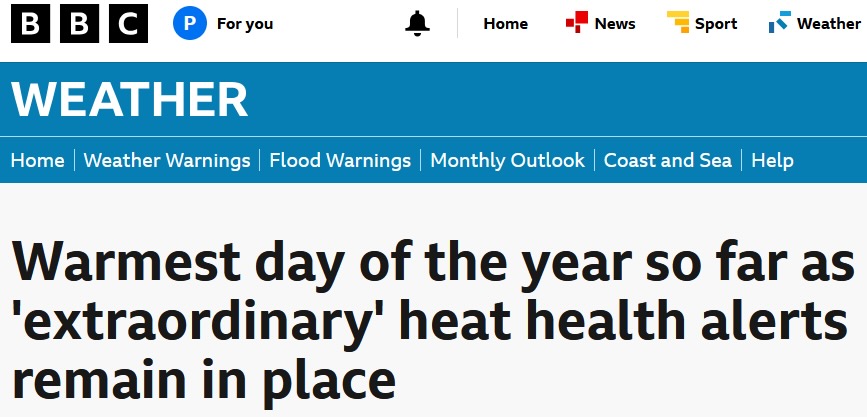
There is, of course, nothing “extraordinary” about temperatures of 32°C or 33°C, as were forecasted at the time.
The intention was to put that impression into people’s minds.
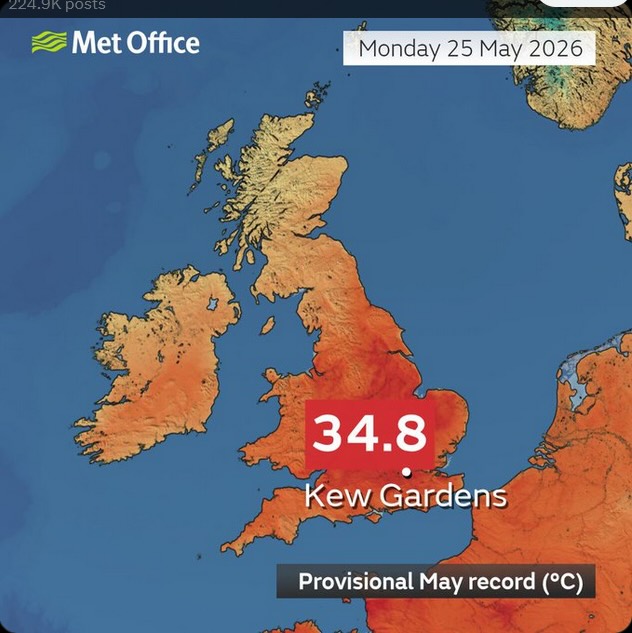
The Met Office eventually got the May record it wanted, albeit in the London UHI bubble, which is estimated to add at least 2°C to rural areas.
The previous record of 32.8°C was set in the small market towns of Horsham and Tunbridge Wells, where the UHI effect would have been much less back in 1944.
Significantly, the two Class 1 sites closest to London—Benson and Rothamsted—recorded much lower temperatures: 33.6° and 32°, respectively, casting much doubt on the scientific value of Kew:
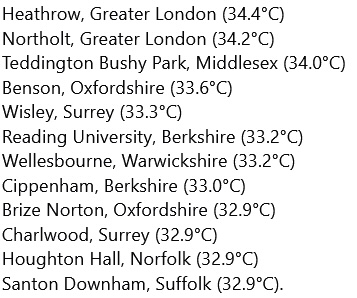
Laughably, the clowns at the Met Office boast that Heathrow temperatures track closely with Kew.
They did the analysis to persuade the public that Heathrow was a suitable place to measure temperatures! Instead, they proved that Kew Gardens was just as much a junk site as Heathrow.
Northolt is a junk Class 5, and Teddington, another junk site, is in the middle of a walled garden.
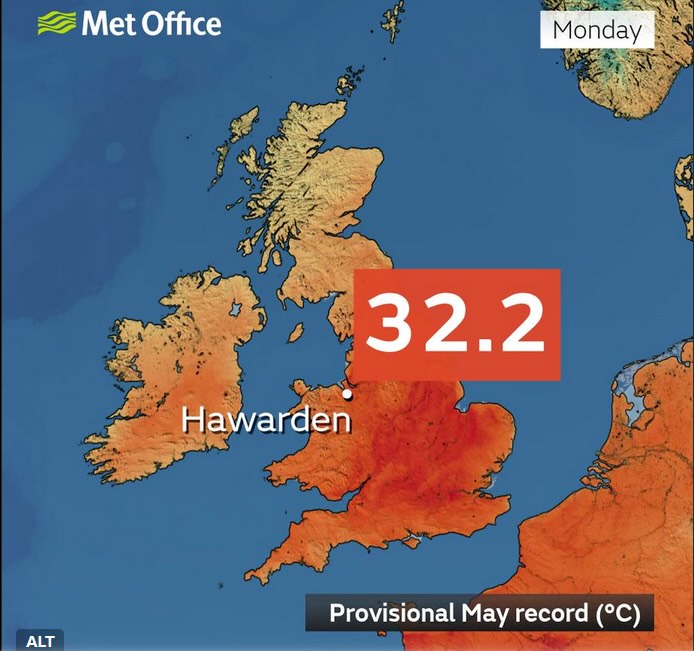
Wales also had a new record. And guess what – Hawarden is another junk Class 4 site, where poor siting can add as much as two degrees to the temperature of the surrounding area.
As the previous record was 30.6 °C, the Met Office cannot legitimately claim a record at Hawarden:
Naturally, the Net Zero lobby was out in force with its misinformation:
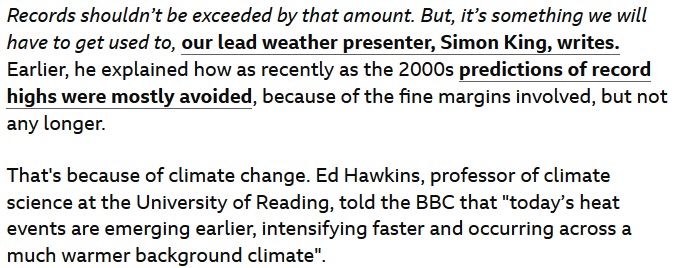
As the professor should know, one day’s weather has nothing to do with climate.
Let me be clear – it was exceptionally hot yesterday, and I am not going to argue whether or not it was a record.
Such records mean nothing climatologically; they are merely used by the Met Office to generate headlines.
The real question we need to address is:
“Was yesterday’s weather unprecedented for the time of year?”
As you will see in Part II tomorrow, the answer is no.
But I’ll leave you with this from the BBC:
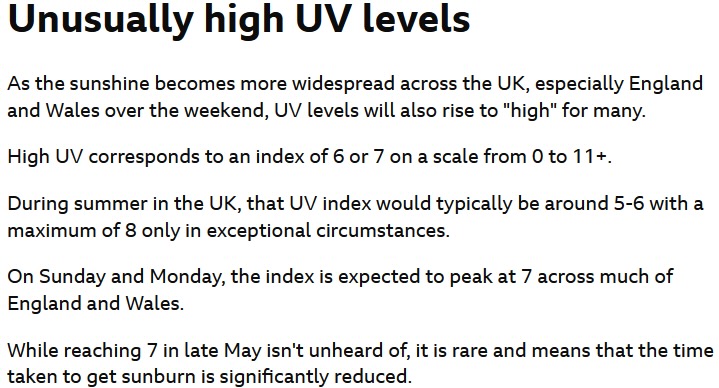
This tells us that the sun has been especially bright, undoubtedly the dominant factor in this week’s heat.
Read more at Not A Lot Of People Know That









Records have to be recorded in exactly the same way and place. Yes, Heathrow is a hot spot as is Kew. That hasn’t changed. Pretty sure the temperature here in leafy Bedfordshire was hotter than it has ever been in May before in my expereience. The globe is warming – our weather does not prove that, but our weather is changing in a way you would expect given the global changes.
Yes it is as 34.8. Sorry, so what is the actual data here Paul?
What was the temperture at Kew, usually quoted as one of the high temperatures, this is Class 2 isn’t it? Lo and behold, not quoted in your list