


It’s rare that an office of state is created using a stark contradiction in terms.
Appointing Ed Miliband as the Secretary of State for Energy Security and Net Zero was the equivalent of creating a Ministry of Defence and Disarmament or perhaps a Secretary of State for the Environment and Tyre Burning. [some emphasis, links added]
The choice this Government has faced since its very beginning has been net zero versus energy security. Keir Starmer should have been able to choose one, prioritize it, and pick which was most important to the country.
Instead, he chose to pretend – to himself and to us – that there was no contradiction between the two. We could have it all: domestic energy in abundance with no external threat to supplies, as well as the climate activists’ dream of producing no more CO2 than we use in any one year.
Miliband was put in charge to continue the work he had started when he served in Gordon Brown’s cabinet the last time Labour was in power, when obeisance to climate change targets was first written into UK law. Now he was back to finish the job.
The direction of travel was made clear in Labour’s 2024 manifesto: “We will not issue new licences to explore new fields [in the North Sea].”
That seems a very long time ago now, a whole Labour prime minister ago. With Andy Burnham’s accession just days away and the Starmer regime packing up its stuff for good, Miliband has his eye on the second most senior job in government: Chancellor of the Exchequer. [Finance minister]
But he himself has queered his own pitch by taking an apparently ideological approach to curbing Britain’s carbon emissions, even to the extent of refusing to exploit our own oil and gas reserves.
With the markets – and the public – desperate for any sign of economic growth, and with the prospect of a vacancy opening up at No 11 Downing Street, he needed to reassure Burnham and at least some of his critics that he isn’t as dogmatic as claimed.
“Judge me by what I’m saying now, not by what I said previously,” seems to be the gist of his Treasury job pitch.
Despite his own manifesto’s explicit commitment, it has emerged, thanks to “sources close to Miliband”, that he does, after all, support new drilling in the North Sea, specifically the Jackdaw field near Aberdeen (though not the Rosebank field, northwest of Shetland, where Miliband dismissed the prospect of drilling as “climate vandalism”).
Miliband is not an “eco-zealot”, said the source. “He’s much more a pragmatist than he’s painted to be, and that wouldn’t be difficult to show, given the way he’s been portrayed.”
It’s those nefarious media outlets’ fault again, wrongly portraying Miliband as entirely committed to net zero and willing to sacrifice North Sea jobs to get there.
Except it’s not just the media: the City has already made its concerns known, but the trade unions have been just as scathing about Miliband’s role in the winding down of the North Sea oil and gas industry, which is haemorrhaging jobs.
Miliband may or may not have changed his mind about drilling at Jackdaw, but since there’s an ongoing consultation that doesn’t end until August 10, he is prevented from expressing an opinion either way before that date or running the risk of a judicial review on the basis that he prejudged the consultation.
But the appointment of a new chancellor will be announced shortly after Burnham arrives in No 10 on July 20, so he must resort to off-the-record briefings about his true intentions.
Miliband is running a big risk. If he fails to win the Chancellor’s job, he will have tainted his own record as a climate champion in the attempt and will have less credibility for the task, even if Burnham chooses to keep him in the same job.
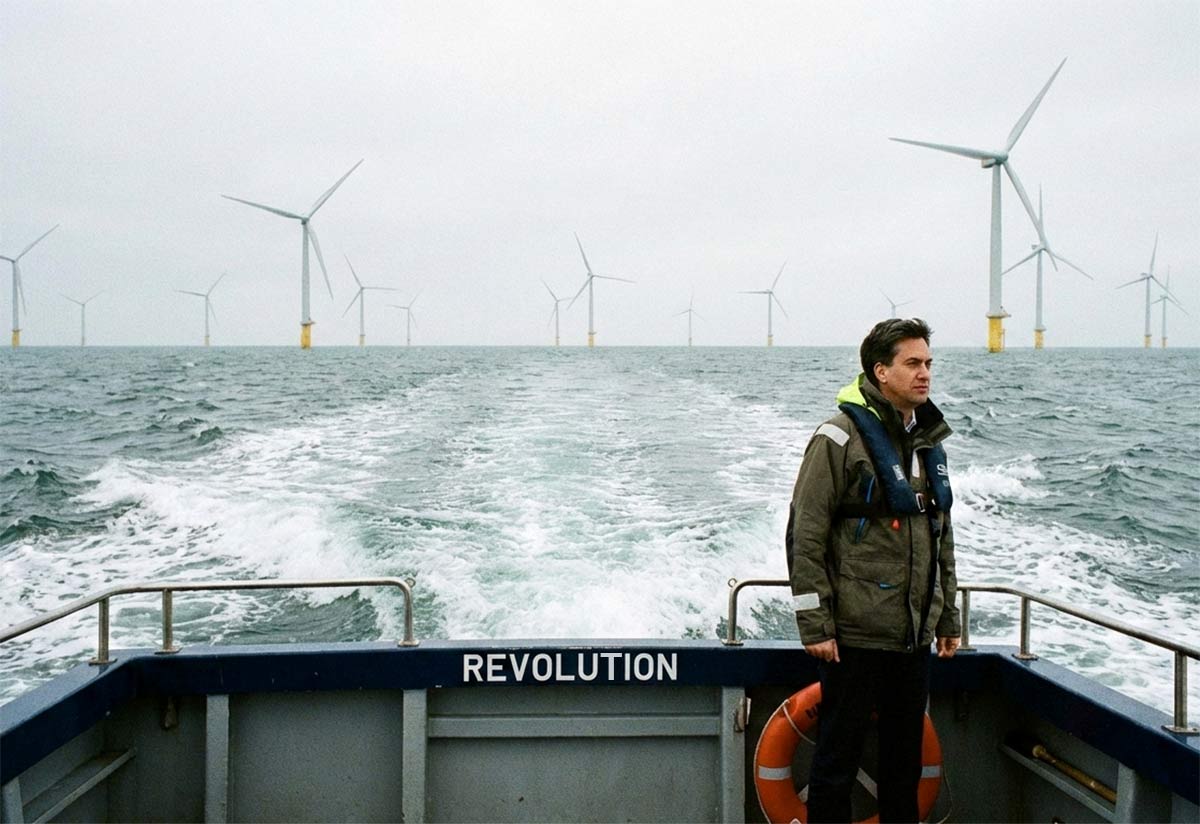
Top: Energy Secretary Ed Miliband on The Rest Is Politics: Leading/YouTube screencap.
Read rest at The Telegraph


It’s depressing how ignorant are both sides of the Net Zero story. CO2
Is not the driver. UK’s contribution is zero. Whether natural or man made, the Keeling curve is unstoppable. Double CO2 to 800ppm? At two and a half ppm a year, half a degree C maybe by 2500? Grow up